Webb and Hubble Team Up for Stunning Saturn Double View
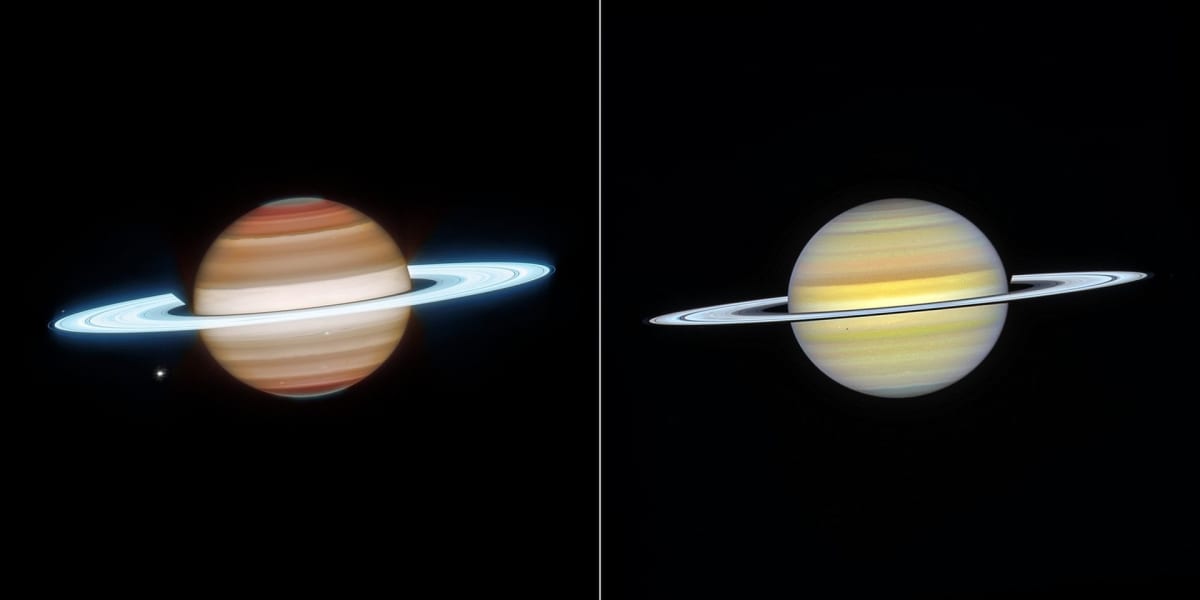
NASA just released matching photos of Saturn taken by its two most powerful space telescopes, giving scientists a breathtaking dual perspective on the ringed planet. The side-by-side images reveal hidden storms, mysterious atmospheric patterns, and details invisible to either telescope alone.
Two of humanity's greatest technological achievements just worked together to capture Saturn like never before, and the results are absolutely stunning.
NASA released matching images of Saturn from both the James Webb Space Telescope and the Hubble Space Telescope, taken in late 2024. While Hubble shows Saturn as it would appear to the naked eye, Webb's infrared vision reveals secrets hiding beneath the planet's swirling clouds.
The pairing isn't just pretty. Scientists can now spot features invisible in visible light alone, like the "Ribbon Wave," a massive jet stream rippling across Saturn's northern hemisphere.
Webb also picked up a whitish speck marking the remnant of the "Great Springtime Storm," an atmospheric disturbance that raged from 2010 to 2012. Other storms pepper the southern hemisphere like pockmarks across the giant planet's clouds.
Saturn's poles glow with a mysterious gray-green tint in Webb's infrared view. NASA scientists think this could be caused by high-altitude aerosols scattering light differently at those latitudes, though auroral activity might also explain the eerie shimmer.
The rings tell their own story across the two images. Webb's infrared camera makes them shine brighter because water ice reflects infrared light beautifully. The faint F ring, Saturn's outermost ring, glows clearly in Webb's view but barely registers in Hubble's visible-light photo.
Six of Saturn's 250-plus moons make cameo appearances in Webb's wide-angle shot, including the giant moon Titan. Hubble caught three different moons, with one casting a perfect shadow across the planet's face.
The timing matters too. Both telescopes photographed Saturn as it approached last year's equinox, when the sun crosses Saturn's equator. As the planet transitions into southern spring and eventually southern summer in the 2030s, both telescopes will get even better views of that hemisphere.
The Bright Side: This collaboration shows how different scientific tools become more powerful together than apart. Hubble has been studying Saturn for 12 years as part of its Outer Planet Atmospheres Legacy program, building a long-term record of how the planet changes. Now Webb adds a whole new dimension to that record with infrared capabilities Hubble can't match.
Together, these two telescopes are writing the most detailed weather report ever created for a planet 746 million miles from Earth.
Based on reporting by Google: James Webb telescope
This story was written by BrightWire based on verified news reports.
Spread the positivity!
Share this good news with someone who needs it