Webb and Hubble Team Up for Stunning Saturn Views
NASA's two most powerful telescopes just gave us an incredible double vision of Saturn, revealing secrets in the gas giant's atmosphere we've never seen before. Scientists are already using these images to track how Saturn changes with the seasons.
Two space telescopes working together just gave us the most detailed view of Saturn ever captured.
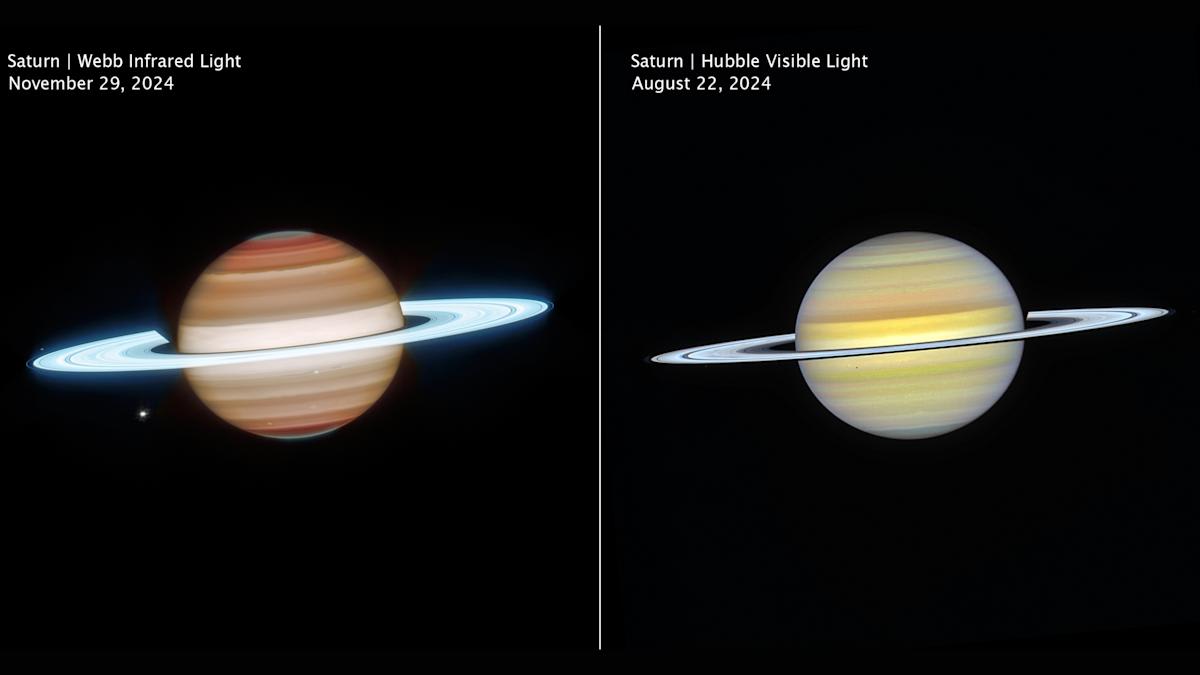
NASA's Hubble and James Webb telescopes photographed Saturn from different perspectives, creating a breathtaking comparison that reveals hidden details in the planet's atmosphere. Hubble snapped its photos in August 2024, while Webb followed up a few months later with its signature infrared vision.
The difference between the two views is stunning. Hubble shows Saturn's familiar golden bands and subtle color variations across its surface, perfect for tracking storms that swirl through the atmosphere. Webb's infrared sensors pierce deeper, turning Saturn's famous rings nearly white and revealing grey-green shading at the poles that scientists had never spotted before.
That mysterious polar coloring has astronomers excited. It could be caused by high-altitude aerosols scattering light across different latitudes, or possibly auroral activity where charged molecules interact with Saturn's magnetic field. Either way, it's giving scientists new clues about what's happening in the planet's upper atmosphere.
The timing of these photos matters too. Saturn was photographed 14 weeks apart as it moved from northern summer toward its 2025 equinox. Just like Earth, Saturn experiences seasons, though each one lasts about seven years.
Why This Inspires
This collaboration shows what's possible when different tools work together. Hubble has been our reliable eye in the sky for decades, tracking storms and weather patterns across our solar system. Webb, the new kid on the block, brings infrared superpowers that reveal what's hidden beneath the surface.
Together, they're creating a time-lapse that will span years. As Saturn transitions into southern spring and eventually southern summer in the 2030s, both telescopes will get progressively better views of the planet's southern hemisphere. Scientists will watch an entire season change on another world.
The partnership between these two telescopes reminds us that progress doesn't always mean replacing the old with the new. Sometimes the biggest breakthroughs come from combining different strengths and perspectives to see what we've been missing all along.
More Images


Based on reporting by Engadget
This story was written by BrightWire based on verified news reports.
Spread the positivity!
Share this good news with someone who needs it