Webb Telescope Captures First 3D View of Uranus' Auroras
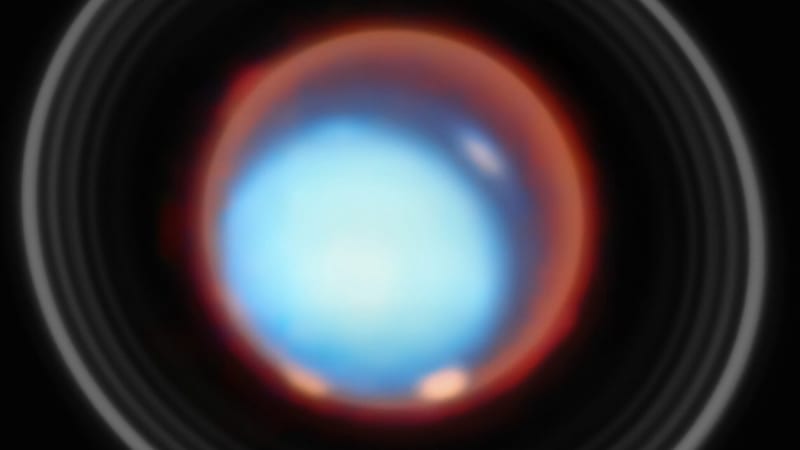
Scientists used the James Webb Space Telescope to create the first-ever video of Uranus spinning through space, revealing dancing auroras shaped by the planet's unusual magnetic field. The breakthrough gives us an unprecedented look at one of the solar system's most mysterious atmospheres.
Scientists just watched an entire day pass on Uranus, and the view is nothing short of spectacular.
Using the James Webb Space Telescope, researchers captured nearly a full rotation of the ice giant, creating a stunning timelapse video that shows glowing auroras swirling across the planet's atmosphere. It's the first time anyone has seen Uranus' upper atmosphere in three dimensions.
The infrared observations revealed something unexpected: Uranus' atmosphere is cooler, thinner, and more unevenly charged than scientists had predicted. The planet's oddly tilted magnetic field creates bright and dim bands of light that sweep across its surface in complex patterns, unlike anything else in our solar system.
"With Webb's sensitivity, we can trace how energy moves upward through the planet's atmosphere and even see the influence of its lopsided magnetic field," said Paola Tiranti, lead author of the study from Northumbria University. The research appears in Geophysical Research Letters.
The team tracked a faint glow from a charged molecule called trihydrogen cation, which forms high above the clouds where sunlight and space particles interact. By measuring changes in temperature and particle density, they essentially scanned the structure of Uranus' entire upper atmosphere.
Uranus is truly the oddball of our solar system. Because it spins sideways, its poles take turns facing the sun for 21 years straight, creating the most extreme seasons imaginable while the opposite hemisphere endures a two-decade winter.
The planet's magnetic field is just as strange, tilted and offset from its rotation axis. This creates auroras with similar patterns to Jupiter's, but they sweep across the surface in wildly different ways.
Before Webb's first look at Uranus in 2023, most people thought of the seventh planet as just a featureless blue ball floating 2 billion miles from Earth. The telescope changed that by revealing vertical rings, dozens of moons, active storms, and a mysterious polar cap.
Why This Inspires
This discovery isn't just about understanding one quirky planet. Planets similar to Uranus are common around other stars, and scientists have struggled to interpret what they're seeing on those distant worlds.
By studying how energy, temperature, and charged particles behave around Uranus, researchers now have a real-world benchmark. The data from Webb gives them a template for understanding potentially thousands of ice giants across the galaxy.
The findings also confirm a puzzling trend scientists noticed over the past 30 years: Uranus' upper atmosphere continues to cool. Understanding why could unlock secrets about how giant planets evolve over billions of years.
What started as watching a distant planet spin has turned into a window for understanding worlds we may never reach directly.
More Images
Based on reporting by Google: James Webb telescope
This story was written by BrightWire based on verified news reports.
Spread the positivity!
Share this good news with someone who needs it