Webb Telescope Captures Sun's Future 5 Billion Years Out
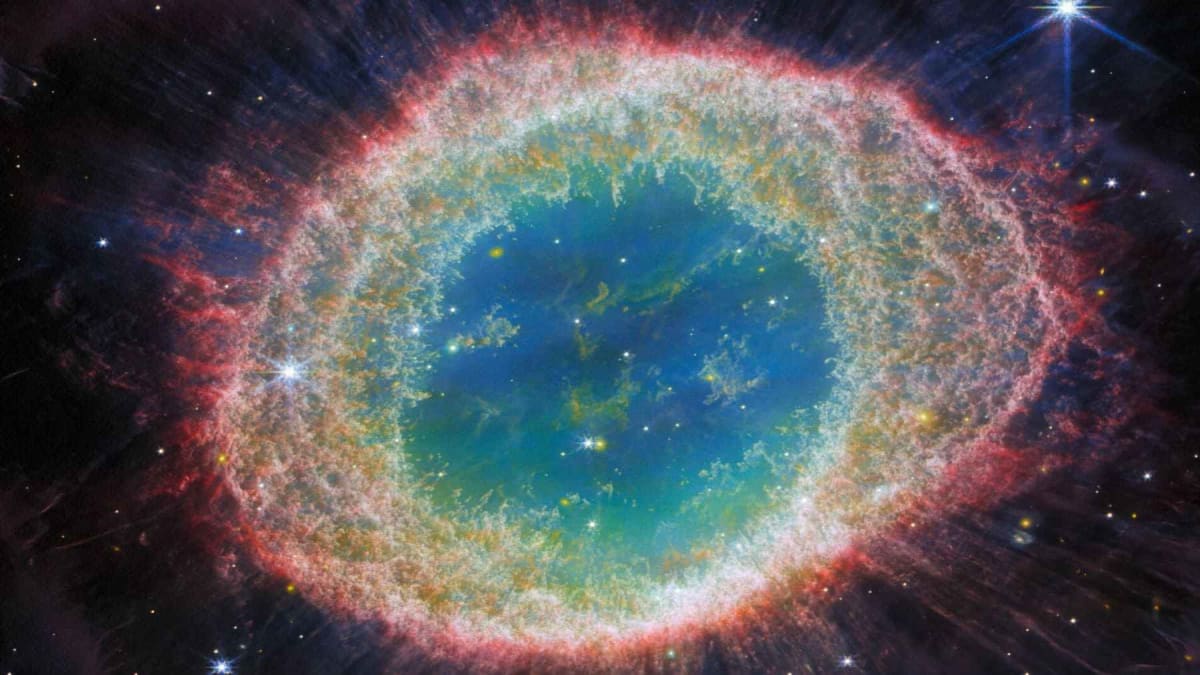
The James Webb Space Telescope just photographed the "Eye of God" nebula, showing us exactly what our Sun will look like when it dies in five billion years. The stunning image reveals layers of glowing gas and dust streaming from a dying star 650 light-years away.
Scientists just got a cosmic time machine glimpse of our Sun's distant finale, and it's surprisingly beautiful.
The James Webb Space Telescope turned its powerful infrared camera toward the Helix Nebula, nicknamed the "Eye of God" for its striking appearance. What Webb captured is a detailed portrait of a star ending its life in exactly the way our Sun will in about five billion years.
The Helix Nebula sits 650 light-years away in the constellation Aquarius, making it one of the closest planetary nebulae to Earth. Despite the confusing name, planetary nebulae have nothing to do with planets. Early astronomers just thought these glowing shells looked like distant worlds through their telescopes.
What we're really seeing is the final act of a Sun-like star. After running out of fuel, the star shed its outer layers into space, creating a brilliant ring of gas and dust lit up by radiation from the tiny white dwarf core left behind.
Webb's Near Infrared Camera reveals details that optical telescopes miss completely. The hottest gas near the center glows blue, cooler hydrogen-rich regions shine yellow, and the coldest dusty zones appear red in the processed image.
The telescope also spotted thousands of tiny structures called cometary knots scattered throughout the nebula. Each knot is a dense clump of gas and dust with a bright head and streaming tail, sculpted by fierce winds and radiation from the central white dwarf.
Why This Inspires
This cosmic snapshot does more than show us the Sun's distant fate. It reveals that stellar death is actually a gift to the universe.
The gas streaming away from the Helix is packed with carbon, oxygen, nitrogen, and other elements essential for building planets and life. Webb spotted pockets of cold molecular hydrogen and dense regions where complex molecules form, the same raw materials that eventually create new star systems.
Scientists at NASA and the European Space Agency see planetary nebulae as proof that endings feed beginnings. The recycled star material drifting through space will mix with interstellar clouds and eventually form new generations of stars and worlds.
For researchers, the Helix Nebula serves as a real-life laboratory. By comparing Webb's detailed observations with computer models, they can test whether their predictions about stellar winds, gas flows, and heating actually match what nature does.
Nobody needs to worry about summer vacation plans. Five billion years gives humanity plenty of time, and stars like ours live predictable lives.
The Eye of God reminds us that stars aren't frozen decorations but dynamic objects with lifetimes and final chapters, each one contributing to the cosmic cycle that makes new worlds and possibly new life possible.
More Images
Based on reporting by Google: James Webb telescope
This story was written by BrightWire based on verified news reports.
Spread the positivity!
Share this good news with someone who needs it