Webb Telescope Confirms Moon Safe From 2032 Asteroid Hit
NASA's James Webb Space Telescope tracked one of the faintest asteroids ever observed to confirm it won't hit the Moon in 2032. The breakthrough shows how space telescopes can protect Earth and lunar satellites years before potential threats arrive.
Scientists just used the most powerful space telescope ever built to solve a cosmic mystery that would have kept astronauts and satellite operators guessing until 2028.
NASA's James Webb Space Telescope confirmed that asteroid 2024 YR4 will safely pass by the Moon in 2032, eliminating concerns about a potential impact. The asteroid already posed no threat to Earth, but its lunar trajectory remained uncertain until now.
The challenge was extraordinary. The asteroid currently glows at magnitude 30, making it four billion times fainter than the dimmest star visible to the naked eye. Think of spotting an almond from the distance of the Moon.
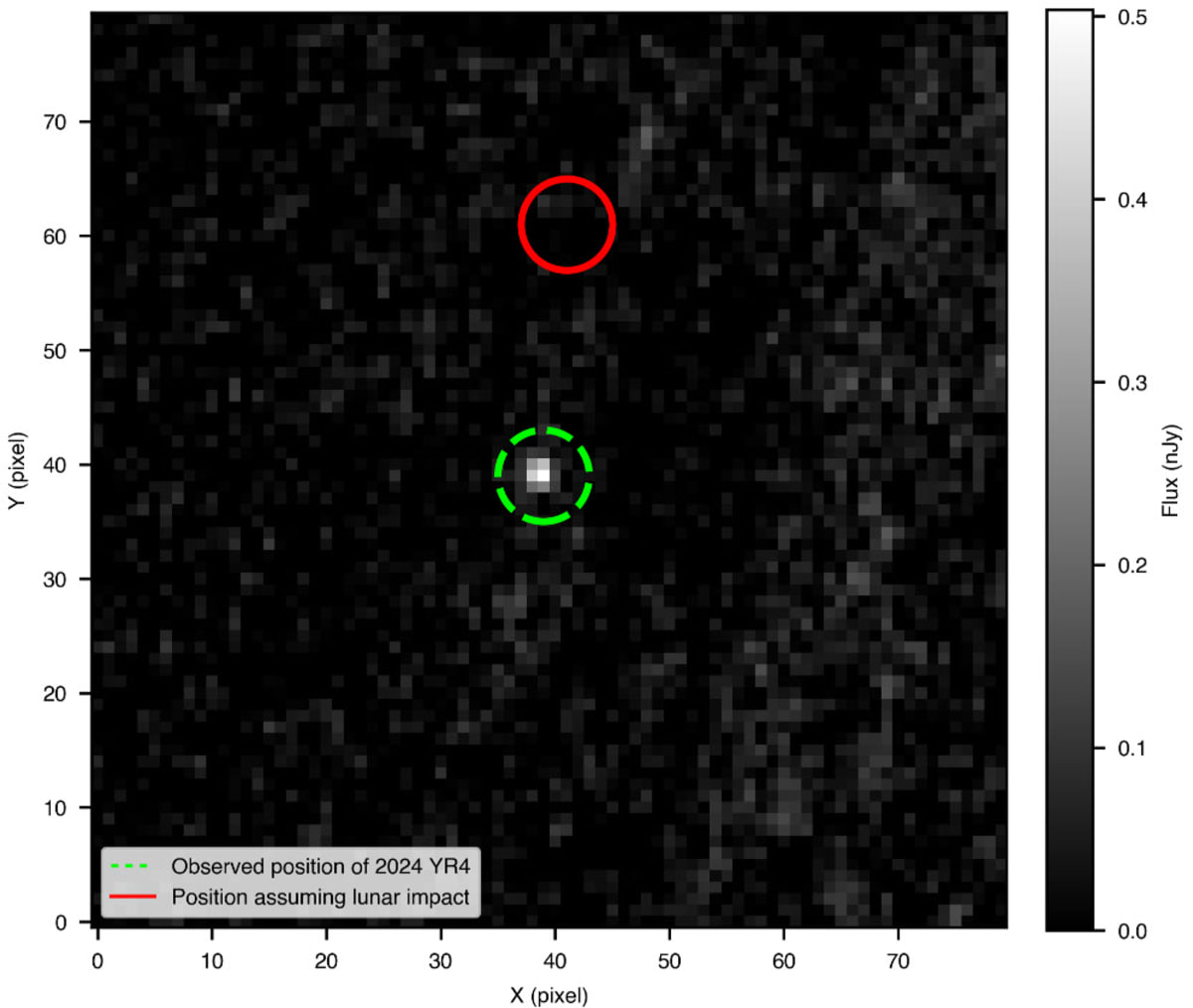
Only Webb had the power to track something this faint. The telescope made several hour-long exposures in late February 2026, capturing the asteroid without it moving even a single pixel. No other observatory on or off Earth could have made these measurements until 2028.
Andy Rivkin from Johns Hopkins University and Julien de Wit from MIT led the observations using Webb's emergency Director's Discretionary Time program. Their team extended the observation period from May 2025 to February 2026, nearly doubling the tracking time and dramatically improving orbit predictions.
The measurements were so precise they placed the asteroid about 22 pixels away from any collision course with the Moon. That might sound small, but in space navigation, it's the difference between impact and safety.
Why This Inspires
This achievement marks the first time Webb has been used for planetary defense, proving the telescope can do more than photograph distant galaxies. Future astronauts working on the Moon will face one less hazard thanks to observations made today.
The team also developed new techniques for imaging extremely faint objects alongside bright reference stars. These methods are now ready to use if another potentially hazardous asteroid appears, meaning scientists won't need to start from scratch.
NASA's upcoming Nancy Grace Roman Space Telescope will capture asteroids during its universe surveys, adding another guardian to our cosmic neighborhood. The planned Habitable Worlds Observatory will have even greater sensitivity for early threat detection.
Meanwhile, NASA is developing the Near-Earth Object Surveyor specifically for finding and tracking asteroids. Together, these missions create a comprehensive early warning system for space hazards.
The Webb observations represent more than just good news about one asteroid. They demonstrate how scientific tools built to explore the universe also protect the people planning to explore it, turning cosmic curiosity into practical safety for tomorrow's space travelers.
More Images
Based on reporting by Google: James Webb telescope
This story was written by BrightWire based on verified news reports.
Spread the positivity!
Share this good news with someone who needs it
%2Fhttps%3A%2F%2Ftf-cmsv2-smithsonianmag-media.s3.amazonaws.com%2Ffiler_public%2F58%2F0a%2F580a77b9-7590-43c5-b70d-e3a590810348%2Fsmithmag-rockwell-edit.jpg)