Webb Telescope Finds Bizarre 'Diamond Planet' Defying Physics
NASA's Webb Telescope has discovered an extraordinary 'diamond planet' with a carbon-rich atmosphere that challenges everything we know about planetary formation. This unique exoplanet orbits a neutron star and may contain diamonds deep within its mysterious structure.
In a groundbreaking astronomical discovery that challenges everything scientists thought they knew about planetary formation, NASA's James Webb Space Telescope has identified an exoplanet so strange it seems more like science fiction than scientific reality.
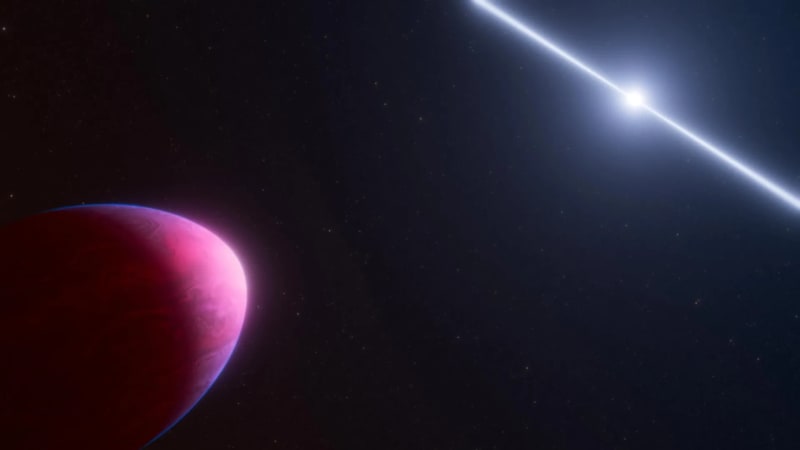
The newly discovered world, named PSR J2322-2650b, orbits a rapidly spinning neutron star and boasts characteristics that have left researchers utterly astonished. With a mass comparable to Jupiter but a shape more reminiscent of a stretched lemon, this carbon-rich planet may harbor diamonds deep within its mysterious atmosphere – a potential treasure trove hidden in the depths of space.
University of Chicago astrophysicist Michael Zhang, the study's principal investigator, described the planet as 'a new type of planet atmosphere that nobody has ever seen before.' The planet's most striking feature is its composition: instead of familiar gases like water or methane, its atmosphere is dominated by helium and carbon, with molecular carbon compounds C3 and C2 detected in unprecedented quantities.
Orbiting just 1 million miles from its pulsar – compared to Earth's 100 million miles from the Sun – the planet completes a full orbit in a mere 7.8 hours. The intense gravitational forces from the neutron star have stretched the planet into its unusual lemon-like shape, creating a planetary system that defies conventional understanding.
The research, which has been accepted for publication in The Astrophysical Journal Letters, reveals a system so unique that researchers can observe the planet throughout its entire orbit – a rare occurrence in astronomical observation. 'This system is unique because we are able to view the planet illuminated by its host star, but not see the host star at all,' explained Maya Beleznay, a Stanford University graduate student involved in the research.
Perhaps most intriguing is the potential for diamond formation within the planet. The extreme internal pressures could compress the abundant carbon into crystalline structures, creating a potential diamond core that adds another layer of wonder to this extraordinary discovery. Peter Gao from the Carnegie Earth and Planets Laboratory captured the team's initial reaction perfectly: 'This was an absolute surprise. I remember after we got the data down, our collective reaction was "What the heck is this?"'
The planet may belong to a rare category known as a 'black widow' system, where a fast-spinning pulsar is paired with a smaller companion. While the exact formation mechanism remains a mystery, scientists are united in their excitement about this unprecedented cosmic discovery that continues to push the boundaries of our understanding of planetary science.
Based on reporting by Science Daily Tech
This story was written by BrightWire based on verified news reports.
Spread the positivity! 🌟
Share this good news with someone who needs it
More Good News
 🚀 Innovation
January's Night Sky: Jupiter and Its Four Massive Moons Offer Spectacular Stargazing Show
 🚀 Innovation
Massive Black Hole Discovery May Rewrite Cosmic Origin Story
 🚀 Innovation