Webb Telescope Finds Galaxy Core Bursting With Carbon
The James Webb Space Telescope discovered an unexpectedly rich mix of carbon molecules in a distant galaxy's dusty core, including a highly reactive compound never before seen outside the Milky Way. The finding reveals that hidden galaxy centers are chemically alive, constantly breaking down and rebuilding carbon in ways scientists hadn't predicted.
Scientists just got their first clear look at what's happening deep inside a dust-covered galaxy, and it turns out to be far more active than anyone expected.
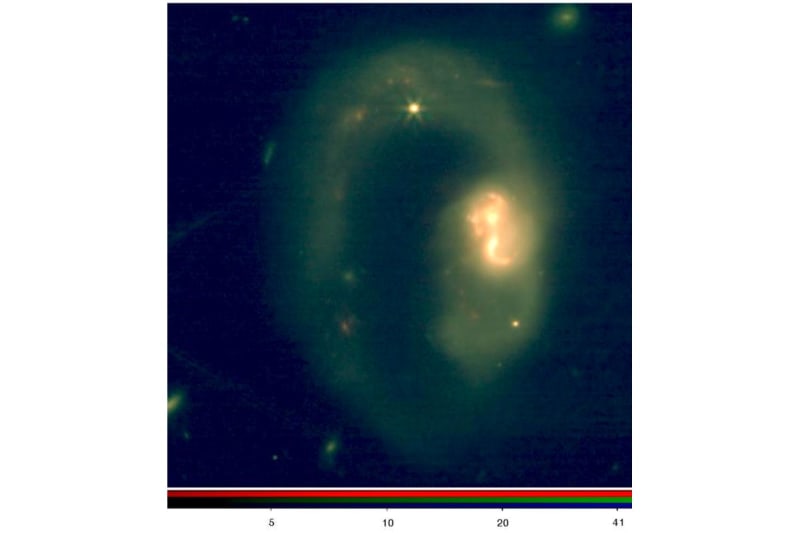
The James Webb Space Telescope peered through thick clouds of gas and dust surrounding the core of galaxy IRAS 07251-0248 and found something remarkable. The galaxy's center is packed with small carbon molecules at levels much higher than current models predicted.
Among the discoveries was the methyl radical, a highly reactive carbon compound detected for the first time beyond our own Milky Way. Because this molecule is so short-lived and reactive, finding it means carbon is being actively broken apart and rebuilt right now, not just sitting dormant in dust grains.
The telescope's infrared instruments identified an array of hydrocarbons including benzene, methane, and acetylene, alongside water ice and carbon-rich dust. Lead researcher Ismael García Bernete called it an "unexpected chemical complexity" that suggests a continuous source of carbon fueling a rich chemical network.
The team believes cosmic rays, high-energy particles racing through space, are driving this activity. When cosmic rays slam into larger carbon compounds in the dust, they break them into smaller pieces that get released back into the surrounding gas.
Rather than simply destroying material, the radiation appears to be recycling it constantly. The galaxy's center isn't chemically quiet at all but instead acts like a cosmic workshop, continuously reshaping carbon.
The Bright Side
This discovery shows that even the most hidden corners of the universe are full of dynamic activity. Galaxies buried in dust aren't dead zones but active laboratories where elements are constantly being transformed.
Understanding how carbon moves and changes in these extreme environments helps scientists trace how galaxies store and redistribute the building blocks of complex molecules over time. While these particular molecules aren't biological, they're part of the chain that can eventually lead to more complex compounds.
The James Webb Space Telescope is allowing astronomers to see through barriers that were impossible to penetrate before. For the first time, researchers can directly measure the chemistry happening in galaxy cores and watch how radiation and dense material work together to reshape matter.
Each new observation reveals that the universe is more chemically rich and active than we imagined, even in places we once thought were too harsh or hidden to harbor much complexity at all.
More Images

Based on reporting by Google: James Webb telescope
This story was written by BrightWire based on verified news reports.
Spread the positivity!
Share this good news with someone who needs it
%2Fhttps%3A%2F%2Ftf-cmsv2-smithsonianmag-media.s3.amazonaws.com%2Ffiler_public%2F3f%2F55%2F3f5579c8-c4a7-43a5-bb54-6498478792fd%2Fhelix1940__fitmaxwzk3mcw2ntbd.jpg)