Webb Telescope Finds Hidden Galaxy Warped by Space Itself
An amateur researcher sifting through public telescope data spotted a stunning cosmic phenomenon hiding in plain sight. The discovery proves groundbreaking science doesn't always need massive teams or exclusive access.
A lone researcher just discovered a cosmic treasure by looking at space images anyone could access online. Homer Dávila Gutiérrez found a never-before-catalogued gravitational arc, a rare phenomenon where gravity itself bends light from distant galaxies into spectacular curved shapes.
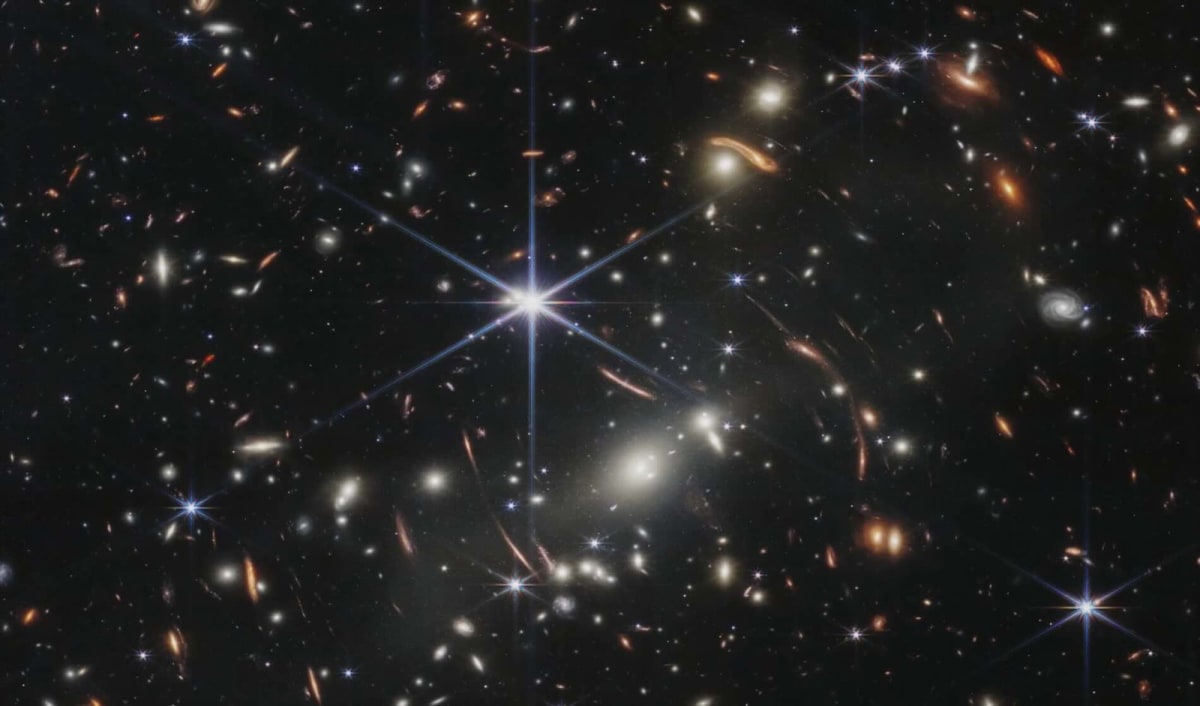
The discovery happened while Gutiérrez was examining publicly available images from the James Webb Space Telescope. He was specifically searching through observations of MACS J0308.9+2645, a massive galaxy cluster located billions of light years away.
Gravitational arcs form when something incredibly massive, like a galaxy cluster, sits between Earth and a more distant galaxy. The massive object's gravity warps the space around it, bending the light from the faraway galaxy like a cosmic magnifying glass. The result looks like a stretched, curved streak of light across space.
The new arc, designated A1, stretches about 5.1 arcseconds across the sky with a length six times greater than its width. Its curved shape points directly toward the center of the massive cluster, exactly as scientists would expect from gravitational lensing.
Here's where it gets interesting. At first, the galaxy appeared to be from the early universe, roughly 1.5 billion years after the Big Bang. But Gutiérrez dug deeper, combining Webb data with old Hubble Space Telescope images to get a clearer picture.
The corrected analysis revealed the galaxy is actually much closer than initially thought, from a time when the universe was about 4.6 billion years old. The initial measurements had accidentally made it appear redder and more distant because they only captured a fraction of the arc's total light.
Why This Inspires
This discovery shows that world-class science doesn't require billion-dollar budgets or elite institutional access. Gutiérrez made this finding by systematically reviewing 54 publicly available telescope fields containing 1,591 potential sources, work anyone with dedication and knowledge could attempt.
The story gets even better. Space agencies intentionally make Webb telescope data public specifically so researchers anywhere can make discoveries. This policy transforms expensive space missions into shared resources for humanity's collective curiosity.
The finding also demonstrates how much remains undiscovered in existing data. Countless images from our most powerful telescopes sit online right now, potentially containing phenomena no human has yet noticed. Each public dataset represents an invitation for curious minds worldwide to participate in exploring the universe.
Gutiérrez's paper, published on the preprint server arXiv, now gives other astronomers a new cosmic laboratory to study how gravity shapes light across vast distances. His meticulous work turned a hidden detail in crowded space images into a window for understanding the universe's grand architecture.
One person with curiosity and free internet access just expanded our map of the cosmos.
Based on reporting by Google: James Webb telescope
This story was written by BrightWire based on verified news reports.
Spread the positivity!
Share this good news with someone who needs it