Webb Telescope Maps Auroras on Tilted Uranus
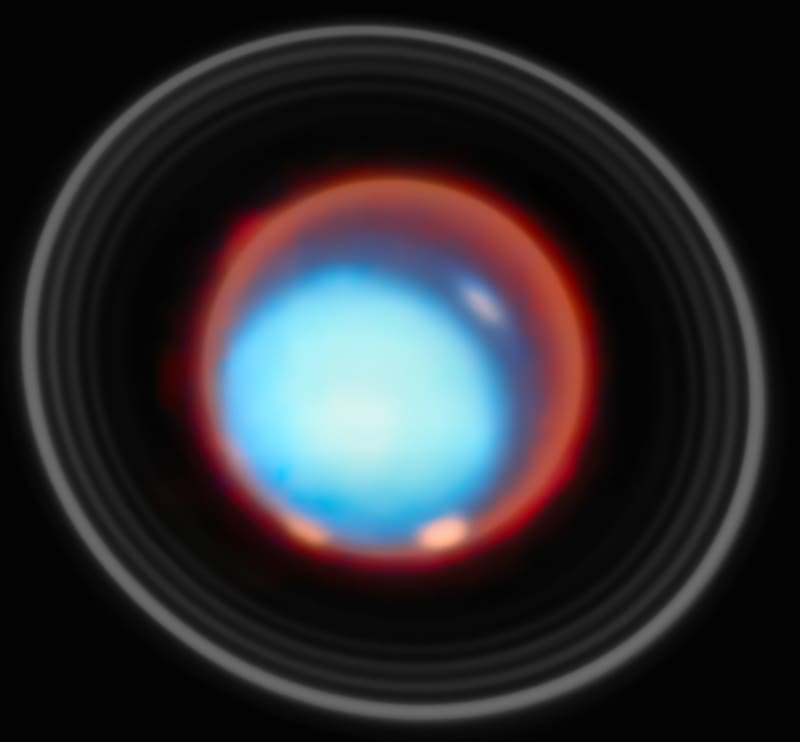
NASA's James Webb Space Telescope just captured the most detailed view ever of Uranus's upper atmosphere, revealing how auroras dance across the ice giant's surface in ways unlike anywhere else in our solar system. The breakthrough is helping scientists understand mysterious distant planets beyond our own cosmic neighborhood.
The James Webb Space Telescope just gave us front-row seats to one of the solar system's weirdest light shows.
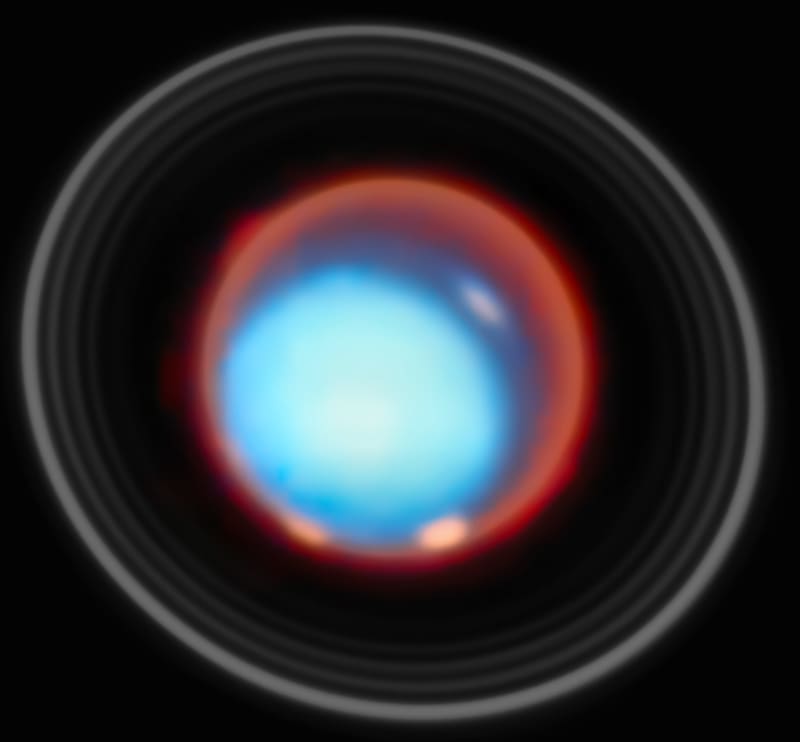
NASA released images on February 19, 2026, showing the first vertical view of Uranus's ionosphere, the region where its atmosphere meets its magnetic field. What scientists discovered is both beautiful and bizarre.
Uranus literally rolls through space on its side, spinning like a barrel instead of a top. Its magnetic field is tilted and offset from its rotation axis, creating a magnetosphere unlike any other planet we know.
This unusual setup means auroras don't stay put at the poles like they do on Earth. Instead, they move across the surface in complex, shifting patterns as the planet rotates.
The new Webb images reveal exactly where these auroras form and how the magnetic field shapes them. Scientists are also tracking how Uranus's atmosphere has continued cooling since the 1990s, adding another piece to the puzzle of how ice giant planets evolve over time.
Getting this detailed look at an ice giant in our own solar system is like having a practice field before the big game. Thousands of planets beyond our solar system likely share similarities with Uranus, but they're too far away to study in detail.
Why This Inspires
Understanding the strange workings of Uranus helps us decode what's happening on distant worlds we may never visit. Every quirk of this tilted ice giant teaches us something new about how planets form, evolve, and create their own unique environments.
The Webb telescope continues proving that even in our own cosmic backyard, there are still wonders waiting to surprise us. Each new image reveals details that were completely invisible just a few years ago, transforming planets we thought we knew into fresh mysteries worth solving.
Scientists can now use this atmospheric data as a reference point when they detect similar signals from exoplanets light-years away. What looks like abstract data from a distant world suddenly becomes readable when you have a nearby example to compare it against.
The research represents years of technological advancement finally paying off. Webb's instruments can detect temperature changes, chemical compositions, and magnetic field interactions that previous telescopes could only guess at.
This breakthrough reminds us that exploration never really ends, even in familiar territory.
More Images
Based on reporting by NASA
This story was written by BrightWire based on verified news reports.
Spread the positivity!
Share this good news with someone who needs it