Webb Telescope Maps Uranus Atmosphere in 3D for First Time
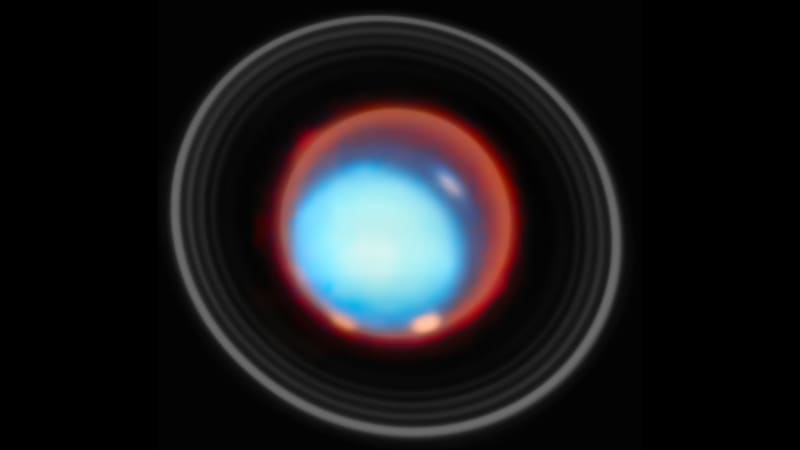
NASA's James Webb Space Telescope just created the first three-dimensional map of Uranus's upper atmosphere, revealing dramatic temperature shifts and swirling auroras on the mysterious ice giant. The breakthrough gives scientists their clearest view yet of one of our solar system's least understood planets. #
For the first time in history, scientists can see inside the upper atmosphere of Uranus in stunning three-dimensional detail, thanks to NASA's James Webb Space Telescope.
The groundbreaking observations, released Tuesday, show how temperature and charged particles dance thousands of miles above the ice giant's cloud tops. Webb traced temperatures peaking between 1,800 and 2,500 miles up, while electrically charged ions cluster most densely around 621 miles above the clouds.
"This is the first time we've been able to see Uranus's upper atmosphere in three dimensions," said Paola Tiranti of Northumbria University, who led the study. "With Webb's sensitivity, we can trace how energy moves upward through the planet's atmosphere and even see the influence of its lopsided magnetic field."
Uranus has remained one of our solar system's greatest mysteries since Voyager 2 flew past in 1986, capturing only limited data. The planet's upper atmosphere, composed mostly of hydrogen and helium, extends thousands of miles into space but has been nearly impossible to study in detail until now.
Webb's Near-Infrared Spectrograph changed everything by observing Uranus through nearly a full rotation. The telescope captured bright auroras shaped by the planet's unusually tilted magnetic field, which causes charged particles to swirl in patterns completely unlike anything we see on Earth or Jupiter.
"Uranus's magnetosphere is one of the strangest in the Solar System," Tiranti explained. "It's tilted and offset from the planet's rotation axis, which means its auroras sweep across the surface in complex ways."
The new data also confirmed something surprising: Uranus's upper atmosphere has continued cooling over the past three decades, a trend scientists first noticed in the early 1990s but couldn't fully track until now.
Why This Inspires
This breakthrough shows how far our ability to explore space has come in just 40 years. What Voyager 2 could only glimpse in passing, Webb can now map in intricate detail without ever leaving our solar system's neighborhood.
The discovery matters beyond Uranus itself. Understanding how energy moves through ice giant atmospheres helps astronomers interpret observations of similar exoplanets orbiting distant stars, expanding our knowledge of worlds we may never visit in person.
Webb continues proving that even familiar corners of our cosmic backyard hold secrets waiting to be revealed with the right tools and persistence.
#
Based on reporting by Google: James Webb telescope
This story was written by BrightWire based on verified news reports.
Spread the positivity!
Share this good news with someone who needs it