Webb Telescope Maps Uranus's Strange Auroras in 3D
Scientists used the Webb telescope to create the first 3D map of Uranus's upper atmosphere, revealing how the planet's sideways magnetic field creates uniquely strange auroras. The discovery helps us understand mysterious ice giant planets both in our solar system and beyond.
For 17 hours on January 19, the Webb Space Telescope focused on one of our solar system's strangest planets and discovered something remarkable about its glowing northern lights.
An international team of researchers created the first ever three-dimensional map of Uranus's upper atmosphere, revealing new details about how the planet's unusual magnetic field shapes its auroras. The findings, published in Geophysical Research Letters, show energy moving through the atmosphere in ways scientists had never seen before.
Uranus is truly the odd one out in our cosmic neighborhood. The planet rotates on its side, tilted over 90 degrees, and its magnetic field is tilted another 60 degrees from that. This double tilt creates a magnetosphere unlike anything else in our solar system.
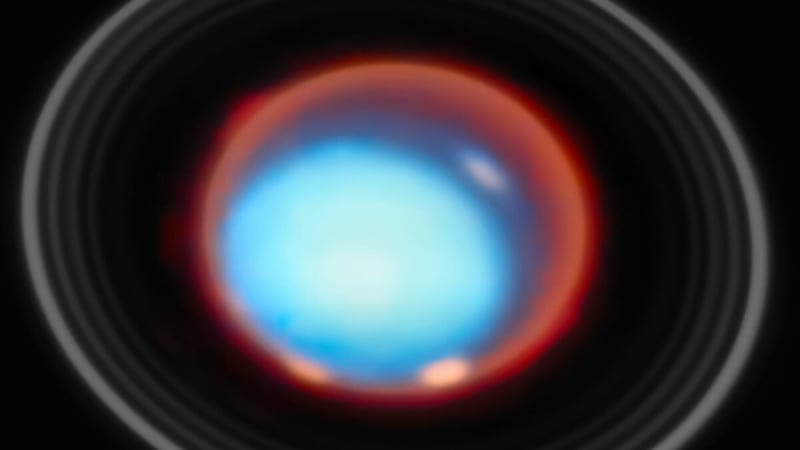
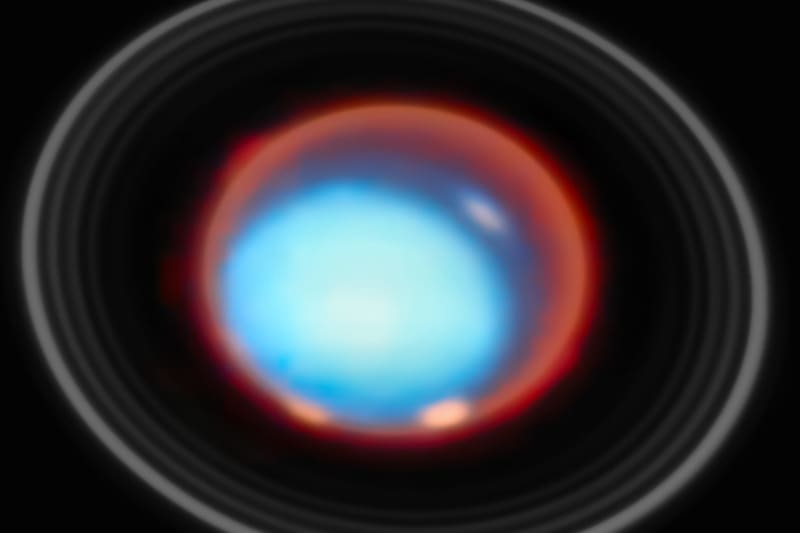
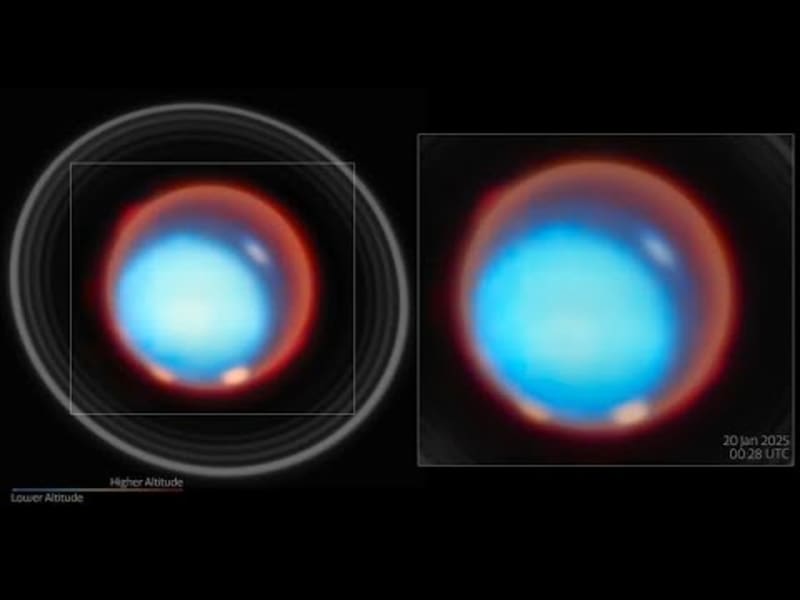
Using Webb's powerful Near-Infrared Spectrograph, the team mapped temperatures and ion density about 3,000 miles above Uranus's cloud tops. They spotted two bright auroral bands near the magnetic poles with a surprising gap of depleted particles between them.
"This is the first time we've been able to see Uranus's upper atmosphere in three dimensions," said Paola Tiranti, a PhD student at Northumbria University who led the study. The detailed view shows exactly how charged particles follow magnetic field lines through the atmosphere.
The Hubble Space Telescope first spotted auroras on Uranus back in 2012. Since then, scientists have worked to understand how this sideways planet creates its northern lights differently than Earth or other planets.
Webb also confirmed something unexpected: Uranus's upper atmosphere is still cooling down. When Voyager 2 flew past the planet in 1986, temperatures had already dropped below minus 353 degrees Fahrenheit. The new measurements show temperatures are now 302 degrees Fahrenheit cooler than previous recordings.
Why This Inspires
Understanding Uranus helps scientists unlock mysteries far beyond our own solar system. Ice giants similar to Uranus appear to be common around other stars, but we've never been able to study one up close until now.
The detailed temperature and density maps Webb created serve as a blueprint for understanding giant planets orbiting distant suns. By revealing how energy moves through Uranus's atmosphere, scientists can better predict what exoplanets might look like and how they behave.
"By revealing Uranus's vertical structure in such detail, Webb is helping us understand the energy balance of the ice giants," Tiranti explained. "This is a crucial step towards characterizing giant planets beyond our solar system."
The sideways planet with the lopsided magnetic field just taught us something valuable about the wider universe.
More Images


Based on reporting by Google News - Science
This story was written by BrightWire based on verified news reports.
Spread the positivity!
Share this good news with someone who needs it