Webb Telescope Reveals Thousands of Hidden Baby Stars
NASA's James Webb Space Telescope just pulled back the cosmic curtain on W51, revealing thousands of newborn stars that have been hidden behind dust clouds for a million years. Scientists can now study these massive young stars for the first time, unlocking secrets about how the biggest stars in our universe are born.
The cosmos just got a little less mysterious, and astronomers at the University of Florida are celebrating a breakthrough that's been a million years in the making.
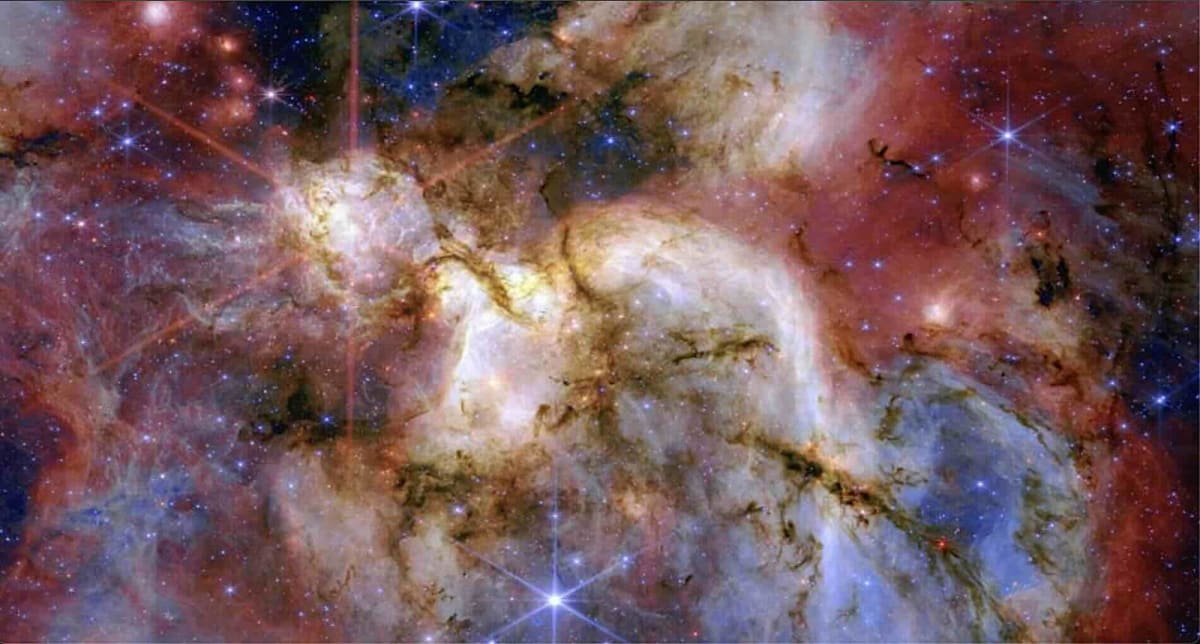
NASA's James Webb Space Telescope has revealed stunning new images of W51, a star-forming region that was essentially invisible until now. The powerful telescope peered through thick cosmic dust clouds to spot thousands of baby stars that formed within the last million years.
These aren't just any stars. They're massive stellar infants still wrapped in the gas and dust of their birth environment, like newborns in a celestial nursery. Scientists have never been able to see them clearly until Webb's infrared vision cut through the cosmic fog.
"Because of James Webb, we can see those hidden, young massive stars forming in this star-forming region," said Taehwa Yoo, a doctoral candidate who led the research. "By looking at them, we can study their formation mechanisms."
The discovery matters because these high-mass stars behave completely differently than their smaller cousins. They heat their surroundings more intensely and interact with nearby gas in unique ways that scientists are only beginning to understand.
The new images reveal features that look like science fiction made real. Protostellar jets shoot out from young stars. Giant bubble regions float through space. Dark cosmic filaments weave through the region like threads in a tapestry.
The team combined Webb's observations with data from the Atacama Large Millimeter Array in Chile, creating the most complete picture yet of what's happening in W51. Only a handful of stars appeared in both datasets, proving that astronomers need multiple telescopes working together to see the full story.
Professor Adam Ginsburg called it a game changer. "Every time we look at these images, we learn something new and unexpected," he said.
The research removes thousands of smaller stars from the "invisible" category and brings them into focus for the first time. Each new discovery helps scientists piece together how the universe builds its most massive stars.
Why This Inspires
This breakthrough reminds us that even after studying the sky for thousands of years, we're still finding entire neighborhoods of stars we didn't know existed. Webb's ability to see the invisible opens doors that were closed to every previous generation of astronomers.
The collaborative spirit behind the discovery shows what's possible when scientists combine different tools and perspectives. What was hidden yesterday becomes tomorrow's textbook knowledge.
The universe still holds countless secrets, and we're getting better at uncovering them every day.
Based on reporting by Google: James Webb telescope
This story was written by BrightWire based on verified news reports.
Spread the positivity!
Share this good news with someone who needs it