Webb Telescope Reveals Universe's Hidden Skeleton in Detail
The James Webb Space Telescope just mapped dark matter in unprecedented detail, capturing 800,000 galaxies and revealing the invisible framework holding our universe together. Scientists can now see the cosmic "highways" that shaped everything we know.
Scientists just got their clearest view ever of the invisible scaffolding holding our entire universe together, and it's changing how we understand the cosmos.
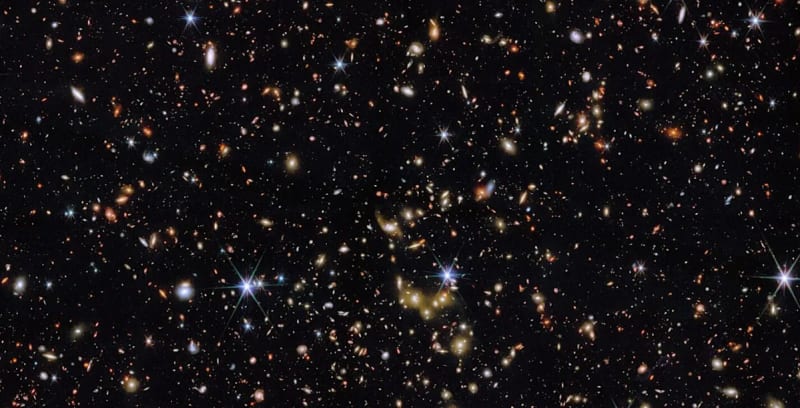
The James Webb Space Telescope created the most detailed dark matter map in history, capturing 800,000 galaxies with twice the resolution of previous attempts. Dark matter makes up 85% of all matter in the universe but stays completely invisible because it doesn't interact with light.
Webb cracked this challenge using a clever technique called weak gravitational lensing. The telescope measured how dark matter's gravity subtly bends light from distant galaxies, like detecting a glass sculpture by watching how it warps the view behind it.
The telescope's Mid-Infrared Instrument spent 255 hours examining a patch of sky 2.5 times larger than the full Moon. This represents Webb's largest first-year survey, pushing the boundaries of what space telescopes can achieve.
The results are stunning. The new map reveals filamentary "bridges" connecting galaxy clusters like a cosmic subway system. These structures represent the universe's original framework, the gravitational highways that pulled ordinary matter together to form the first stars and galaxies.
Diana Scognamiglio, the JPL astrophysicist who led the study, put it simply: "This is the largest dark matter map we've made with Webb, and it's twice as sharp. Now we're seeing the invisible scaffolding in stunning detail."
The COSMOS field studied by Webb has been astronomy's most examined patch of sky for two decades, observed by over 15 different telescopes since the early 2000s. Webb's contribution represents the payoff from sustained effort, finally bringing 4K resolution to a movie scientists have been watching in standard definition.
Why This Inspires
This breakthrough shows how persistence pays off. Twenty years of observations by different telescopes laid the groundwork for Webb to deliver this revolutionary view. While Hubble could map dark matter using visible light, Webb's infrared capabilities cut through cosmic dust to reveal structures hidden for decades.
The new map confirms predictions about how the universe evolved while providing unprecedented detail about low-mass galaxy groups previously invisible to ground-based telescopes. Published in Nature Astronomy this week, the research will keep cosmologists busy for years, potentially revealing subtle clues that could point toward new physics beyond our current understanding.
Scientists now have the clearest picture ever of the cosmic web that makes galaxies, stars, planets, and ultimately us possible.
More Images

Based on reporting by Google: James Webb telescope
This story was written by BrightWire based on verified news reports.
Spread the positivity!
Share this good news with someone who needs it