Webb Telescope Shows Saturn's Glowing Rings in Infrared
NASA's James Webb Space Telescope captured a stunning infrared view of Saturn that reveals the planet's icy rings glowing brighter than ever seen before. Scientists are combining this image with Hubble's to unlock new secrets about the gas giant's mysterious atmosphere.
Saturn just got a stunning close-up that reveals the ringed planet in ways we've never seen before.
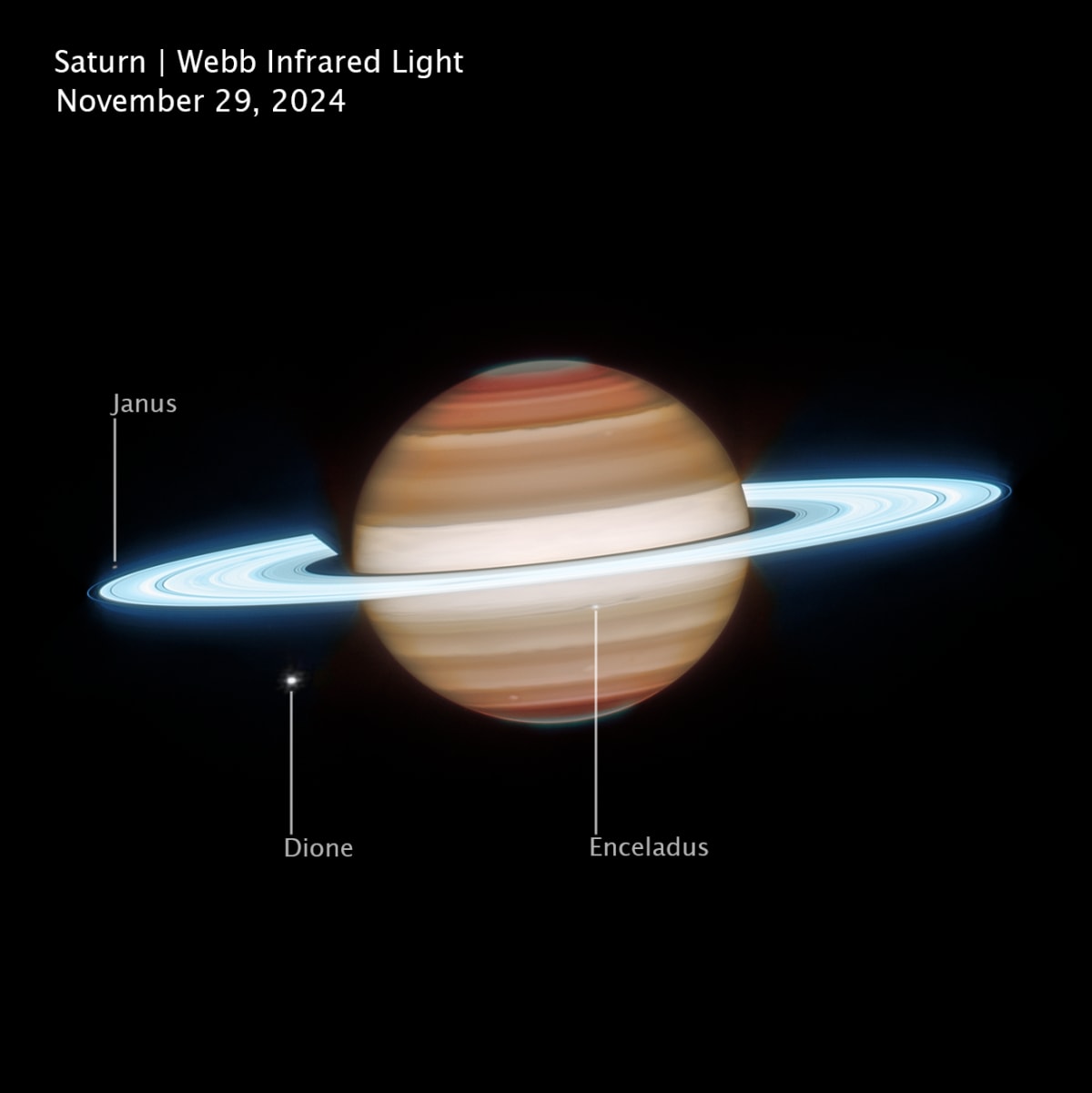
NASA's James Webb Space Telescope captured an infrared image of Saturn released on March 25, 2026, showing the planet's famous icy rings glowing brilliantly against the darkness of space. The telescope snapped the photo back in November 2024, and scientists have been studying it ever since.
The rings shine exceptionally bright in this view because they're made of highly reflective water ice that stands out in infrared light. Webb also spotted several of Saturn's moons in the image, including Janus, Dione, and Enceladus.
But the real surprise came at Saturn's poles. The north and south poles appear distinctly grey-green in the infrared image, a feature that has scientists buzzing with theories.
One possibility is that high-altitude aerosols in Saturn's atmosphere scatter light differently at those latitudes, creating the unusual color. Another exciting explanation involves auroral activity, similar to Earth's northern lights, where charged particles interacting with Saturn's magnetic field produce glowing emissions near the poles.
NASA released Webb's infrared image alongside a new Hubble Space Telescope photo captured on the same day. By combining both images, scientists can build a richer, more complete picture of what's happening in Saturn's complex atmosphere.
The two telescopes work as a perfect team. Hubble captures visible light that shows us what Saturn would look like to our eyes, while Webb's infrared vision reveals hidden features invisible to us, like temperature variations and atmospheric chemistry.
Why This Inspires
This collaboration between two legendary space telescopes shows how different perspectives unlock deeper understanding. Webb and Hubble together can see what neither could alone, revealing mysteries about a planet we've studied for centuries yet still barely understand.
The glowing rings and mysterious polar colors remind us that our solar system still holds countless surprises waiting to be discovered. Every new image brings fresh questions and the thrill of finding answers.
Scientists will continue studying these images to understand Saturn's atmospheric dynamics, ring composition, and seasonal changes. What we learn about Saturn helps us understand how gas giants form and evolve throughout our universe.
The universe keeps sharing its beauty with us, one spectacular image at a time.
More Images
Based on reporting by Google: James Webb telescope
This story was written by BrightWire based on verified news reports.
Spread the positivity!
Share this good news with someone who needs it