Webb Telescope Solves Mystery of Crystals in Distant Comets
NASA's James Webb Space Telescope just explained how heat-formed crystals end up in comets billions of miles from the sun. The answer involves baby stars shooting cosmic minerals across space like a highway.
Scientists finally figured out one of space's strangest puzzles, and the answer is blowing their minds.
For years, astronomers couldn't understand why distant comets contain crystalline minerals that only form in extreme heat. These icy wanderers spend most of their time in the freezing Oort cloud and Kuiper Belt, where temperatures drop to 450 degrees below zero Fahrenheit.
NASA's James Webb Space Telescope found the answer by watching a young star called EC 53, located 1,300 light years away in the Serpens Nebula. The protostar is about the same size as our sun and wrapped in scorching hot dust and gas.
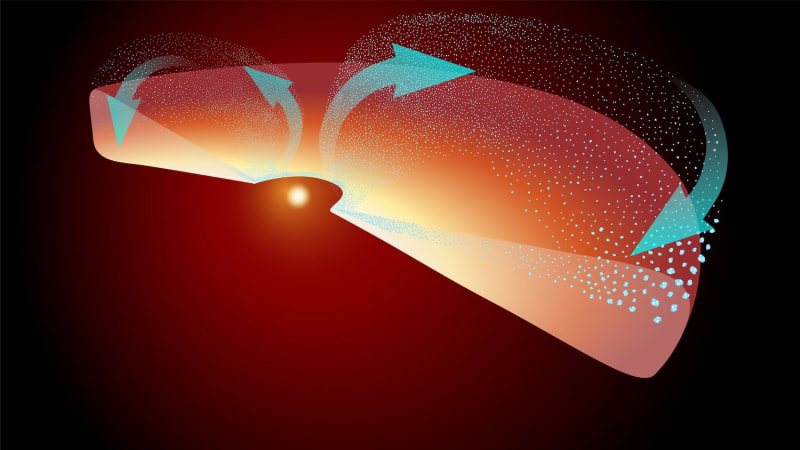
Researchers discovered something remarkable about EC 53's eating habits. Every 18 months, the baby star goes on a 100-day feeding frenzy, gobbling up surrounding dust clouds.
During these cosmic meals, powerful jets shoot newly formed crystals like forsterite and enstatite outward to the edges of the star system. Astronomer Jeong-Eun Lee from Seoul National University describes it as a "cosmic highway" flinging minerals into deep space.
"Webb not only showed us exactly which types of silicates are in the dust near the star, but also where they are both before and during a burst," Lee explained in the study published this week in Nature.
Here's the connection to our own neighborhood. These same crystalline silicates eventually become part of comets forming in the cold outer reaches of young solar systems.
Doug Johnstone from Canada's National Research Council pointed out something wonderful about this discovery. The minerals shooting through space near EC 53 are the same ones found on Earth, including forsterite and enstatite.
Why This Inspires
This breakthrough shows how connected our universe really is. The building blocks of planets and comets travel incredible distances, linking star systems across time and space.
EC 53 has been growing for millions of years and will continue forming for another 100,000 years. During that time, tiny rocks and debris will keep colliding and merging into the foundations of future planets.
Eventually, a new star system similar to our own will emerge from EC 53, complete with its own family of planets and comets carrying those heat-forged crystals across the cosmos.
More Images


Based on reporting by Google: James Webb telescope
This story was written by BrightWire based on verified news reports.
Spread the positivity!
Share this good news with someone who needs it