Webb Telescope Solves Mystery of Missing Red Supergiant Stars
NASA's James Webb Space Telescope just cracked a cosmic cold case 40 million years in the making by spotting the dusty red supergiant that exploded into supernova 2025pht. The discovery explains why some of the universe's most massive stars have been hiding in plain sight.
Astronomers at Northwestern University just solved a mystery that's puzzled them for years: where have all the red supergiants gone?
These massive stars should be among the brightest objects visible from Earth before they explode as supernovas. Instead, they've been playing a cosmic game of hide and seek, barely visible in telescope images despite their enormous size.
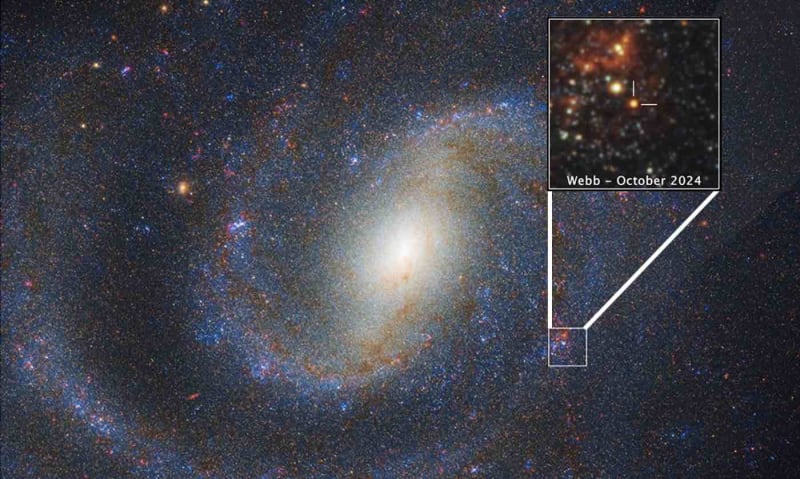
The James Webb Space Telescope finally revealed their secret. When supernova 2025pht exploded in galaxy NGC 1637, Webb's powerful cameras caught something Hubble had missed: a surprisingly red supergiant star surrounded by thick clouds of dust.
The dust acts like a cosmic curtain, blocking blue wavelengths of light and making these giant stars nearly invisible to astronomers. Graduate student Aswin Suresh called it "the reddest, most dusty red supergiant that we've seen explode as a supernova."
Lead researcher Charlie Kilpatrick and his team got lucky. Webb had already photographed NGC 1637 in 2024, giving them rare before and after images of the same cosmic neighborhood.
By comparing Webb's mid-infrared images with earlier Hubble photos, the team confirmed they'd found the exact star that later exploded. This marks Webb's first confirmed detection of a supernova progenitor, the technical term for a star before it goes boom.
The dust surrounding the star held another surprise. Computer models showed it's packed with carbon rather than silicate minerals, suggesting the star was spewing carbon from its interior right before exploding.
Why This Inspires
This discovery proves that some of nature's most spectacular events happen behind the scenes. The missing red supergiants weren't gone at all. They were just wrapped in dusty disguises, waiting for the right telescope to reveal them.
The Webb Telescope's mid-infrared cameras can peer through dust that would blind other instruments. What seems invisible to one observer becomes crystal clear through different eyes, a reminder that perspective changes everything.
Kilpatrick admitted he'd argued this dust theory before but never expected it to be so dramatic. "Even I didn't expect to see it as extreme as it was for supernova 2025pht," he said.
The team plans to hunt for more hidden red supergiants using Webb and NASA's upcoming Nancy Grace Roman Space Telescope. Each discovery will help astronomers understand how these stellar giants live their final days before exploding in brilliant supernovas.
Light from this explosion traveled 40 million years to reach us, carrying clues about a star that died when dinosaurs still roamed Earth. Webb's cameras caught those ancient photons and turned them into answers for a cosmic mystery that's finally solved.
Based on reporting by Google: James Webb telescope
This story was written by BrightWire based on verified news reports.
Spread the positivity!
Share this good news with someone who needs it
%2Fhttps%3A%2F%2Ftf-cmsv2-smithsonianmag-media.s3.amazonaws.com%2Ffiler_public%2F58%2F0a%2F580a77b9-7590-43c5-b70d-e3a590810348%2Fsmithmag-rockwell-edit.jpg)