Webb Telescope Spots 'Jellyfish Galaxy' 8.5 Billion Years Old
The James Webb Space Telescope discovered a stunning galaxy with gaseous tentacles stretching behind it like a jellyfish, offering a glimpse 8.5 billion years into the past. This finding is rewriting what scientists thought they knew about how galaxies evolved in the early Universe.
Scientists just spotted something extraordinary floating in deep space: a galaxy with sweeping tentacles of gas trailing behind it like a cosmic jellyfish.
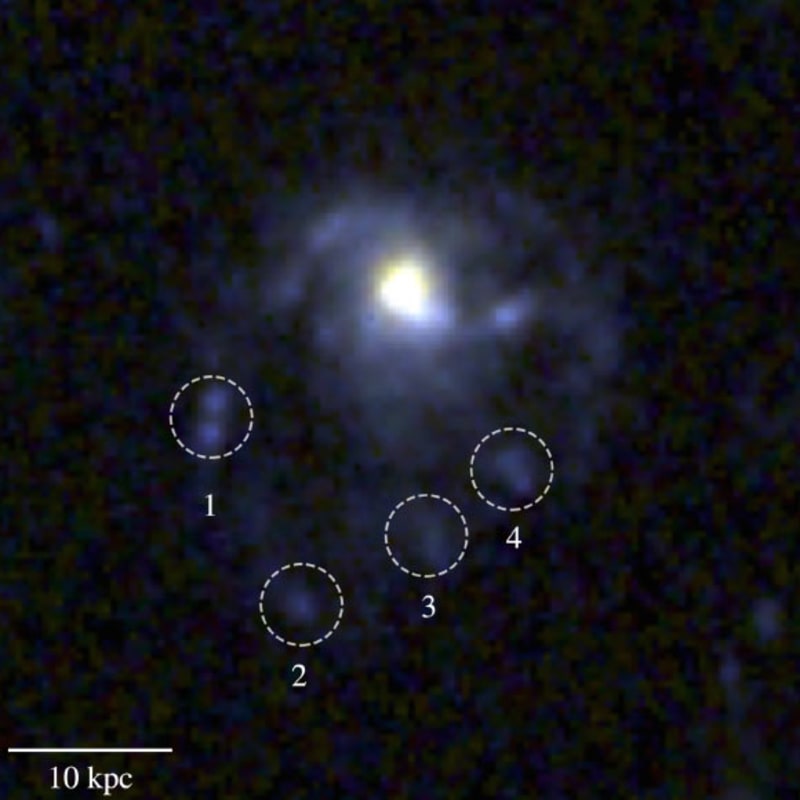
The James Webb Space Telescope captured images of COSMOS2020-635829, a distant galaxy that lived 8.5 billion years ago. Dr. Ian Roberts from the University of Waterloo and his team found this galactic wonder while searching through data from a well-studied patch of sky.
The galaxy earned its nickname from the long, tentacle-like streams flowing behind it. As the galaxy speeds through its hot, dense galaxy cluster, surrounding gas acts like a powerful wind, pushing the galaxy's own gas backward into beautiful trails.
Inside those glowing blue trails, the team discovered something unexpected: brand new stars being born far from the galaxy's main disk. These young stars are forming in the stripped gas itself, proving that even in the chaos of being pulled apart, galaxies can still create new life.
This discovery is challenging long-held scientific beliefs. Researchers had assumed that galaxy clusters 8.5 billion years ago were still peacefully forming, and that this dramatic gas-stripping process was rare during that era.
The Ripple Effect
The findings could transform our understanding of cosmic history in three major ways. First, galaxy clusters were already harsh environments capable of dramatically reshaping galaxies much earlier than scientists realized.
Second, these powerful cluster environments may have started altering galaxy properties billions of years sooner than previously thought. This earlier timeline changes the entire story of how galaxies evolved.
Third, this violent stripping process might explain a cosmic mystery: why so many "dead" galaxies exist in clusters today. These galaxies stopped forming new stars long ago, and this discovery suggests their gas may have been stripped away during similar encounters billions of years in the past.
The research provides rare insight into a transformative period in cosmic history. Scientists are watching galaxies being fundamentally changed during the Universe's middle age, filling in crucial gaps in our knowledge of how the cosmos evolved.
What makes this discovery particularly exciting is what it promises for the future. Webb's incredible sensitivity means scientists can now spot these rare cosmic jellyfish that were previously invisible, opening a window into processes that shaped the galaxies we see around us today.
The team's findings appear in the Astrophysical Journal, adding another chapter to humanity's growing understanding of our cosmic home.
Based on reporting by Google: James Webb telescope
This story was written by BrightWire based on verified news reports.
Spread the positivity!
Share this good news with someone who needs it