Whale Families Unite to Deliver Newborn Calf in Caribbean
Rare footage captured off Dominica shows 11 sperm whales working together to help deliver a calf and keep it afloat. Scientists say this level of teamwork is almost never seen outside of primates.
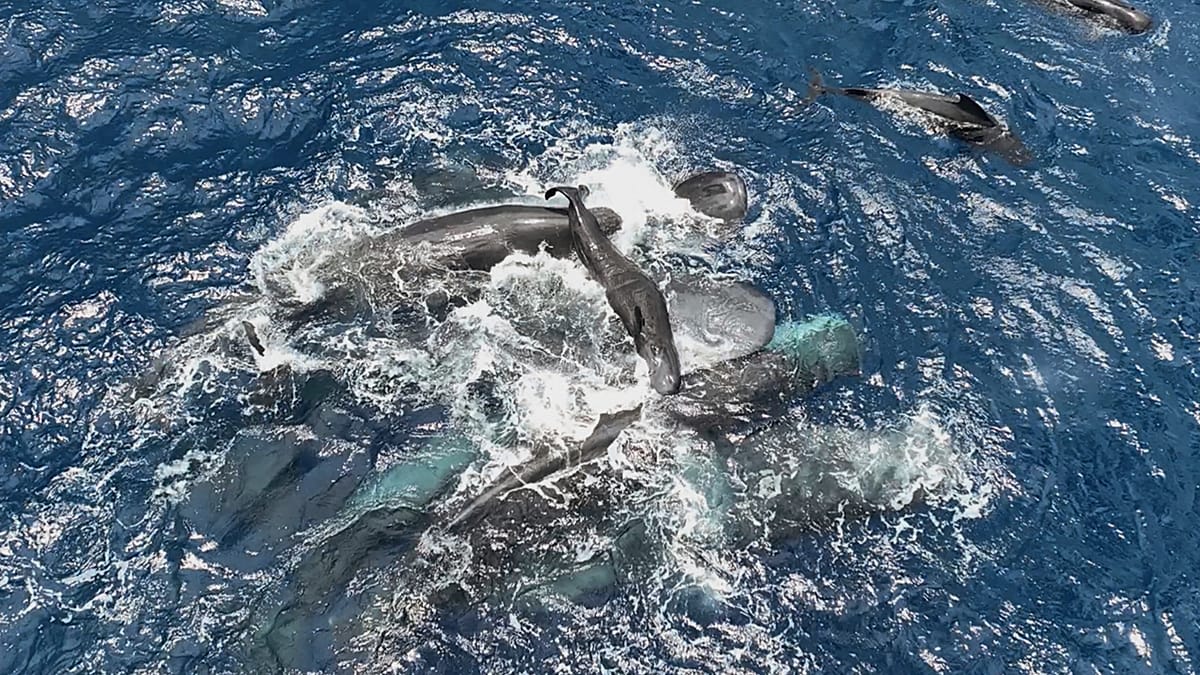
Eleven sperm whales from different family lines gathered in the Caribbean waters off Dominica in 2023, and what happened next stunned researchers watching from their boat.
The whales surfaced together, heads facing one another, thrashing and diving in coordinated movements. Scientists quickly realized they were witnessing something incredibly rare: a sperm whale giving birth, with the entire group working together to help.
The delivery took about 30 minutes, but the teamwork didn't stop there. For hours afterward, pairs of whales held the newborn calf above the water until it could swim on its own.
"This was just really a special event," says David Gruber, study co-author with Project CETI (Cetacean Translation Initiative). His team was studying whale communication when they stumbled upon the birth and immediately deployed drones and microphones to document everything.
There are only a handful of sperm whale birth records from the past 60 years, mostly anecdotal accounts or observations from whaling boats. This marked the first time scientists could capture the entire event on camera with detailed audio recordings.
What amazed researchers most was seeing mother, sister, and daughter whales unite to support the newborn, including whales that weren't even related to the calf. Sperm whales live in close-knit, female-led societies, and this observation shows how those bonds matter most during vulnerable moments.
The team created special software to analyze the footage and chronicled their findings in two studies published March 26, 2026, in Scientific Reports and Science. They discovered the whales made different sounds during key moments of birth, including slower, longer sets of clicks that may have helped them coordinate their efforts.
Why This Inspires
This level of cooperation is extremely uncommon in the animal kingdom, especially outside primates like monkeys and humans. "It's amazing to think about how, when faced with this impossible challenge, these animals come together to succeed," says co-author Shane Gero.
The findings raise fascinating new questions about how whales communicate and organize. How did the group know to gather? How did they coordinate without visible signals? While answers remain elusive, the footage offers a precious window into the hidden social lives of these deep-diving giants.
"The group quite literally helps bring the calf into the world," says Oregon State University behavioral ecologist Mauricio Cantor, who wasn't involved in the research but reviewed the findings. Biologist Susan Parks from Syracuse University agrees: "I think it's just exciting to think about the social lives of these animals."
The newborn calf is thriving, supported by a community that proves even in the ocean's depths, no one has to face life's biggest moments alone.
More Images



Based on reporting by Euronews
This story was written by BrightWire based on verified news reports.
Spread the positivity!
Share this good news with someone who needs it