Wobbling Planet Hints at Moon Half the Size of Jupiter
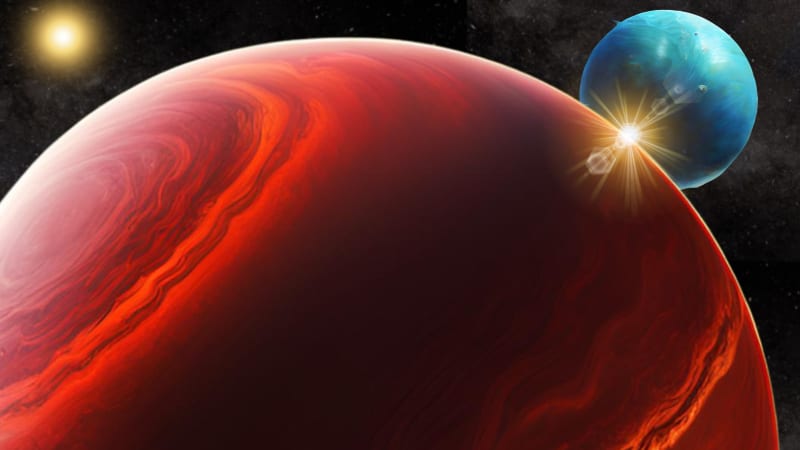
Astronomers may have found the first confirmed exomoon, and it's so massive it could change how we define what a moon actually is. The potential moon orbiting a distant gas giant weighs half as much as Jupiter.
Scientists have spotted something extraordinary 133 light-years from Earth: a gas giant planet that wobbles as it orbits its star, suggesting it has a moon so massive it challenges our understanding of what moons can be.
The planet HD 206893 B is already a giant, with 28 times Jupiter's mass. But what has astronomers excited is the tiny back-and-forth motion they detected in its orbit, a telltale sign of an unseen companion tugging at it gravitationally.
Using the GRAVITY instrument at Chile's Very Large Telescope, a team led by University of Cambridge astronomer Quentin Kral measured the planet's position over days and months. They found a wobble with a nine-month pattern, exactly what you'd expect from a large moon pulling on its parent planet.
The suspected moon would be truly enormous: about 40% of Jupiter's mass, or nine times heavier than Neptune. To put that in perspective, Ganymede, the largest moon in our solar system, is thousands of times less massive than Neptune.
This staggering size raises a fascinating question: at what point does a moon become something else entirely? There's currently no official definition of an exomoon, so astronomers use the term for any object orbiting a planet, regardless of size.
The discovery method itself represents a breakthrough. While the transit method has found thousands of exoplanets by watching for dips in starlight, it struggles to detect moons. Astrometry, which precisely tracks an object's position over time, works better for finding moons around planets far from their stars, where those moons can remain stable.
The Bright Side
If confirmed, this would be the first officially recognized exomoon ever discovered. Previous candidates have all been controversial, but this detection's precision and clarity give scientists real hope.
The technique also opens doors for future discoveries. Just as the first exoplanets found were massive gas giants because they were easiest to detect, this enormous moon is likely just the beginning. Smaller, more Earth-like moons might be waiting in systems across the galaxy.
The finding suggests that planetary systems can be far more complex and diverse than we imagined, with moons that dwarf anything in our own cosmic neighborhood.
This discovery reminds us that the universe still holds surprises that expand our cosmic perspective.
More Images


Based on reporting by Space.com
This story was written by BrightWire based on verified news reports.
Spread the positivity!
Share this good news with someone who needs it