Woman Farmer Earns $8,400 From 1 Acre of Orange Trees
While record rains destroyed orange orchards across India's Amravati district, one woman's 1-acre farm thrived, earning her $8,400 through scientific farming methods. Bharti Pohorkar's success challenges both gender norms and traditional farming practices in her region.
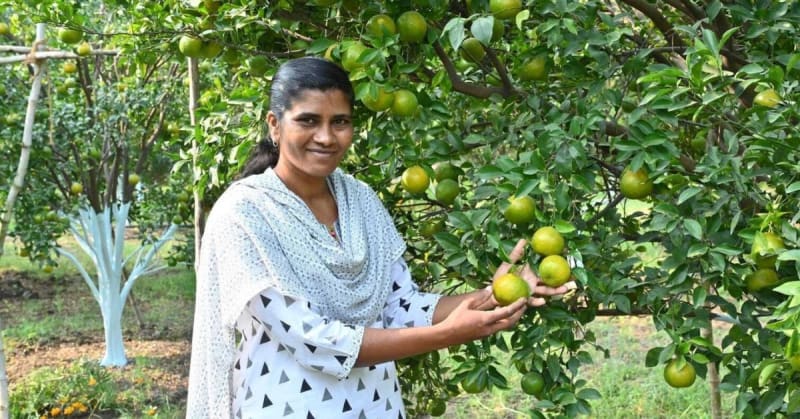
While her neighbors watched helplessly as monsoon rains destroyed their orange crops, Bharti Pohorkar's trees bent heavy with golden fruit. The 38-year-old farmer earned 700,000 rupees (about $8,400) from just over one acre of land using scientific methods most traditional farmers had never tried.
Bharti lives with her 68-year-old mother on land gifted by her grandparents in Karajgaon village, Amravati district. After earning her master's degree in commerce, she tried office work but couldn't make the farm profitable paying laborers.
So she became the laborer herself. She planted 180 grafted Rangpuri Nagpur Santra orange trees and managed every task alone: weeding, irrigation, pest control, and fertilizing.
Her neighbors said farming wasn't women's work. In 2023, she won the Best Young Woman Farmer Award and proved them wrong with her unprecedented harvest.
The secret was treating her orchard like a science lab. Bharti studied how orange trees behave and discovered they suffer from "alternate bearing," producing heavy crops one year then poor yields the next because the trees exhaust themselves.
She refused to accept this as inevitable. Instead, she pruned carefully after each harvest, removed excess flowers to prevent overload, and fed the trees nutrients in precise doses like medication.
When unseasonal May rains threatened her monsoon bloom cycle, she adjusted quickly. She applied zinc sprays to boost tree health and fungicides to prevent disease from excess moisture while still timing the stress period needed for flowering.
Her basin irrigation system delivers water directly to roots every seven to ten days. She planted marigolds between rows to attract beneficial insects and hung traps to monitor pests.
The physical work was grueling. Most days, only Bharti and her elderly mother tended the entire orchard while neighbors watched skeptically.
Then came last year's record rains. Across Chandur Bazar's 17,000 hectares of citrus farms, fruit blackened and dropped prematurely as water pooled at tree roots.
Bharti's orchard stayed healthy. Her drainage planning and precise watering schedule meant her trees could handle the excess moisture without stress.
Why This Inspires
Bharti's story challenges two stubborn myths at once. First, that women can't handle the physical demands of farming. Second, that traditional methods are the only way to farm successfully.
She combined modern agricultural science with relentless physical work, managing both the intellectual and manual aspects of farming alone. Her education became an asset rather than a reason to leave rural life.
In a region where 17,000 hectares produce oranges, her one-acre plot became a teaching model for what precision and persistence can achieve.
Today, neighbors who once doubted her walk through her rows studying her techniques. Her success proves that scientific farming isn't just for large operations or men, and that educated young people can thrive in agriculture when they bring new knowledge to old practices.
More Images
%2Fenglish-betterindia%2Fmedia%2Fmedia_files%2F2026%2F02%2F18%2Ftbi-featured-image-26-2026-02-18-12-03-23.jpg)
%2Ffilters%3Aformat(webp)%2Fenglish-betterindia%2Fmedia%2Fmedia_files%2F2026%2F02%2F18%2Forange-6-2026-02-18-12-02-34.jpeg)
%2Ffilters%3Aformat(webp)%2Fenglish-betterindia%2Fmedia%2Fmedia_files%2F2026%2F02%2F18%2Fbharti7-2026-02-18-12-01-58.jpeg)
%2Ffilters%3Aformat(webp)%2Fenglish-betterindia%2Fmedia%2Fmedia_files%2F2026%2F02%2F18%2Forange-5-2026-02-18-12-02-16.jpeg)
Based on reporting by The Better India
This story was written by BrightWire based on verified news reports.
Spread the positivity!
Share this good news with someone who needs it