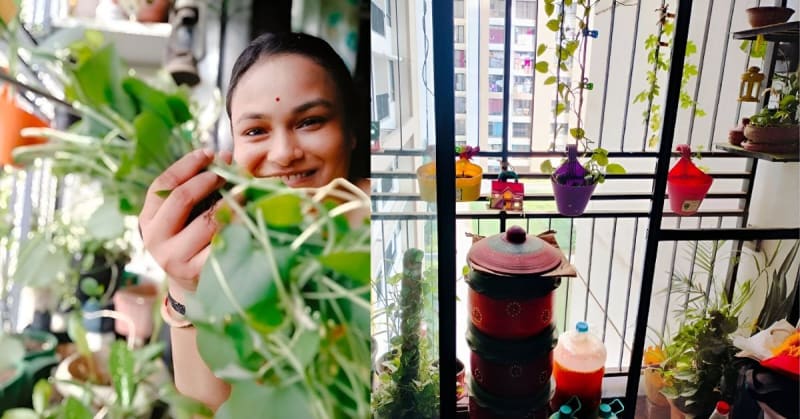
Woman Transforms 400 sq ft Balcony Into Thriving Ecosystem
In a tiny Mumbai apartment with barely any sunlight, 38-year-old Asmita Purohit has turned her balcony into a flourishing sanctuary for over 70 plants, sparrows, and butterflies using just compost and patience. What started as a way to heal from childhood loss has become a blueprint for sustainable urban living in the smallest spaces.
On most mornings in Dombivli, while the city rushes through its chaos, Asmita Purohit stands on her tiny balcony surrounded by sparrows flitting between birdhouses and butterflies dancing through leaves. In her 400 square foot flat with limited sunlight, she has created something remarkable: a thriving ecosystem of over 70 plants that proves you don't need a backyard to bring nature home.
The journey began with grief. After losing her father in a road accident as a child, young Asmita kept asking her mother where he had gone. Her mother told her he was everywhere: in the sunrise, the breeze, and in every plant around them. Today, every seedling Asmita plants feels like growing his love a little more.
When she moved from green Nagpur to concrete-heavy Mumbai in 2016, the culture shock hit hard. She saw cows tied outside temples where people had to pay to feed them, a stark contrast to her childhood where animals freely roamed to eat vegetable peels. With heavy pollution and hardly any direct sunlight in her apartment, Asmita decided to build the green space the city couldn't give her.
Learning came through failure. Her first composting attempt using a converted oil can smelled terrible and attracted flies. But those failures taught her, and now she runs two successful composters using terracotta pots and a simple layering method: dry crushed leaves, kitchen scraps, more dry material, turned every 15 days. In 40 days, rich compost emerges.
She tackled the sunlight problem by choosing plants that thrive in shade: money plants, spider plants, areca palms, and butterfly pea vines that now climb her window grill. Her ajwain plants grew so abundantly she shared cuttings with neighbors. Good soil, she learned, needs to breathe, so she mixes sieved dirt with sand, small stones, and her homemade compost for perfect aeration.
For seven years, Asmita has been brewing bioenzymes from fruit peels, flowers, and leaves. She now makes over 40 varieties used for everything from speeding up compost to cleaning drains and feeding plants. Once, after buying a pineapple, she asked the vendor for leftover peels and later returned with a bottle of bioenzyme she had made from them, closing the waste loop completely.
Sunny's Take
The sparrows that nest on Asmita's balcony raise their young there season after season, returning home like clockwork. She watches caterpillars transform into butterflies, calling herself not just a mother to her daughter but to countless plants, birds, and insects. Her advice for busy city dwellers is beautifully simple: spend just one hour a week on your pots and compost, and your garden will thrive.
In a city where green spaces vanish daily, Asmita proved that nature doesn't need sprawling land or perfect conditions—it just needs someone willing to make room for it.
More Images
%2Fenglish-betterindia%2Fmedia%2Fmedia_files%2F2026%2F02%2F09%2Fapartment-garden-2026-02-09-16-10-29.jpg)
%2Ffilters%3Aformat(webp)%2Fenglish-betterindia%2Fmedia%2Fmedia_files%2F2026%2F02%2F04%2Fbalcony-garden-2026-02-04-20-42-25.jpg)
%2Ffilters%3Aformat(webp)%2Fenglish-betterindia%2Fmedia%2Fmedia_files%2F2026%2F02%2F04%2Fcomposting-2026-02-04-20-38-58.jpg)
Based on reporting by The Better India
This story was written by BrightWire based on verified news reports.
Spread the positivity!
Share this good news with someone who needs it