Woman Turns Banned Craft Into Jobs for 300 Indian Artisans
When her community banned traditional wedding embroidery, Pabiben Rabari reimagined it into a faster technique that became a thriving business. Now her colorful bags support 300 women artisans across Kutch, India.
When community leaders in Kutch, India banned traditional wedding embroidery in the 1990s, it looked like the end of a centuries-old craft. Instead, it became the beginning of something new.
Pabiben Rabari grew up surrounded by the intricate embroidery traditions of the Rabari community in Kukadsar village. The elaborate handwork on wedding clothes could take months to complete, and community leaders decided it was delaying marriages. So they banned it.
Rather than let their craft disappear, the women experimented. They combined machine appliqué, ribbons and decorative trims with traditional Rabari colors and patterns, creating a faster, more contemporary technique called Hari Jari.
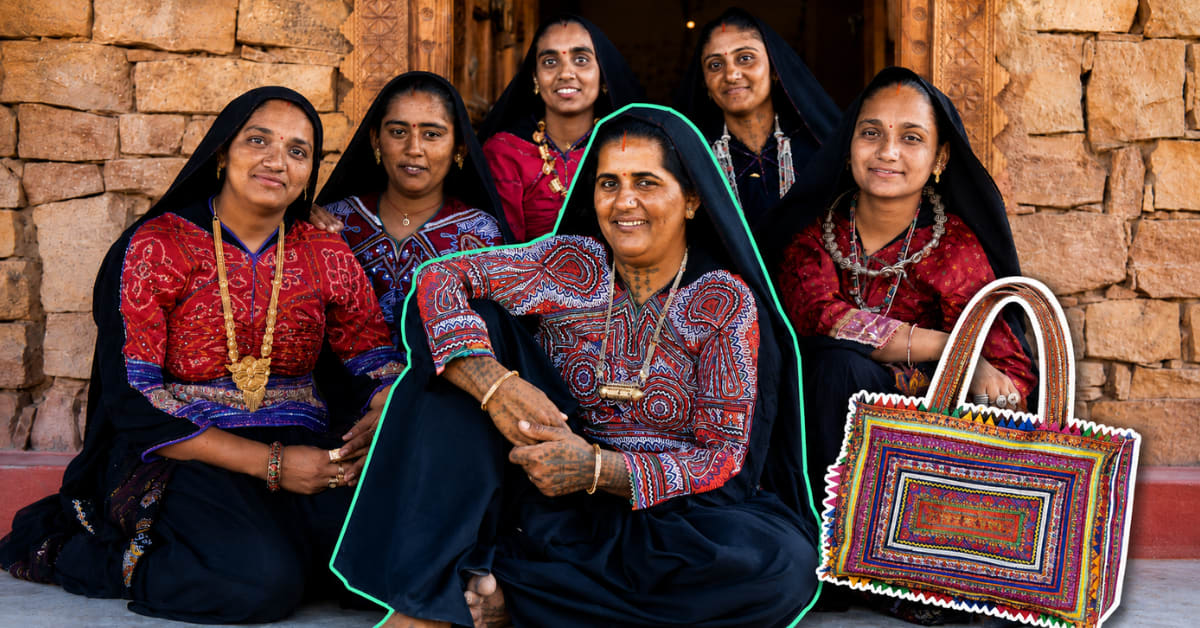
Pabiben saw potential beyond preservation. At a design program in 2015, she created a colorful bag using the new technique, combining ribbons and trims with locally block-printed, naturally dyed cotton fabric. The Pabi Bag was born.
The bag retained everything visually striking about Rabari craft while transforming it into something practical for modern life. Soon it appeared in Bollywood's "Luck by Chance" and Hollywood's "The Other End of the Line," giving unexpected global visibility to a craft that started in village homes.
But Pabiben wanted more than admiration. She wanted to create real income for the women making these products.
She made the leap from artisan to entrepreneur, launching Pabiben.com in 2015. What started with one bag design grew into purses, quilts, cushion covers, and lifestyle products, all featuring Hari Jari embroidery.
The Ripple Effect
The impact rippled far beyond one successful product. Today, more than 300 women artisans across Kutch earn income through Pabiben's enterprise, using skills they already possessed to reach customers around the world.
These women aren't just preserving tradition for museums and festivals. They're participating in a value chain built around their own craftsmanship, turning what they know into work that pays.
Pabiben understood something important: for a craft to survive, it sometimes has to change. A restriction meant to speed up marriages became a catalyst for innovation. That innovation became products people wanted to buy. And those products created livelihoods that didn't exist before.
Every brightly colored Pabi Bag now carries the story of a community that refused to let their craft disappear, and a woman who transformed tradition into opportunity.
More Images
%2Fenglish-betterindia%2Fmedia%2Fmedia_files%2F2026%2F08%2F14%2Fpabiben-rabari-2026-08-14-15-53-49.png)

%2Ffilters%3Aformat(webp)%2Fenglish-betterindia%2Fmedia%2Fmedia_files%2F2026%2F08%2F14%2Fpabiben-rabari-2026-08-14-15-54-57.png)
%2Ffilters%3Aformat(webp)%2Fenglish-betterindia%2Fmedia%2Fmedia_files%2F2026%2F08%2F14%2Fpabiben-rabari-2026-08-14-15-55-53.png)
Based on reporting by The Better India
This story was written by BrightWire based on verified news reports.
Spread the positivity!
Share this good news with someone who needs it