World's Oldest Cave Art Found in Indonesia: 67,800 Years
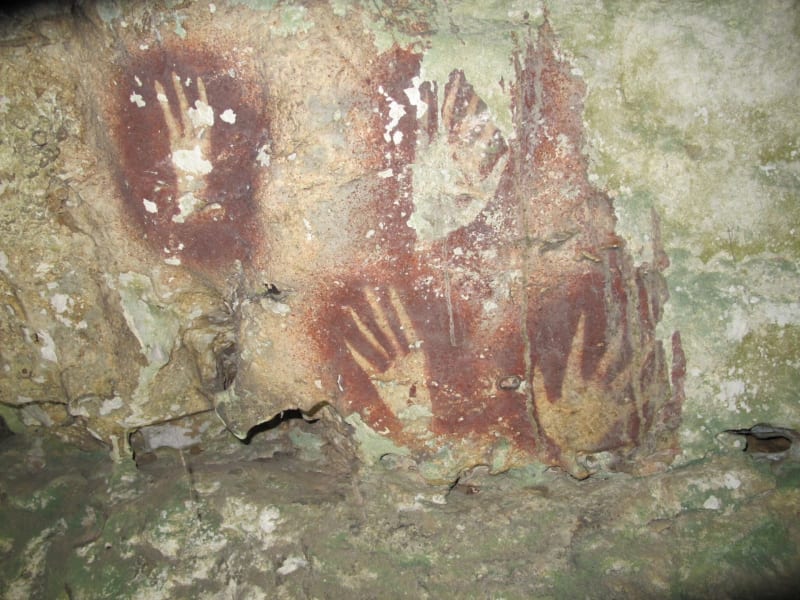
Ancient handprints discovered on Indonesia's Muna Island have been dated to nearly 68,000 years old, making them the oldest known paintings in human history. The mysterious stencils feature deliberately sharpened fingertips that may have been designed to look like animal claws.
Deep inside limestone caves on a remote Indonesian island, scientists have just confirmed humanity's oldest known artwork has been hiding in plain sight for almost 70,000 years.
Researchers from Indonesia and Australia discovered tan-colored handprints on Muna Island that date back 67,800 years. That makes them more than 15,000 years older than any previously known cave art in the region.
The ancient artists created these images using a surprisingly sophisticated technique. They placed their hands against cave walls and blew pigment over them, leaving ghostly outlines that would last tens of thousands of years.
But here's where it gets really interesting. The fingertips weren't left natural. Instead, the artists carefully reshaped them to appear pointed, almost like claws.
"It was almost as if they were deliberately trying to transform this image of a human hand into something else, an animal claw perhaps," said archaeologist Adam Brumm from Griffith University. The meaning behind this creative choice remains a mystery, though researchers suspect it reveals a deep symbolic relationship these ancient people had with animals.
Indonesian archaeologist Adhi Agus Oktaviana spent years searching for these handprints since 2015. At first, his colleagues doubted they were even hands at all because of the unusual pointed fingers.
The discovery came with modern detective work too. Scientists analyzed tiny amounts of uranium in mineral layers that formed on top of the pigment over millennia, comparing it to thorium decay to establish a precise minimum age.
Why This Inspires
This discovery rewrites our understanding of human creativity and migration. The Muna caves show that early humans weren't just surviving as they moved through Southeast Asia. They were creating sophisticated art and expressing complex ideas about their relationship with nature.
The caves were used as artistic spaces for tens of thousands of years. Some paintings were even created over the ancient handprints up to 35,000 years later, showing generation after generation returning to these sacred spaces.
"It also shows that our ancestors were not only great sailors," Adhi said, "but also artists." His words remind us that the human drive to create, express, and leave our mark has been with us from the very beginning.
These ancient artists reached across nearly 68,000 years to tell us they were here, they were thinking deeply, and they saw beauty worth preserving forever.
Based on reporting by Google: archaeological discovery
This story was written by BrightWire based on verified news reports.
Spread the positivity!
Share this good news with someone who needs it