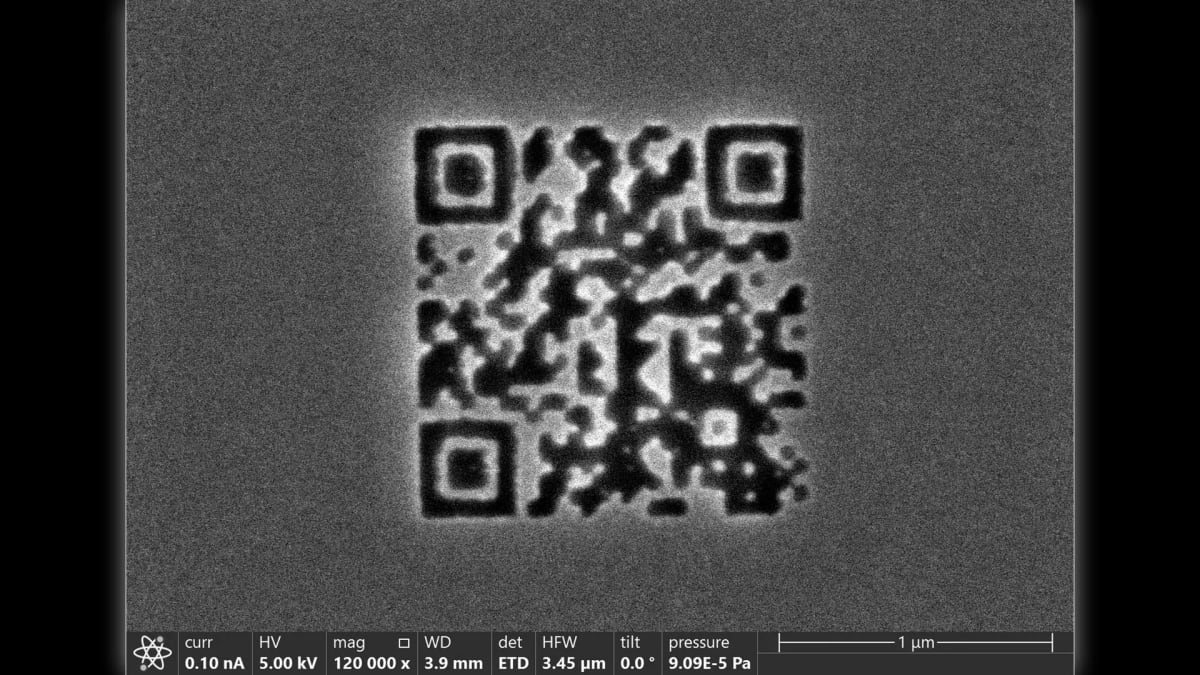
World's Smallest QR Code Could Store Data for Centuries
Scientists created a QR code smaller than most bacteria that can store information for thousands of years without electricity. This breakthrough could revolutionize how we preserve data for future generations.
Imagine storing all your photos, documents, and memories in a format that lasts longer than the pyramids and never needs charging.
Scientists at Vienna University of Technology just made that vision closer to reality. Working with data storage company Cerabyte, they created a QR code so tiny it's invisible to the naked eye and can only be seen with an electron microscope. The code measures just 1.98 square micrometers, smaller than most bacteria, and recently earned a Guinness World Record.
But the real breakthrough isn't the size. It's the durability.
The team engraved their microscopic code into ceramic materials, the same ultra-stable substances used to coat high-performance cutting tools. Unlike your hard drive or USB stick that might fail within a few years, these ceramic codes could preserve information for centuries or even millennia without any power or maintenance.
"We live in the information age, yet we store our knowledge in media that are astonishingly short-lived," says researcher Alexander Kirnbauer. Modern storage systems need constant electricity, cooling, and upkeep. Ancient civilizations carved knowledge into stone that we can still read thousands of years later.
Using focused ion beams, the researchers etched each pixel at just 49 nanometers, about ten times smaller than the wavelength of visible light. When scanned with an electron microscope, the code reads perfectly every time. The ceramic material prevents atoms from shifting positions, keeping the stored data intact indefinitely.
The storage capacity is remarkable. Using this approach, more than 2 terabytes of data could fit on a single sheet of paper. That's enough space for hundreds of thousands of photos or years of video.
Why This Inspires
This technology tackles one of our era's quietest crises: digital preservation. Libraries and museums worldwide struggle to keep digital archives alive as formats become obsolete and storage media degrade. Family photos, scientific research, historical records, they all risk disappearing if we can't maintain the servers and systems that hold them.
Ceramic storage offers a solution that's both ancient and futuristic. Like those stone carvings that survived millennia, these tiny codes can outlast empires without consuming any energy. Data centers currently use massive amounts of electricity for cooling and power, but ceramic storage sits quietly on a shelf, preserving memories for generations yet unborn.
The team is already working on the next phase: faster writing speeds, better materials, and industrial-scale production. They're exploring how to encode complex data structures beyond simple QR codes into ceramic films that can be written and read quickly and efficiently.
Future generations might thank us for finally finding a way to preserve today's knowledge for tomorrow's world.
Based on reporting by Science Daily
This story was written by BrightWire based on verified news reports.
Spread the positivity!
Share this good news with someone who needs it