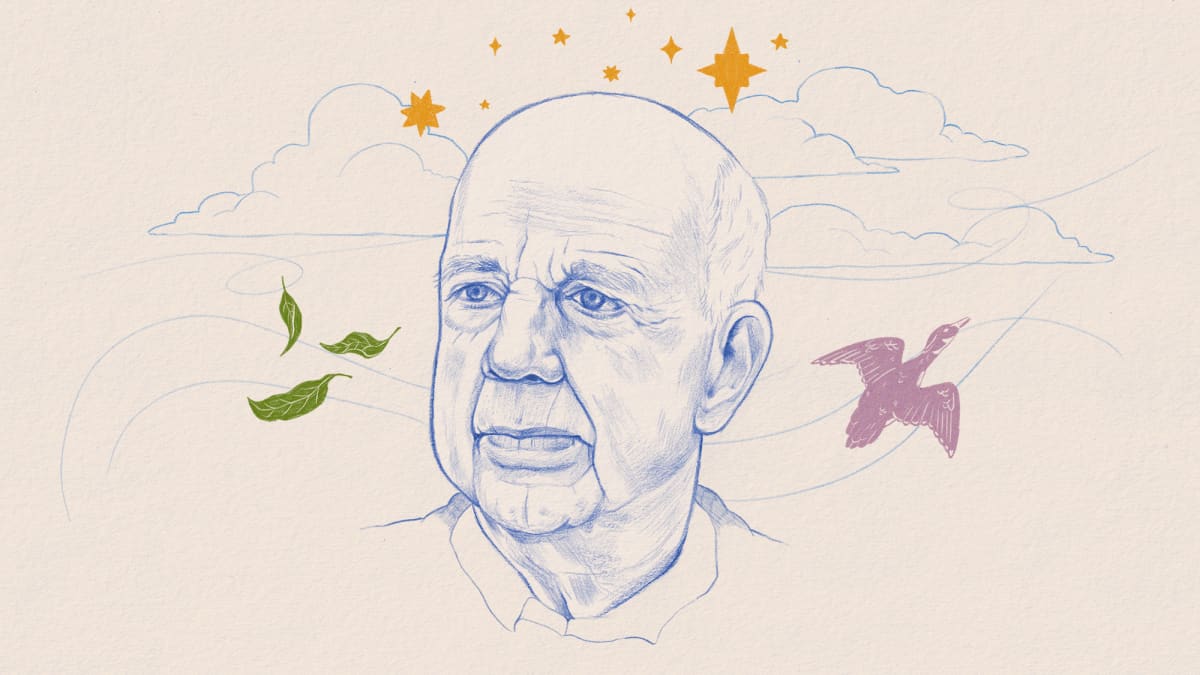
Writer Wendell Berry Lived What He Preached for 92 Years
Wendell Berry spent nine decades showing the world how to live in harmony with the land—one small, intentional choice at a time. The farmer, poet, and environmental advocate who wrote over 50 books by hand passed away last week, leaving behind a legacy that continues inspiring people to heal their relationship with nature.
For 92 years, Wendell Berry proved that one person living intentionally could spark change across generations.
The Kentucky farmer and writer, who passed away last week, spent his life demonstrating a simple truth: healing the planet starts with healing our own small corner of it. From his Henry County farmhouse, he wrote more than 50 books of poetry, fiction, and essays—most with just pencil and paper.
Berry never owned a computer or smartphone. He chose instead to stay connected to what mattered most: the land, his community, and the rhythms of nature that guided his work.
His famous poem "Manifesto: Mad Farmer Liberation Front" captured his philosophy perfectly: "Plant sequoias," he wrote, urging readers to invest in a future they'd never see. That kind of long-term thinking defined everything Berry did.
While others focused on convincing politicians to fix environmental problems, Berry believed real change happened through individual choices. He saw the environmental crisis as deeply personal, not just political. "There is no public crisis that is not also private," he wrote in 1972.
But Berry wasn't just a thinker. He got arrested twice for environmental activism—once protesting a nuclear plant in 1979, and again fighting mountaintop removal coal mining in 2011. When the University of Kentucky accepted $7 million from a coal company, the then-80-year-old pulled all his papers from the school in protest.
Jeffrey Bilbro, an English professor who's written several books about Berry's work, said the writer understood that perfect purity isn't possible. "Our hands are all dirty, and we're making these compromises," Bilbro explained. Berry believed in doing what we can to live right, even when we fall short.
Berry rejected the idea that humans are separate from nature. He hated dividing the world into competing categories. That perspective gave his message broad appeal across political lines, reaching anyone who felt modern life had drifted too far from honest, grounded work.
The Ripple Effect
Berry's influence spread far beyond Kentucky farmland. Generations of writers, farmers, and environmental advocates found inspiration in his conviction that small, daily acts of care for the earth matter deeply.
He showed that you don't need grand gestures to make a difference. Planting a seedling, tending soil, learning the rhythms of your local ecosystem—these quiet acts connect us to something larger. "By tending a sprouted seedling in the ground, you can recognize you are it, and it is you," he wrote.
His work reminded people that healing damaged land takes patience. The mountaintop you replant today might not become a lush forest until long after you're gone. That's okay. The work itself is the point.
Berry believed in thinking cyclically, not linearly—in death and rebirth, not apocalypse or salvation. Even when imagining the end of everything, his poem "A Discipline" concluded with hope: "It is the time's discipline to think of the death of all living, and yet live."
Berry's life proved that choosing to live gently on the earth, to work with your hands, and to care for your immediate community creates ripples that spread farther than we can measure.
More Images


Based on reporting by Grist
This story was written by BrightWire based on verified news reports.
Spread the positivity!
Share this good news with someone who needs it