Yale Student Discovers Tiniest Dust Around Dying Stars
A college junior helped uncover dust grains a billion times smaller than a grain of sand swirling around a rare dying star system. The discovery shows how massive cosmic forces create some of the universe's smallest building blocks.
A Yale undergraduate just helped solve a cosmic mystery that connects some of the largest objects in space to particles you could never see with your eyes.
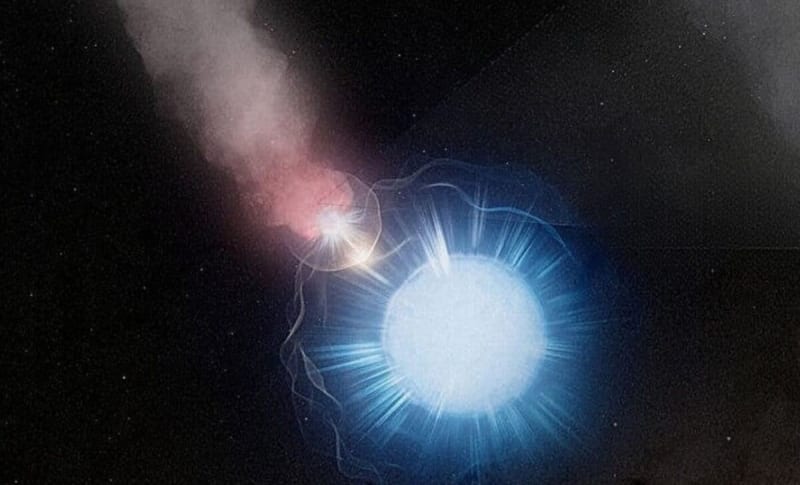
Donglin Wu spent his summer at Caltech studying WR 112, a rare binary star system containing a Wolf-Rayet star. These massive dying stars burn so intensely they only last a cosmic blink before exploding as supernovas.
What Wu and his team discovered changes how scientists understand dust formation in space. Using data from both the James Webb Space Telescope and the ALMA observatory in Chile, they found something remarkable when they compared notes.
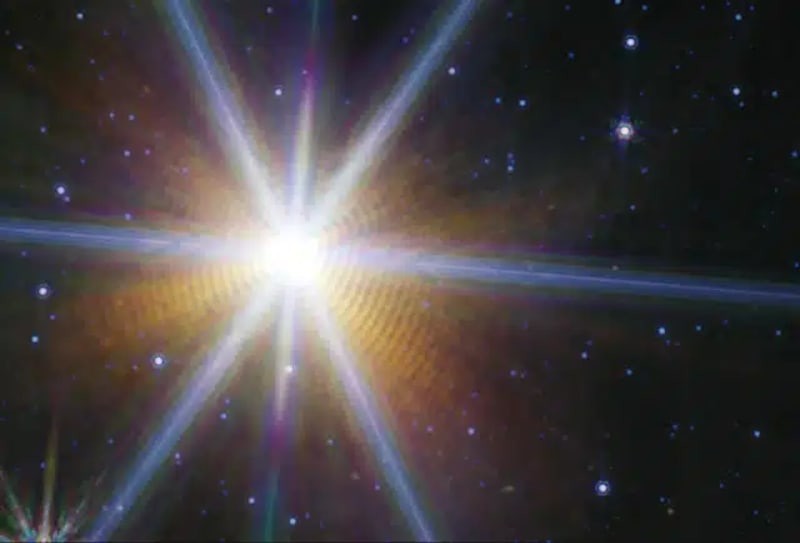
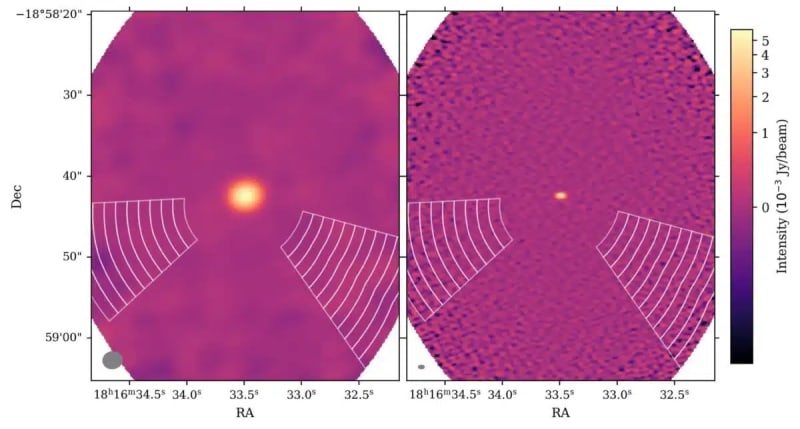
JWST showed beautiful spiral arcs of glowing dust around the system. But when the team looked at ALMA's millimeter-wavelength data, they saw nothing at all.
That absence told them everything. ALMA can easily detect larger dust grains, so the lack of signal meant the dust had to be incredibly tiny.
The team calculated that most grains measure just a few nanometers across. To put that in perspective, the size difference between the star and its dust approaches a quintillion to one.
Why This Inspires
Wu conducted this research as a junior, proving that groundbreaking discoveries don't require decades of experience. His work during a summer undergraduate program helped resolve conflicting measurements that had puzzled astronomers for years.
The discovery also reveals two distinct populations of dust grains spiraling through space. The dominant group measures just nanometers, while a smaller population reaches about one-tenth of a micrometer.
These tiny particles eventually scatter throughout the universe, becoming the raw materials for new stars, planets, and potentially life itself. The carbon-rich dust from WR 112 formed in the collision zone where winds from both stars meet and cool.
Wu reflected on what drew him to astronomy in the first place. "You look up at the night sky and think about how immense it is," he said. "There are so many things that are still unknown, things that are difficult to observe, things that are rare."
His summer project captured exactly that rare moment when powerful telescopes reveal something completely unexpected. Sometimes the most massive objects in the cosmos create the smallest wonders we can barely detect.
More Images

Based on reporting by Google: James Webb telescope
This story was written by BrightWire based on verified news reports.
Spread the positivity!
Share this good news with someone who needs it