Young Musicians Merge Math and Music at Science Festival
The Australian Youth Orchestra is premiering a saxophone concerto inspired by Einstein tiles and string theory at Brisbane's World Science Festival. Young performers are discovering how mathematical patterns and musical harmonies speak the same universal language.
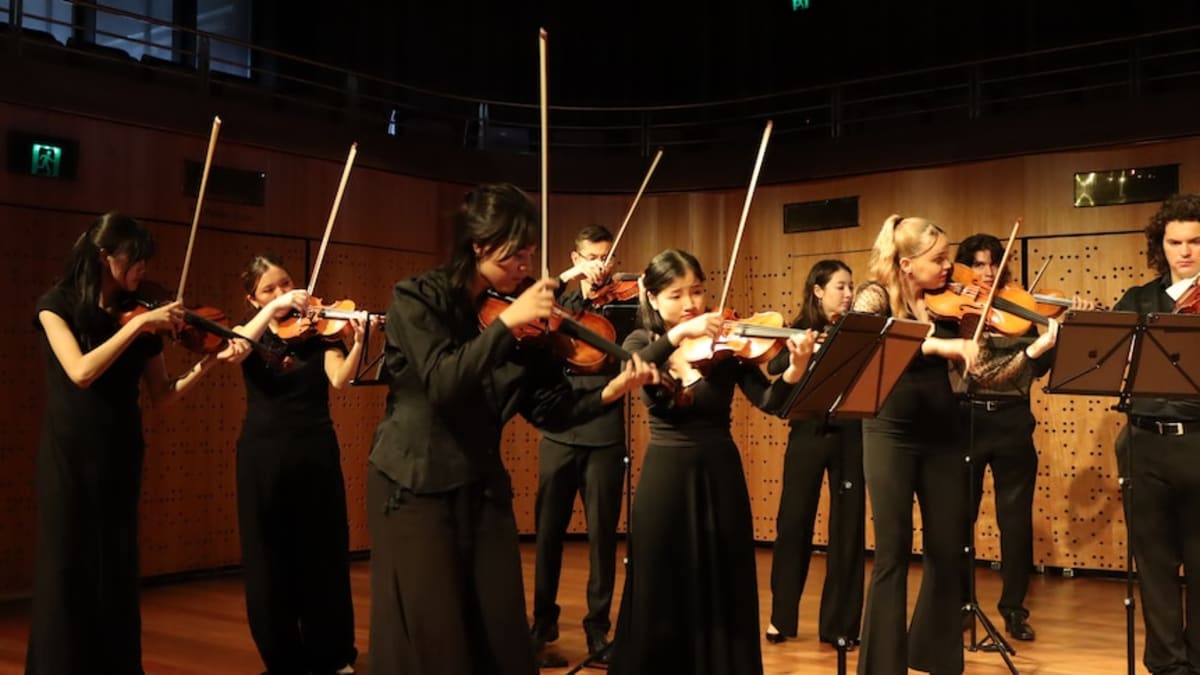
When 18-year-old violinist Katherine Ma touches specific spots on her violin strings to create harmonics, she's not just making music. She's creating mathematical fractions that split sound waves into perfect proportions.
Ma is part of the Australian Youth Orchestra's Momentum Ensemble, preparing to perform "Beautiful Equations" at the World Science Festival in Brisbane. The concert celebrates how music and mathematics intersect through patterns, symmetry, and the search for beauty.
The centerpiece is "Three Mathematical Diversions," a new saxophone concerto that translates pure mathematics into sound. British saxophonist Jonathan Radford will premiere the work, which transforms complex mathematical concepts into musical phrases.
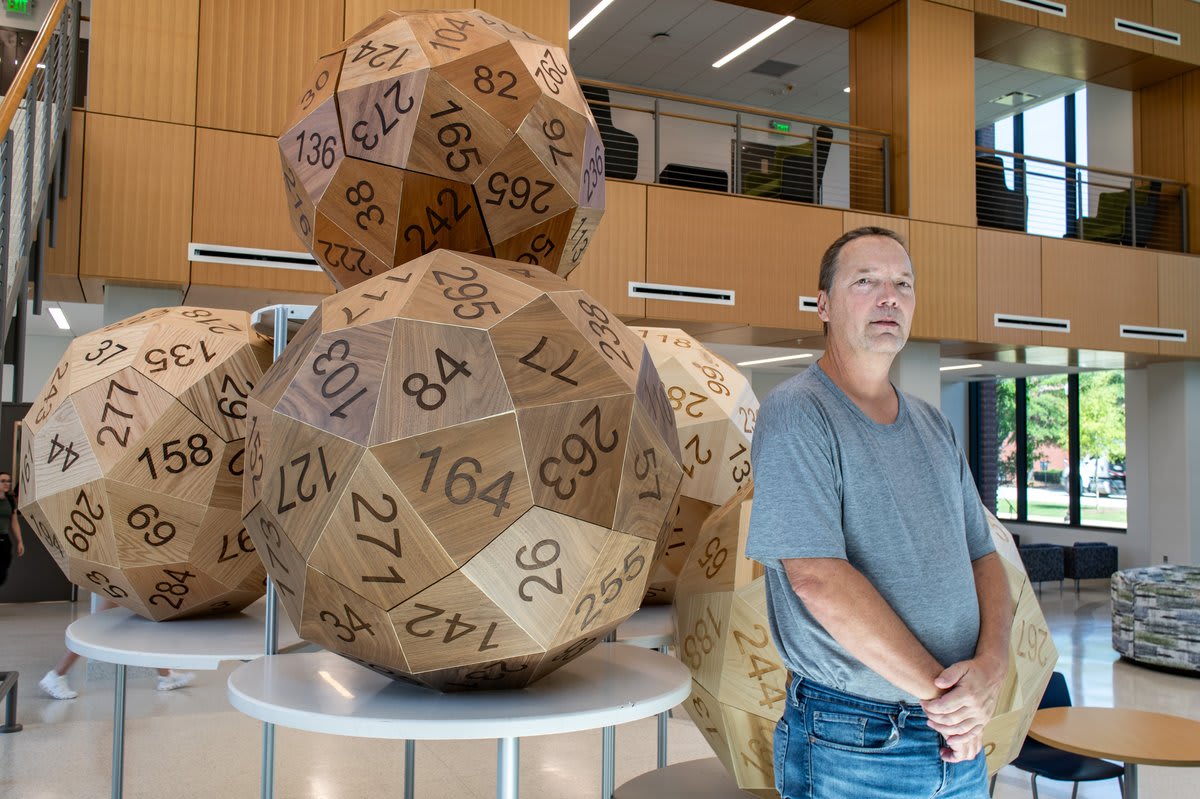
One movement explores the 13-sided Einstein tile, a shape discovered in 2023 that tiles endlessly without repeating. Another section illustrates the mysterious behavior of elliptic curves and prime numbers through visual shapes on the musical score.
For Ma, the concert connects her musical passion with her family's love of mathematics. Her father and brother work in engineering and research, while her mother taught math.
"Growing up, maths was pretty much everywhere," Ma says. While she considers herself the weakest at math in her family, playing violin lets her explore the subject in her own way.
Professor Yang-Hui He, a mathematician and physicist who grew up in Melbourne and Sydney, helped inspire the project. He collaborated with British composer Cheryl Frances-Hoad to create music based on his work searching for a unified theory of everything.
"Pattern, symmetry, proportion and the search for beauty are ideas we all recognize," says Radford. The connection between music and mathematics isn't new—ancient philosopher Pythagoras theorized about universal harmony linking the two disciplines.
The Ripple Effect
The concert demonstrates how breaking down barriers between disciplines opens new ways of understanding the world. Young musicians in the ensemble are discovering that creativity and analytical thinking aren't opposites but partners in exploring universal truths.
Professor He sees music and mathematics as "probably the only two universal languages." Both start with basic definitions and patterns, then build into infinite complexity and beauty.
Even famous works like John Cage's silent piece "4'33"" contain hidden mathematical meaning. The piece's duration of 273 seconds references minus 273 Celsius, absolute zero temperature, representing complete silence.
For the young performers, the experience goes beyond simply playing notes on a page. They're learning how harmonics work as fractions, how patterns repeat in both equations and melodies, and how string theory might explain the universe itself.
The World Science Festival performance shows a new generation discovering that the search for truth and beauty follows the same path, whether through instruments or equations.
More Images


Based on reporting by ABC Australia
This story was written by BrightWire based on verified news reports.
Spread the positivity!
Share this good news with someone who needs it