AI Suit Teaches New Skills by Moving Your Muscles
University of Chicago researchers created a wearable suit that uses AI and electrical pulses to physically guide your body through unfamiliar tasks in real time. The breakthrough system just won Best Paper Award at the world's largest human-computer interaction conference.
📺 Watch the full story above
Learning a new skill might soon feel less like studying and more like having an expert gently move your hands through the perfect motions.
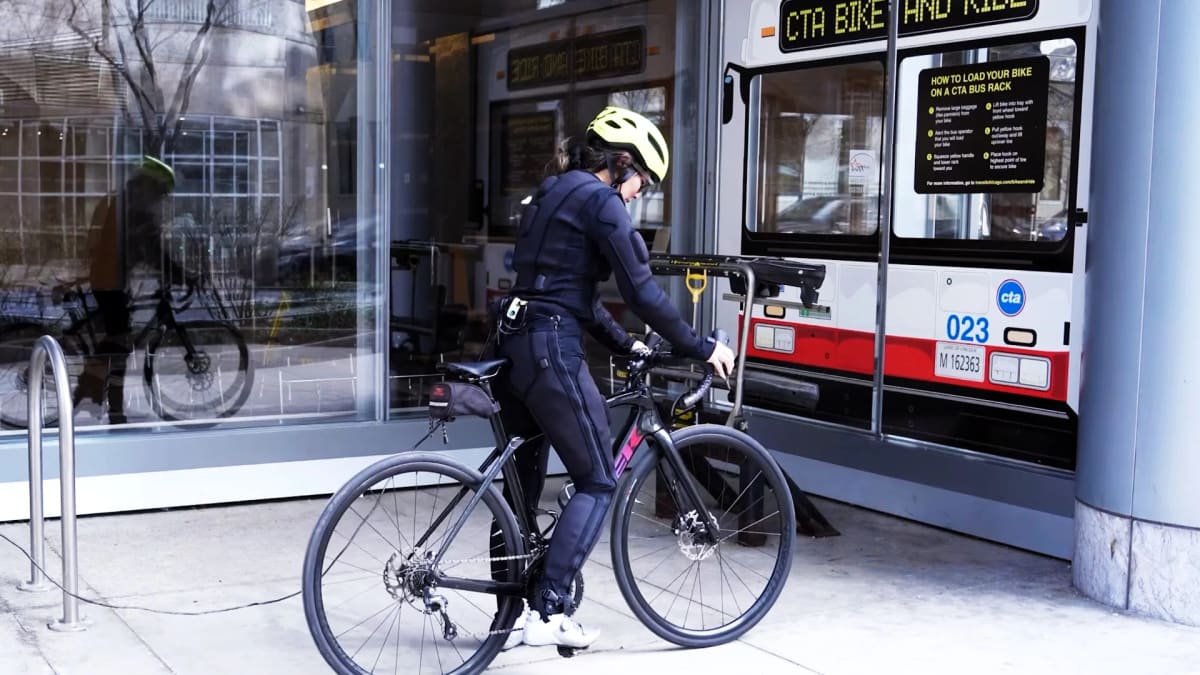
Researchers at the University of Chicago have built an AI-powered suit that teaches your muscles new tasks by physically guiding them through the right movements. The system combines a wearable electrode suit, smart glasses with a camera, motion tracking, and a multimodal AI model similar to GPT-4.
PhD students Yun Ho and Romain Nith developed the technology under researcher Pedro Lopes at the University's Human Computer Integration Lab. When a user approaches an unfamiliar window and says "EMS, help me open this," the system identifies the handle type and electrically guides their fingers, wrist, and elbow through the correct sequence.
The secret lies in electrical muscle stimulation, or EMS, which sends low-level electrical pulses to specific muscles to trigger movement. Physical therapists have used basic EMS for years, but earlier systems followed fixed scripts without understanding context. Show an old system a spray bottle that doesn't need shaking, and it would shake it anyway.
This new system actually reasons about what it sees. The smart glasses capture the task ahead, the motion-tracking suit reads body position, and the AI processes everything to generate custom movement instructions. It decides which joint to move, in which direction, and in what order.
Safety is built into every movement. An anatomical filter sits between the AI and your body, checking every instruction before it happens. If the AI tries to rotate a wrist 180 degrees, which would cause injury, the system automatically redistributes that motion across multiple joints.
The Ripple Effect
The applications reach far beyond simple tasks. In rehabilitation, the suit could guide patients through safe movements at home without constant supervision, making recovery more accessible and affordable.
For industrial workers, it could slash training time and reduce injuries when learning unfamiliar machinery. Instead of watching videos or reading manuals, workers would feel exactly how to operate new equipment safely.
Perhaps most powerfully, the system could help blind people or those with low vision navigate unfamiliar environments. Rather than audio descriptions, they'd receive direct physical guidance through spaces and objects they've never encountered.
In user tests, participants caught errors when the system deliberately made mistakes. One person noted that the body's own intuition made problems immediately obvious, suggesting humans can maintain genuine control even while being guided.
The researchers acknowledge current limitations. Electrode calibration needs personalization for each body, the tingling sensation can be uncomfortable, and the system doesn't yet build lasting muscle memory. Security concerns also need addressing before real-world deployment, since a suit controlling your body must be completely hackproof.
"Currently this is not something you can just wear in your everyday life but more of a superhero suit that researchers are experimenting with in the lab," Lopes explained. The project just won Best Paper Award at ACM CHI 2026, the world's largest human-computer interaction conference.
The gap between watching someone perform a skill and doing it yourself just got a little smaller.
More Images



Based on reporting by New Atlas
This story was written by BrightWire based on verified news reports.
Spread the positivity!
Share this good news with someone who needs it