China Solves 50-Year Physics Mystery With Glueball Discovery
After 15 years of detective work, scientists in China found the strongest evidence yet for a particle made entirely of pure force. Physicists worldwide are calling it a triumph that could reshape our understanding of how the universe works.
📺 Watch the full story above
Scientists in China just cracked a puzzle that has stumped physicists since the 1970s, and the breakthrough is getting Nobel Prize buzz on social media.
Researchers presented the strongest evidence yet for the existence of glueballs at a major physics conference in Brazil last week. These mysterious particles are made entirely of gluons, the tiny force carriers that glue atomic nuclei together.
Think of it this way: if atoms are like houses, gluons are the invisible cement holding the bricks together. Scientists predicted you could make a particle out of pure cement with no bricks at all. That particle is a glueball.
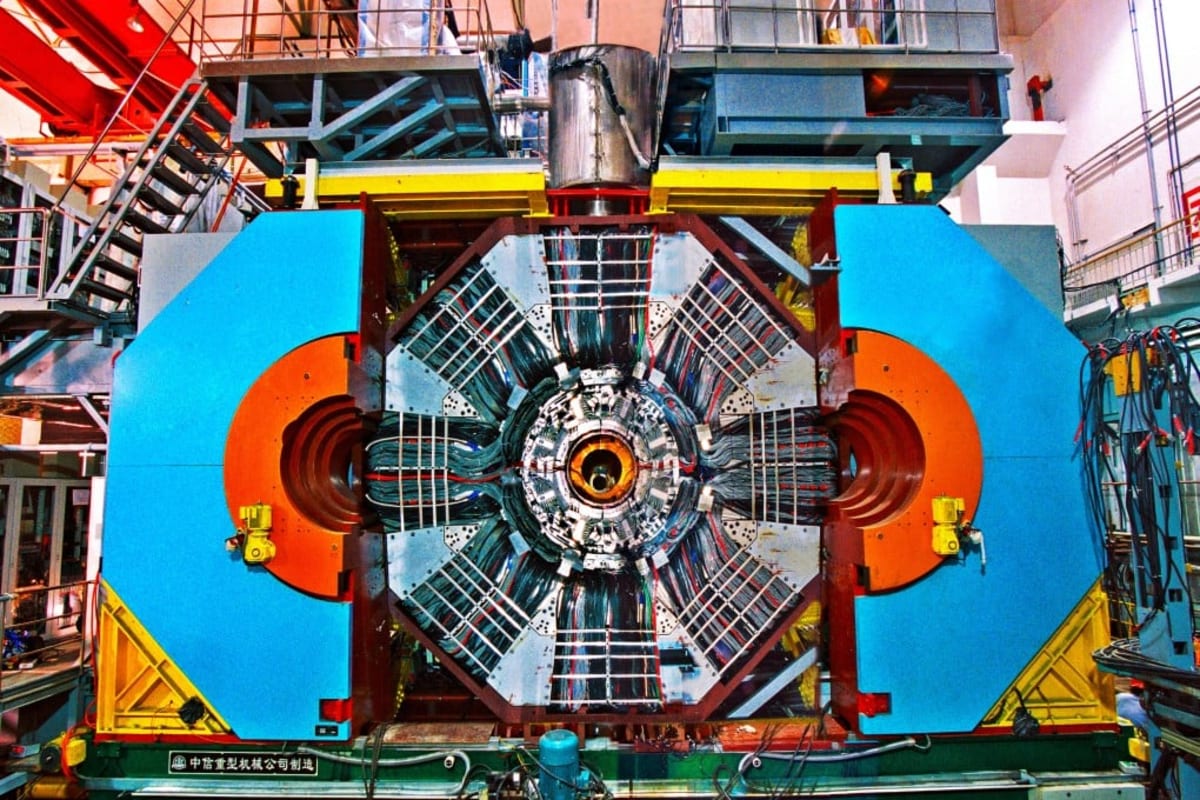
The discovery took 15 years and involved researchers from 15 countries working with the Beijing Electron Positron Collider. They sifted through billions of measurements from particle collisions happening in an underground lab in western Beijing.
Colin Morningstar, a physicist at Carnegie Mellon University, called the work "an experimental triumph." Marek Karliner from Tel Aviv University said there's a very good chance the team nailed it.
The particle, called X(2370), first appeared in 2011 among the debris of colliding particles. But confirming it was actually a glueball required years of careful testing to rule out other possibilities.
What made this discovery possible was patience and the right tool for the job. Unlike Europe's Large Hadron Collider, which creates many different particles all at once, the Beijing collider operates at precise energy levels that produce less clutter and make rare particles easier to spot.
The Ripple Effect
This isn't just about finding one weird particle. Glueballs were one of the last major predictions of quantum theory waiting to be confirmed. Proving they exist deepens our understanding of the fundamental forces that hold all matter together.
The discovery validates decades of theoretical work and shows that international collaboration in science continues to push human knowledge forward. Morningstar noted it could even lead to technological applications scientists haven't imagined yet.
The Beijing team worked through a detailed checklist accepted by experts worldwide, testing the particle's mass, quantum properties, and other identifying features one by one. Their methodical approach turned decades of uncertainty into solid evidence.
Scientists still have questions about exactly how many gluons are inside X(2370), and whether pure glueballs exist or if they always mix with ordinary matter. But after 50 years of searching, researchers finally have something real to study.
This breakthrough shows what's possible when scientists around the world work together on hard problems that take decades to solve.
More Images

Based on reporting by South China Morning Post
This story was written by BrightWire based on verified news reports.
Spread the positivity!
Share this good news with someone who needs it