Dehradun Removes Concrete to Save Trees From Falling
After a falling tree killed an 11-year-old in Mumbai, Dehradun found a simple fix that could prevent monsoon tragedies across India. The city is removing concrete from around tree trunks, letting roots breathe and grow strong enough to survive storms.
📺 Watch the full story above
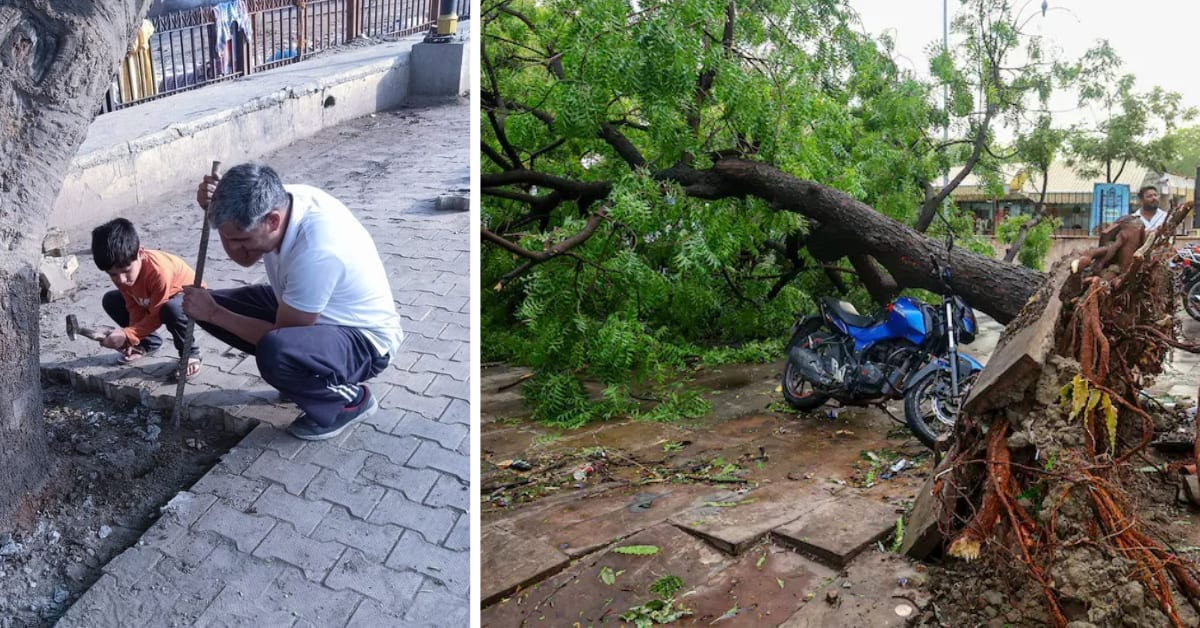
When monsoon winds blow through Indian cities, falling trees don't just damage cars and block roads. Sometimes they kill people, like 11-year-old Vihan Srivastava, who died when a tree crushed his school bus in Mumbai last July.
Dehradun decided to do something about it. The city discovered that the problem isn't just the storms—it's what's happening underground.
For years, Indian cities have built concrete pavements right up to tree trunks, creating neat-looking streets but slowly suffocating the trees. When cement covers the soil around a tree, rainwater can't seep in, air can't reach the roots, and the ground hardens like a rock.
Trees might look healthy above ground, but their roots become weak and shallow. When heavy rains and strong winds arrive, those weakened roots can't hold the tree upright anymore.
Dehradun's solution is beautifully simple. Working with the environmental group Citizens for Green Doon, city authorities are carefully removing concrete from around tree bases, creating open rings of exposed soil.
That small change transforms everything. Rainwater soaks into the ground instead of running off into drains. Oxygen reaches the roots again. Earthworms and microorganisms return to enrich the soil. Trees develop deeper, stronger root systems that can anchor them through the worst monsoon storms.
The National Green Tribunal has backed the approach with legal muscle. The tribunal recently ordered Dehradun officials to remove concrete within one meter of tree trunks and submit compliance reports within four weeks.
Other cities are paying attention. The Bombay High Court just directed Mumbai's municipal corporation to investigate how road construction is harming trees across the city.
The Ripple Effect
The benefits reach far beyond preventing falling trees. Open soil allows rainwater to recharge underground water supplies instead of overwhelming storm drains. Exposed earth stays cooler than concrete during summer, reducing urban heat around neighborhoods.
Healthy mature trees provide shade, clean air, lower temperatures, and homes for birds and insects. These benefits take decades to develop, which makes protecting existing trees far more effective than only planting new saplings.
The approach also challenges another common practice that can weaken trees: excessive pruning before monsoon season. Instead of reacting to perceived dangers, Dehradun focuses on improving long-term tree health.
As climate change brings stronger storms and heavier rainfall, Indian cities need practical solutions that don't require expensive technology or massive construction projects. Dehradun proved that sometimes the best answer is removing something rather than adding more.
The method works because it addresses the root cause—literally. Give trees room to breathe underground, and they'll stand strong when the storms come.
More Images
%2Fenglish-betterindia%2Fmedia%2Fmedia_files%2F2026%2F07%2F09%2Fdehradun-3-2026-07-09-15-35-38.png)

%2Ffilters%3Aformat(webp)%2Fenglish-betterindia%2Fmedia%2Fmedia_files%2F2026%2F07%2F09%2Fdehradun-2-2026-07-09-15-29-02.png)
%2Fenglish-betterindia%2Fmedia%2Fmedia_files%2F2026%2F07%2F09%2Fsustainable-living-2026-07-09-15-20-15.jpg)
Based on reporting by The Better India
This story was written by BrightWire based on verified news reports.
Spread the positivity!
Share this good news with someone who needs it