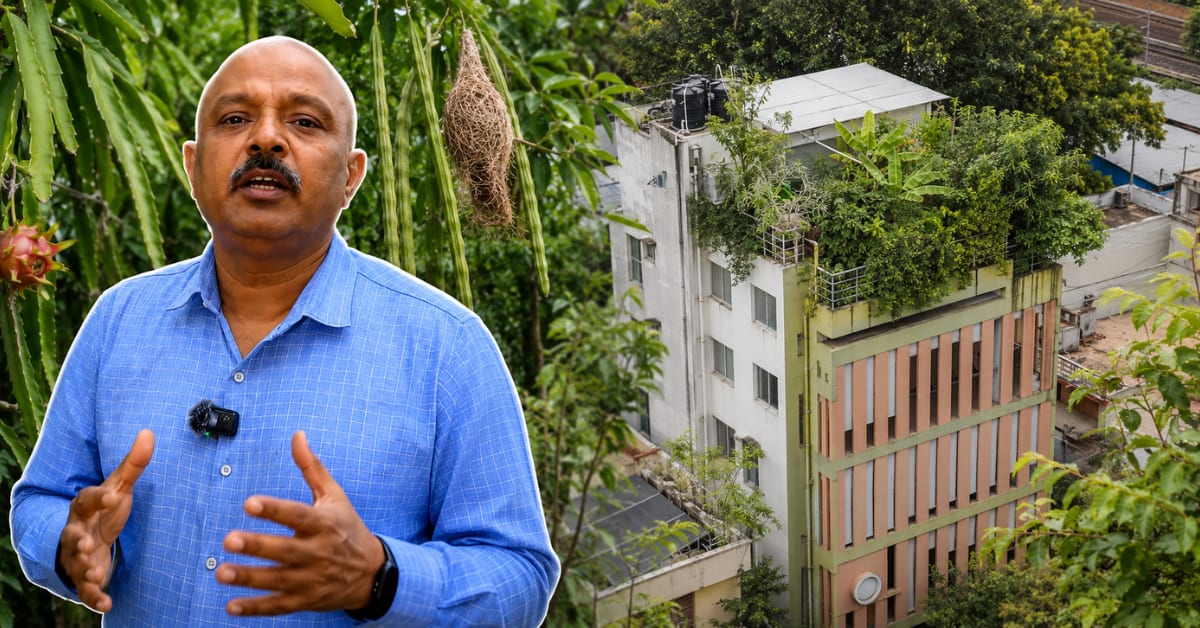
Engineer Grows 100+ Plant Rooftop Forest in Bengaluru
While monsoon storms topple trees across Bengaluru each year, a 600-square-foot terrace forest with over 100 plant species stands firm. Mechanical engineer Venkataraman designed his rooftop like a natural forest floor, where interconnected roots create a network strong enough to weather the worst storms.
📺 Watch the full story above
While monsoon rains flood Bengaluru streets and knock down thousands of trees citywide, one rooftop forest keeps standing strong through every storm.
Mechanical engineer Venkataraman built a 600-square-foot ecosystem on his terrace featuring over 100 varieties of fruits, vegetables, and medicinal plants. Coffee, vanilla, cherries, dragon fruit, drumstick trees, pepper vines, and native greens all grow together in a dense, layered network.
The secret? He designed it to function like a real forest, not a collection of separate potted plants.
"The strength of a forest lies underground," Venkataraman explains. "Roots connect with one another. They support each other and create stability."
That underground network proved itself during heavy storms. The drumstick tree's roots had woven themselves around neighboring plants, locking into a shared system. Instead of standing alone against strong winds, the plants held each other in place.
It's the same principle that keeps natural forests resilient, now working five stories above the city streets.
The Ripple Effect
The terrace does far more than grow food, though it does produce two kilograms of coffee beans. Nearly 80 percent of rainwater that falls on it gets harvested, filtered, and reused instead of rushing into overwhelmed stormwater drains.
Venkataraman says the terrace lowers surrounding temperatures by three to four degrees Celsius and improves air quality by 10 to 12 percent. Butterflies move between flowering plants. Birds settle into thick foliage. Pollinators have found a home.
The forest began as a tribute to his mother and slowly expanded into a living experiment. Architects initially discouraged the idea, warning that a rooftop forest would be too difficult to sustain and risky for the building structure.
But Venkataraman approached it like an engineer, with load calculations, water management plans, and practical improvisation. Years later, the result is a functioning ecosystem that works like infrastructure.
He believes rooftops across Bengaluru can do more than host water tanks and solar panels. They can cool homes, store rain, feed pollinators, and bring biodiversity back into neighborhoods by borrowing the logic of a forest.
In a city struggling with climate challenges, his terrace offers proof that nature, when designed to work as a system, can hold its own.
More Images
%2Fenglish-betterindia%2Fmedia%2Fmedia_files%2F2026%2F06%2F25%2Fforest-2026-06-25-18-16-37.png)

%2Ffilters%3Aformat(webp)%2Fenglish-betterindia%2Fmedia%2Fmedia_files%2F2026%2F06%2F25%2Fforest-1-2026-06-25-18-25-37.png)
%2Fenglish-betterindia%2Fmedia%2Fmedia_files%2F2026%2F06%2F25%2Fsustainability-1-2026-06-25-11-56-39.png)
Based on reporting by The Better India
This story was written by BrightWire based on verified news reports.
Spread the positivity!
Share this good news with someone who needs it