James Webb Captures New Solar Systems Being Born
The James Webb Space Telescope has photographed two stunning protoplanetary disks where brand new planets are forming right now, 450 light-years away. Scientists can watch the same process that created our own Earth 4.5 billion years ago.
📺 Watch the full story above
Imagine watching the birth of another solar system in real time. That's exactly what scientists are doing with stunning new images from the James Webb Space Telescope.
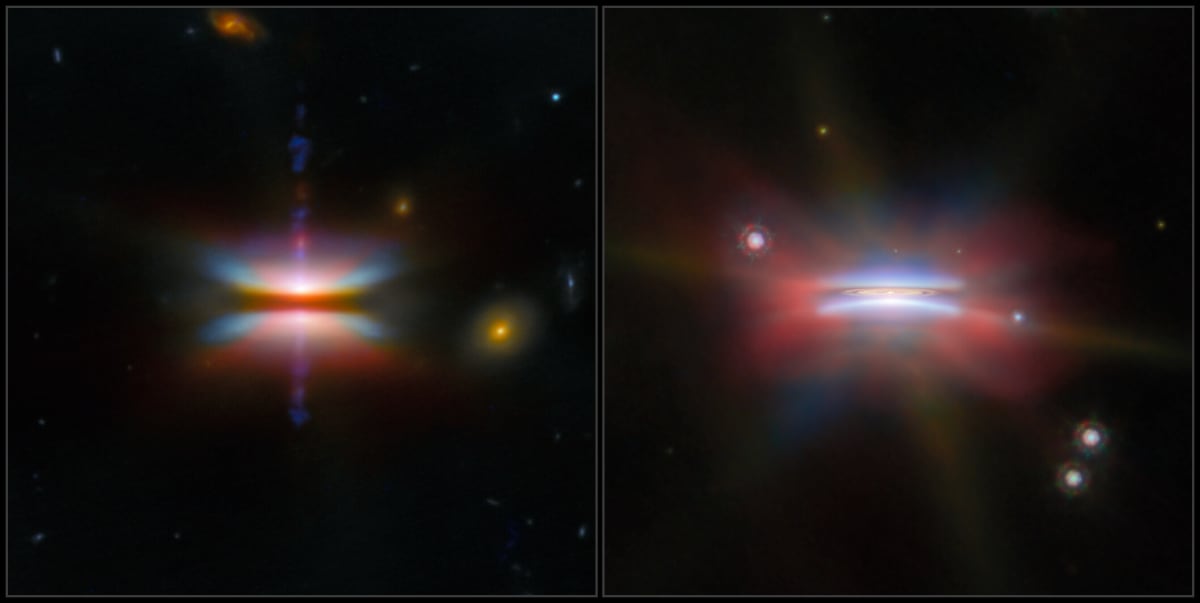
The telescope captured two extraordinary protoplanetary disks called Tau 042021 and Oph 163131, located about 450 light-years from Earth. These glowing, rainbow-colored structures spinning in space are cosmic nurseries where brand new planets are forming at this very moment.
Think of them as time machines. By observing these disks, astronomers are essentially watching a replay of how our own solar system formed 4.5 billion years ago, when Earth, Mars, and Jupiter emerged from clouds of gas and dust.
The images are breathtaking partly because of a lucky angle. Both disks are positioned edge-on to Earth, which blocks the blinding light from their central stars and reveals delicate dust clouds floating above and below.
But this isn't just about pretty pictures. The disks are invaluable laboratories for understanding how planets come to life.
The process starts with a collapsing cloud of gas that forms a young star. Leftover material swirls around it in a flat disk, where microscopic dust particles constantly collide and stick together. Over millions of years, they grow into asteroids, then planetesimals, and eventually full-sized planets.
Webb's infrared cameras can see through the thick dust that would block ordinary telescopes. The vibrant colors in the images reveal the chemical ingredients: hydrogen molecules, carbon monoxide, and complex organic compounds that could someday support life.
Why This Inspires
The most exciting discovery came from analyzing Oph 163131. Scientists found a distinct gap in the disk's inner region, which is strong evidence that a planet is already forming there. The growing world is clearing its orbital path, sweeping up dust and gas with its gravity.
This discovery shows we're not just looking at static images. We're witnessing the universe actively building new worlds that might one day harbor life.
The James Webb telescope continues proving its worth since launching in 2021. Working alongside the Hubble telescope and ground-based observatories, it's giving humanity an unprecedented view of cosmic creation in action.
These observations help scientists understand not just how planets form, but where and what types emerge. The distribution of dust in these disks determines whether a system will have gas giants like Jupiter or rocky worlds like Earth.
In just a few tens of millions of years, radiation from the young stars will blow away any remaining gas, and these disks will disappear, leaving behind complete planetary systems spinning through space.
More Images



Based on reporting by Google: James Webb telescope
This story was written by BrightWire based on verified news reports.
Spread the positivity!
Share this good news with someone who needs it