NASA's Giant Space Umbrella Could Reveal New Earths
NASA is developing a massive orbiting sunshade that teams up with ground telescopes to photograph planets like Earth around distant stars. The breakthrough could finally let us detect signs of life beyond our solar system.
📺 Watch the full story above
Imagine blocking out a star's blinding light from 50,000 miles away so perfectly that Earth's biggest telescopes can photograph distant planets smaller than our own.
NASA scientists just proved this wild idea could actually work. Their Hybrid Observatory for Earth-like Exoplanets uses a giant space umbrella called a starshade that creates a near-perfect shadow over ground telescopes, letting astronomers see faint planets that would normally be drowned out by their blazing suns.
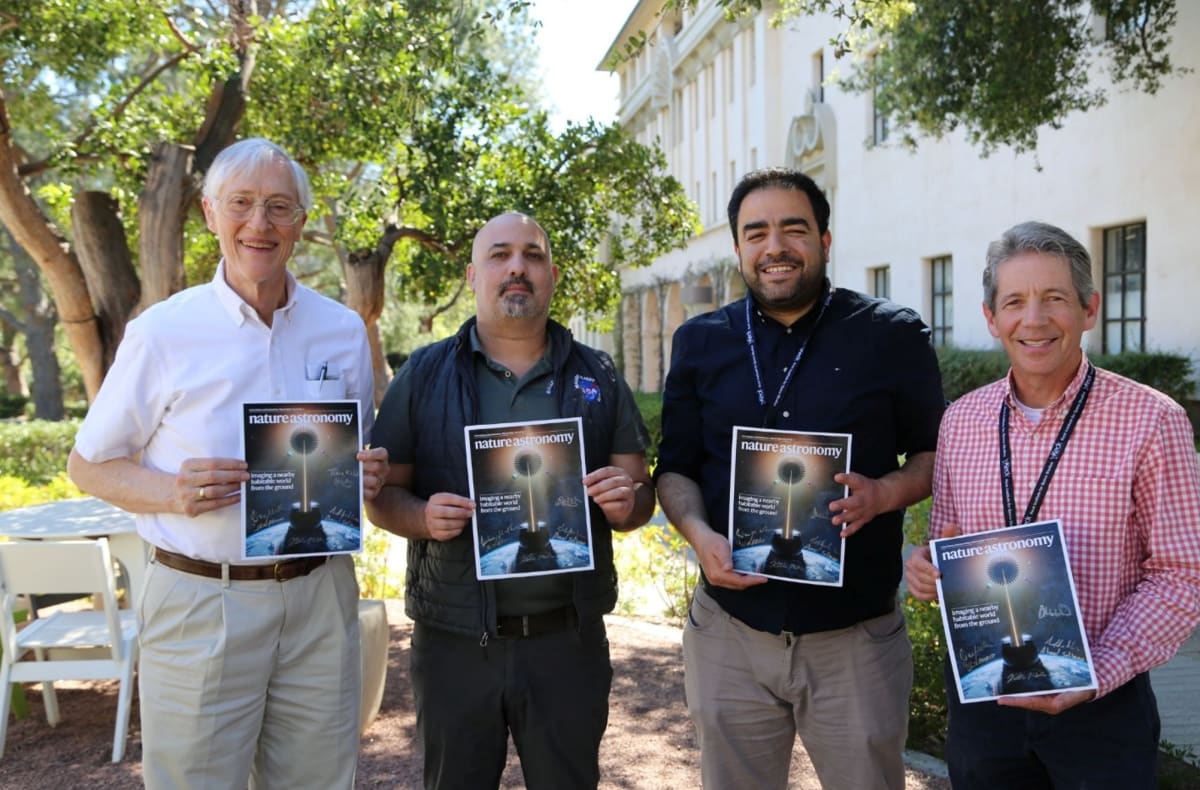
The research, featured on the cover of Nature Astronomy this month, shows the system could produce incredibly sharp images of entire planetary systems. Scientists could separate individual planets from each other, from dust clouds, and from their host stars with unprecedented clarity.
Here's why that matters. Right now, we can't easily study reflected light from distant planets, which would tell us whether they have water, oxygen, and other ingredients for life. Stars are just too bright, overwhelming our view like trying to spot a firefly next to a searchlight.
John Mather, the project's lead investigator at NASA's Goddard Space Flight Center, describes it as transformative. By suppressing starlight before it even enters Earth's atmosphere, the system could detect planets as small as dwarf planets and analyze their chemical signatures in detail.
The technology uses spectroscopy to study how matter and light interact, essentially reading the chemical fingerprints of distant worlds. That capability could identify the telltale signs of life on exoplanets billions of miles away.
The starshade concept has been around for decades, but NASA's Innovative Advanced Concepts program is now building a roadmap to make it real. The project has already received multiple awards and brought together teams from Goddard, the Jet Propulsion Laboratory, and Ames Research Center.
The Ripple Effect
This isn't just about finding new worlds. The technology could fundamentally change how we answer humanity's oldest question: Are we alone?
By combining space-based and ground-based tools, NASA is creating observation capabilities that neither could achieve alone. The approach opens doors to studying not just individual planets, but entire solar systems in the kind of detail previously reserved for science fiction.
The engineering challenges are enormous, but researchers are methodically working through each obstacle. Their recent breakthrough shows the concept isn't just theoretically possible but practically achievable with current and near-future technology.
The search for Earth's cosmic cousins just got a giant leap closer to reality.
More Images

Based on reporting by NASA
This story was written by BrightWire based on verified news reports.
Spread the positivity!
Share this good news with someone who needs it