Scientists Prove Atoms Can Exist in Two Places at Once
Australian physicists just observed pairs of atoms existing in two locations simultaneously, confirming a century-old quantum theory that seemed too strange to be true. This breakthrough could help scientists understand how the tiny quantum world connects to the vast universe.
📺 Watch the full story above
Imagine being in your kitchen and your living room at the exact same time. That's essentially what quantum physicists at the Australian National University just watched atoms do for the first time ever.
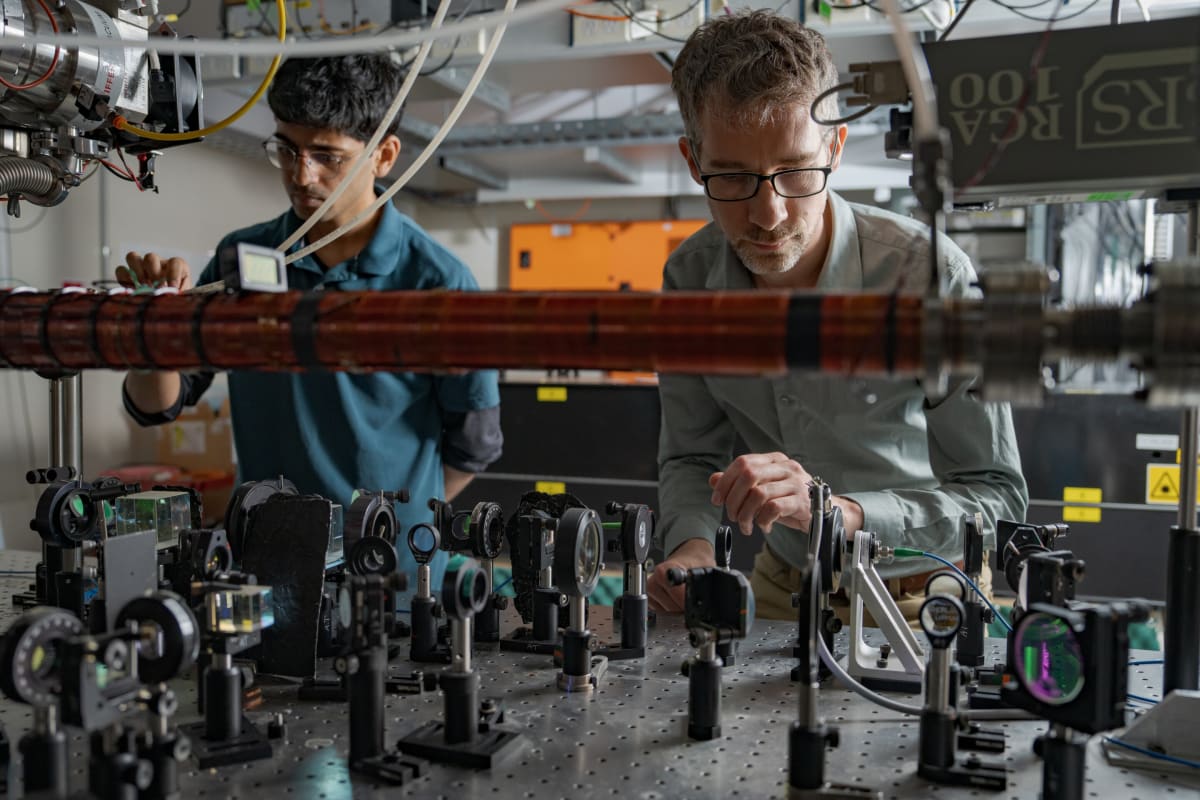
Dr. Sean Hodgman and his team successfully observed pairs of helium atoms existing in two places at once while remaining connected through quantum entanglement. "You can read about it in a textbook, but it's really weird to think that a particle can be in two places at once," Hodgman says.
This isn't just a parlor trick with light particles. Previous experiments used photons, which are weightless bits of light. But helium atoms have mass and gravity affects them just like it affects us. That makes this breakthrough profoundly more significant for understanding our universe.
Ph.D. researcher Yogesh Sridhar, who led the study, explains why this matters: "Experimentally, it's extremely hard to demonstrate this. Several people have tried in the past to show these effects, and they have always come short."
The team's success opens new doors for exploring one of science's biggest mysteries. How does quantum mechanics, which governs the tiniest particles, interact with gravity and general relativity, which govern galaxies and black holes?
Why This Inspires
For over a century, physicists predicted that matter could be in multiple locations simultaneously and interfere with itself across those locations. Now we've finally seen it happen with our own eyes, or at least with extremely sophisticated equipment.
This confirmation brings scientists one step closer to developing a "theory of everything" that would unite quantum mechanics with gravity. Such a theory could revolutionize our understanding of reality itself, from the smallest atom to the largest cosmic structures.
The research, published in Nature Communications, represents years of painstaking work. These kinds of experiments require precision beyond what most people can imagine, with equipment cooled to nearly absolute zero and measurements more delicate than anything in everyday life.
But the payoff extends far beyond satisfying scientific curiosity. Understanding quantum mechanics at this level could eventually lead to revolutionary technologies, from quantum computers that solve problems in seconds that would take traditional computers millennia, to new ways of exploring space and understanding the origins of our universe.
The universe just got a little weirder, and that's genuinely exciting news for everyone who's ever wondered how reality really works.
More Images
Based on reporting by Google News - Science
This story was written by BrightWire based on verified news reports.
Spread the positivity!
Share this good news with someone who needs it