Tesla Runs Dry in Desert, Solar Panels Save the Day
When a YouTuber's Tesla died in Chile's Atacama Desert with no charger in reach, he did something impossible with a gas car: pulled power from the sun. His emergency solar panels trickle-charged just enough range to survive until help arrived.
📺 Watch the full story above
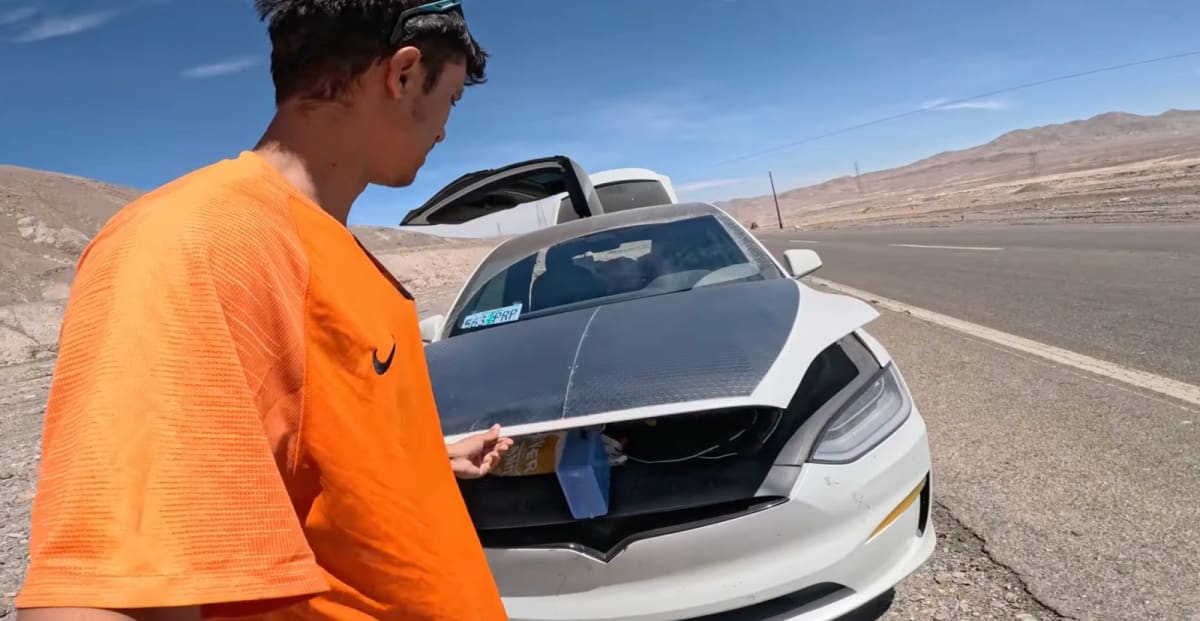
When Sandro van Kuijck's Tesla Model X hit zero range in the middle of the Atacama Desert, he had a backup plan no gas car could match: sunlight.
The Oregon-based creator has spent three years driving his customized Tesla from northern Canada to the southern tip of South America. He calls the SUV "Beluga," and it's his home on wheels, complete with a kitchen, bed, and a crucial add-on: a 287-watt solar panel on the hood.
That panel became a lifeline south of Calama, Chile. Van Kuijck had charged to 95% at a fast charger but underestimated the energy drain from climbing to 3,000 meters elevation against desert headwinds. When his range dropped to 37 kilometers with the nearest charger 42 kilometers away, he pulled over and deployed his solar setup.
The math was humbling but real. At 180 to 200 watts of solar input, his Tesla gained roughly one to two kilometers of range per hour. That's nowhere near enough to drive anywhere quickly, but it kept the high-voltage battery from shutting down completely.
Five tow companies refused to drive out to his remote location. His backup house battery drained to zero as temperatures soared.
Then a road construction crew working nearby became the unexpected heroes of his journey. They let him plug into their industrial generator, feeding just enough power to keep the battery alive. Van Kuijck eventually arranged a tow truck for $135 to reach the nearest Copec fast charger 30 kilometers away.
Why This Inspires
This story captures something unique about electric vehicles that often gets lost in range anxiety debates. When you run out of gas in a desert, you're completely stuck waiting for someone to physically bring fuel. But with an EV and solar panels, you can literally summon energy from the sky.
Van Kuijck's solar setup wasn't designed to charge his car for serious travel. It powers his refrigerator, cooktop, and lights while living on the road. But in an emergency, that same sun-powered system became a genuine lifeline, buying him time and keeping critical systems online.
The incident also highlights real progress happening in South America. Chile launched its first Tesla Supercharger network in late 2024 and partnered with Copec to expand charging stations across major highways. The country aims to allow only electric vehicle sales starting in 2035.
The infrastructure isn't there yet for every remote highway, but it's growing fast. And unlike traditional fuel infrastructure, EV charging can happen anywhere the sun shines, even if it's just a trickle.
Van Kuijck is still on the road, heading south toward Ushuaia with lessons learned and solar panels ready for whatever comes next.
More Images


Based on reporting by Electrek
This story was written by BrightWire based on verified news reports.
Spread the positivity!
Share this good news with someone who needs it