Webb Telescope Spots Galaxy 280M Years After Big Bang
NASA's James Webb Space Telescope confirmed the most distant galaxy ever observed, shining brightly just 280 million years after the universe began. The discovery is rewriting what scientists thought they knew about how quickly galaxies formed in the early cosmos.
📺 Watch the full story above
Scientists just confirmed they've spotted a galaxy that formed when our universe was barely a toddler, and it's challenging everything we thought we knew about cosmic history.
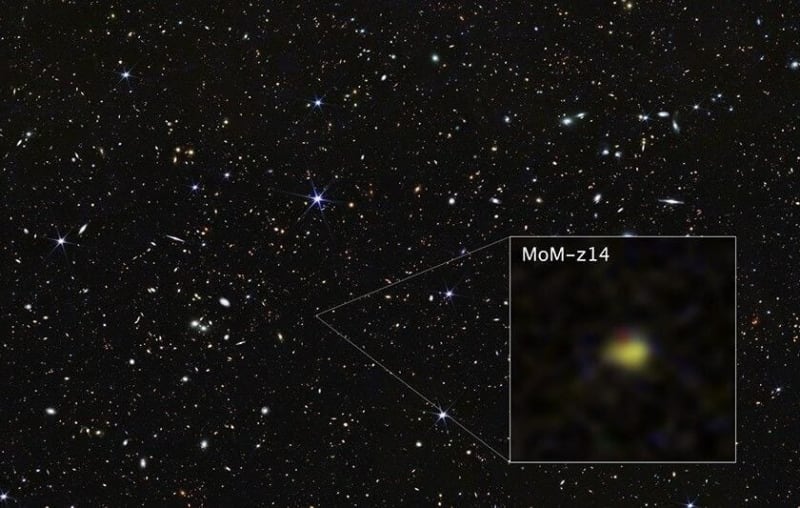
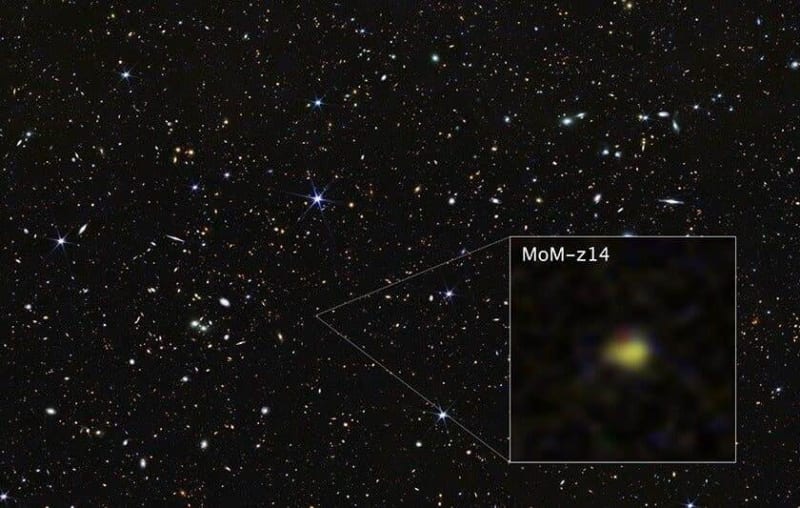
NASA's James Webb Space Telescope validated the existence of MoM-z14, a galaxy that emerged just 280 million years after the Big Bang. Light from this distant galaxy has traveled nearly 13.5 billion years to reach us, making it the farthest confirmed object humans have ever observed.
"Using JWST has enabled us to see much farther back into the ancient past than we are capable of doing here on Earth, and yet what we see does not correspond to anything we had anticipated," said Rohan Naidu from MIT's Kavli Institute for Astrophysics and Space Research, who led the study. The data is both exciting and perplexing for astronomers worldwide.
The surprise isn't just how far away MoM-z14 is. It's how bright and active this early galaxy appears to be.
Before Webb launched, most scientists predicted galaxies from the first 500 million years would be faint or barely detectable. Instead, Webb keeps finding bright, luminous galaxies that are about 100 times more abundant than models predicted.
MoM-z14 is relatively tiny, only about 74 parsecs in diameter, roughly the size of a modern dwarf galaxy. Yet it's pumping out stars at an incredible rate, with about 100 million solar masses worth of material undergoing rapid star formation.
The galaxy's chemical makeup offers even more clues about the universe's infancy. MoM-z14 shows significant nitrogen enrichment, a feature rarely seen in nearby galaxies but detected in a handful of other ancient objects.
This unusual chemistry suggests the early universe may have formed supermassive stars that produced heavy elements far faster than current theories allow. Alternatively, the high density of star clusters during this period might have created entirely new chemical patterns we're only beginning to understand.
Why This Inspires
This discovery represents more than just a record-breaking observation. It's proof that human ingenuity can peer back through time to witness the universe's first chapters.
Every ancient galaxy Webb discovers helps scientists understand how the cosmos evolved from a dark, simple place into the rich tapestry of stars, planets, and eventually life we see today. The fact that these early galaxies are brighter and more complex than expected means the universe got interesting far sooner than anyone imagined.
The team's findings, published in the Open Journal of Astrophysics, also shed light on cosmic reionization, the moment when starlight cleared away the dense hydrogen fog filling space. MoM-z14's spectrum suggests its neighborhood was already partially ionized, offering direct evidence of this transformative era.
These ancient galaxies serve as cosmic fossils, preserving clues about conditions that no longer exist anywhere in the modern universe. By studying them, scientists can test fundamental theories about physics, chemistry, and the nature of matter itself.
The universe is revealing its secrets one photon at a time, and we're finally equipped to listen.
More Images



Based on reporting by Google: James Webb telescope
This story was written by BrightWire based on verified news reports.
Spread the positivity!
Share this good news with someone who needs it