World's Largest Electric Plane Flies for 27 Minutes
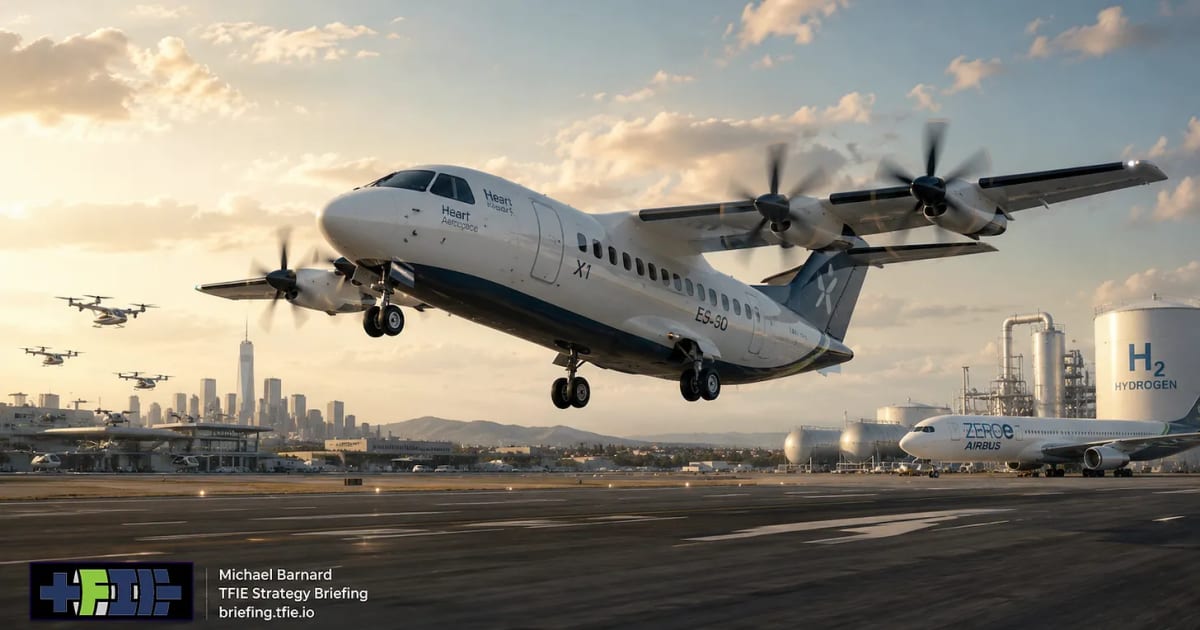
A Swedish company just flew the world's largest battery-electric plane, proving clean aviation can work on regular routes between real airports. Instead of inventing flying taxis or hydrogen dreams, they're solving climate change with technology that can actually scale.
📺 Watch the full story above
On August 12, a plane with a 106-foot wingspan lifted off from Plattsburgh International Airport and flew for 27 minutes on battery power alone. The aircraft weighed over 25,000 pounds and drew more than a megawatt at peak, making it the largest battery-electric plane ever flown.
But the real breakthrough isn't the record. It's what the flight represents for the future of flying.
Heart Aerospace, the Swedish company behind the X1 demonstrator, isn't trying to reinvent transportation. They're electrifying planes that fly routes people already take, using airports that already exist, serving passengers who already want to get from point A to point B. It's less flashy than flying taxis, but it's far more likely to actually happen.
The aviation industry has poured roughly $12 billion into futuristic flying taxi projects over the past decade. Boeing invested $450 million in one company. Hyundai backed another with at least $1 billion. Several have already gone bankrupt, and none have solved the basic question: will enough people pay enough money, often enough, to justify building an entirely new transportation system?
Heart took a different approach. Regional airlines already fly millions of passengers on short routes every year. If batteries can power those flights, the infrastructure is already there. No new airports needed. No waiting for hydrogen fuel stations or urban landing pads that may never come.
The company's production plane, the ES-30, won't enter service until 2031. Major hurdles remain: battery improvements, certification, manufacturing scale, and proving the economics work for airlines. But these are the kinds of problems that money and engineering can solve, not fundamental questions about whether anyone wants the product.
The Ripple Effect
Electric aviation won't replace every flight. Long-haul routes will still need energy-dense liquid fuels, probably sustainable biofuels. But regional flights, the bread and butter of domestic air travel, could run on batteries within a decade.
The shift matters because aviation accounts for about 2.5% of global carbon emissions, a number that's been growing. Short regional flights are also the least efficient, burning disproportionate fuel for takeoff and landing. Those are exactly the routes where electric planes make the most sense.
Heart's approach shows what real climate progress looks like: not waiting for perfect technology, but improving what already works. Every regional flight powered by batteries instead of jet fuel is a win, even if transatlantic flights take longer to solve.
The X1 flight proved something simple but profound: you can build a full-size electric plane that actually flies. Now comes the hard part of making it affordable and reliable enough for everyday use. That's exactly the kind of challenge worth billions in investment.
More Images
Based on reporting by CleanTechnica
This story was written by BrightWire based on verified news reports.
Spread the positivity!
Share this good news with someone who needs it