1,000-Year-Old Himalayan Homes Survive Without Cement
In remote Himachal Pradesh villages, ancient wooden houses built without a single drop of cement are teaching modern engineers how to survive earthquakes. Now a new generation is racing to save this disappearing wisdom.
While concrete buildings crumbled during massive Himalayan earthquakes, thousand-year-old homes in India's mountain villages stood firm without a crack.
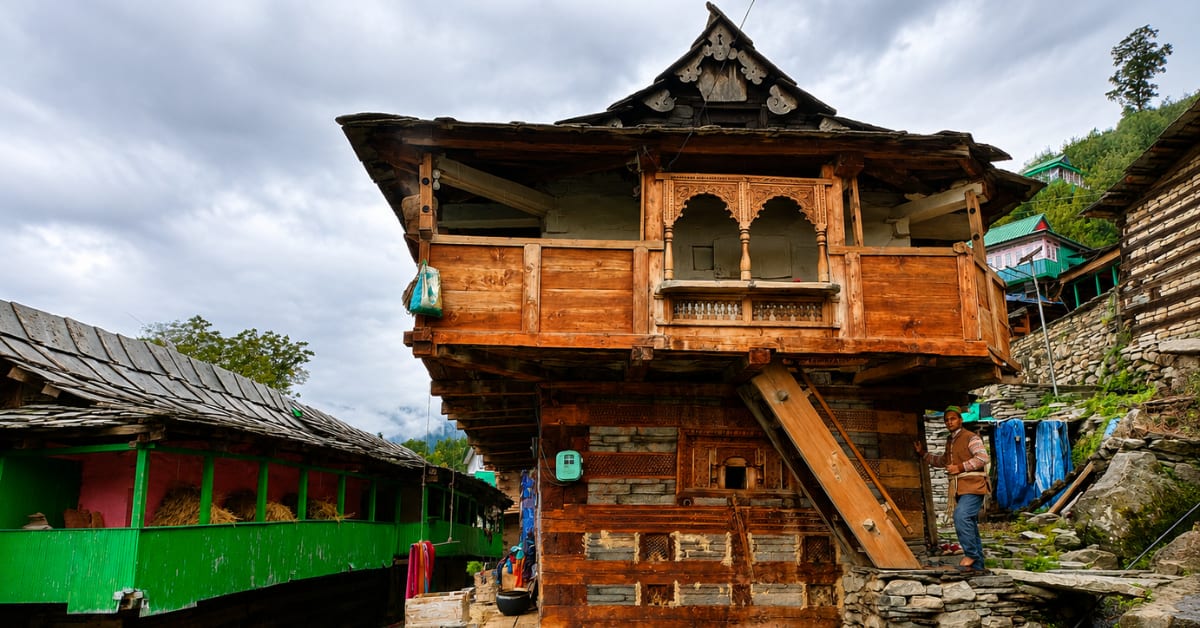
The secret is Kath-Kuni, an ancient building technique from Himachal Pradesh that uses only local stone and deodar wood. No cement, no mortar, no metal fasteners of any kind.
The genius is in how the pieces fit together. Builders stack layers of rough stone between horizontal wooden beams, locking them at corners with wooden pegs called kadil joints. The weight and friction hold everything in place.
When an earthquake hits, the structure sways like a tree instead of snapping like a rigid concrete frame. During the devastating 1905 Kangra earthquake, Kath-Kuni houses in Kullu Valley remained standing while modern buildings collapsed around them.
The climate control is just as impressive. Cattle live on the ground floor, and their body heat rises to warm the living spaces above. Upper floors cantilever outward to capture maximum sunlight in winter. The homes stay warm without electricity and naturally ventilated in summer.
The 350-year-old Chehni Kothi tower stands 12 stories tall, built entirely with this method. No one alive today knows exactly who designed it, but it still hasn't needed repairs.
The problem is that this knowledge lives only in the minds of master craftsmen called Tavus, passed down through years of apprenticeship. As young people leave villages for cities and cheap concrete becomes available everywhere, fewer are learning the craft.
The Ripple Effect
Rahul Bhushan, an architect who returned to his home in Kullu Valley, is changing that through his organization NORTH. He runs hands-on workshops where young builders learn directly from aging Tavus, preserving techniques that took generations to perfect.
His own homestay, constructed from reclaimed wood salvaged from abandoned Kath-Kuni houses, proves the method works beautifully for modern living. A Delhi couple followed his lead, building a Kath-Kuni homestay in Sainj Valley within the Great Himalayan National Park.
INTACH has begun documenting heritage structures across Himachal Pradesh before the knowledge disappears entirely. Each restoration trains new craftspeople in methods their grandparents knew by heart.
The most earthquake-resistant buildings in one of Earth's most seismically active regions were built with nothing but wood, stone, and deep understanding of the mountain.
More Images
%2Fenglish-betterindia%2Fmedia%2Fmedia_files%2F2026%2F06%2F12%2F2-2026-06-12-14-29-57.png)


%2Ffilters%3Aformat(webp)%2Fenglish-betterindia%2Fmedia%2Fmedia_files%2F2026%2F06%2F12%2F4-2026-06-12-14-31-02.png)
Based on reporting by The Better India
This story was written by BrightWire based on verified news reports.
Spread the positivity!
Share this good news with someone who needs it