11th-Century Indian Stepwell Restored After $180K Revival
A hidden 11th-century stepwell covered in serpent carvings has been brought back to life in Karnataka, India, after decades buried under roots and rubble. The $180,000 restoration connects a modern community to an ancient water tradition that once defined their town. #
In the small town of Sudi, Karnataka, stone steps now descend into a world that was hidden for generations.
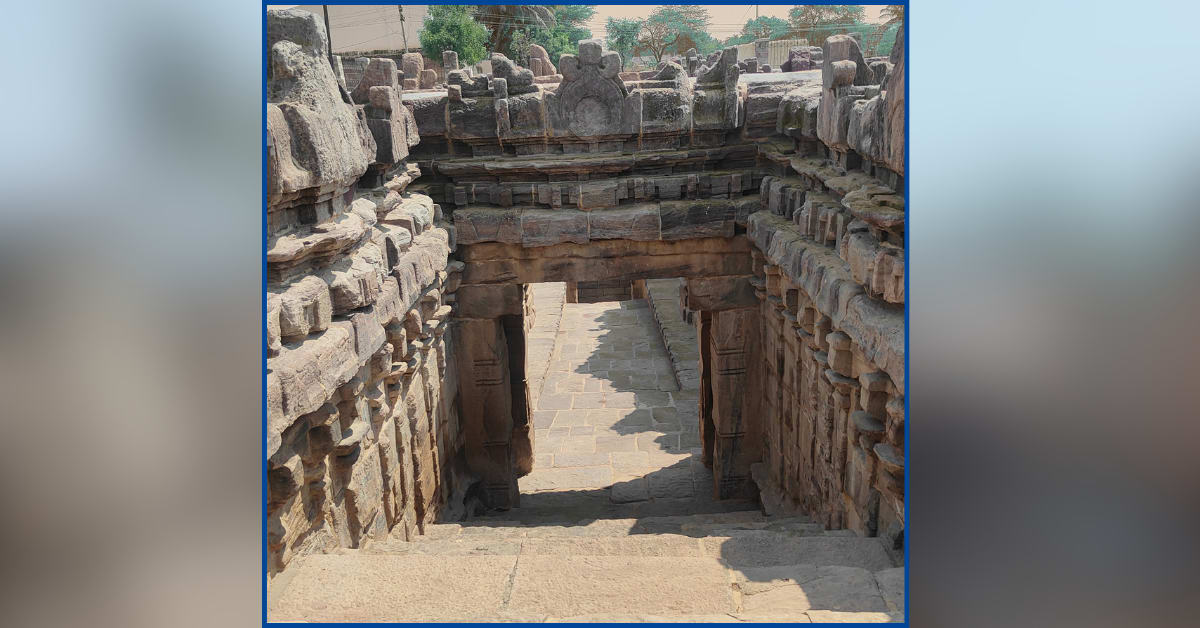
Nagakunda, an 11th-century stepwell built during the Kalyani Chalukya dynasty, spent decades buried under vegetation and debris. Its walls are carved with nagas, serpent figures whose coiled forms wind through the sandstone like frozen water.
Today, visitors can walk those steps again. The air grows cooler with each descent into the stone-lined structure, just as it did a thousand years ago when this architectural marvel served as the heart of community life.
The Deccan Heritage Foundation led the $180,000 restoration under Karnataka's Adopt a Monument program. Philanthropist Rajashree Pinnamaneni funded the entire project, continuing her mission to save India's forgotten stepwells.
"When I first visited in October 2024, I was completely captivated by their beauty," Rajashree recalls. She has already restored stepwells in Hyderabad and Khammam, treating these ancient water structures as living heritage worth protecting.
The restoration began in early 2025, employing local workers who carefully reset stones using traditional lime mortar mixed with jaggery and local stone dust. The team documented every detail using modern survey technology while respecting ancient construction techniques.
The original builders used "paper joints" with almost no visible gaps, a level of precision that astonished the conservation architects. Heavy stone blocks required custom-engineered rigs to lift after bamboo scaffolding proved too weak.
Sudi was once a provincial capital where stepwells did more than store water. They supported ritual practices, demonstrated engineering prowess, and created cool gathering spaces in the heat.
The serpent carvings give Nagakunda its name and sacred character. Unlike the geometric stepwells of northern India, Chalukyan stepwells blended sculpture, function, and religious meaning into single structures.
Local residents contributed to the restoration by returning historic stones their families had collected over generations. Conservation teams assessed each piece for authenticity before integrating them back into the complex.
The Ripple Effect
The restoration has reconnected Sudi to its past in tangible ways. New landscaped pathways now link Nagakunda to the nearby Jodakalasa Temple, recreating an ancient sacred route that once defined the town's spiritual geography.
The revived stepwell also functions as intended. Groundwater flows again through the system, and the breathable stone joints allow natural percolation instead of sealing the structure in modern waterproofing that would damage its original purpose.
Dr. Helen Philon, founder of the Deccan Heritage Foundation, frames the work simply: "Nagakunda is a living water body. Restoring it meant restoring community life."
For Rajashree, this is just the beginning. "Wherever the opportunity arises, I am committed to taking on the restoration and upkeep of stepwells across India," she says.
The 4,502-square-meter complex now stands as proof that ancient infrastructure can serve modern communities when we choose to protect it.
#
More Images
%2Fenglish-betterindia%2Fmedia%2Fmedia_files%2F2026%2F05%2F11%2Ffeatured-img-2026-05-11-09-39-15.png)
%2Ffilters%3Aformat(webp)%2Fenglish-betterindia%2Fmedia%2Fmedia_files%2F2026%2F05%2F11%2Fimg20260308104537_11zon-2026-05-11-10-45-25.jpg)

%2Ffilters%3Aformat(webp)%2Fenglish-betterindia%2Fmedia%2Fmedia_files%2F2026%2F05%2F11%2Fimg20260308104558_11zon-2026-05-11-10-46-18.jpg)
Based on reporting by The Better India
This story was written by BrightWire based on verified news reports.
Spread the positivity!
Share this good news with someone who needs it