150 Farmers Patrol All Night to Protect Elephants and Crops
In India's Katarniaghat forests, over 150 farmers work a second shift after dark, keeping both elephants and villages safe. Their volunteer network has cut crop damage by 70% while protecting ancient migration routes.
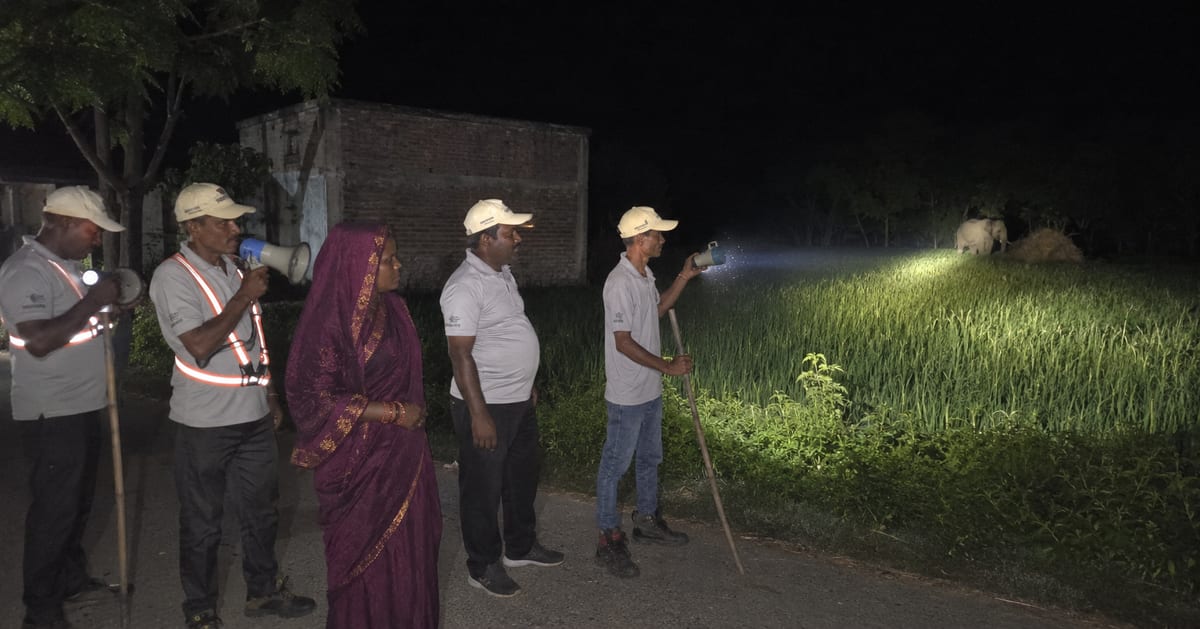
Every night at 10:30 pm, when most farmers are settling in for sleep, Suresh Kumar is just starting his second shift. He pulls on a reflective jacket, tests his torch, and heads to the forest edge where elephants are already on the move.
Kumar is one of 150 Gajmitras, trained volunteers who patrol the borderlands between Uttar Pradesh's Katarniaghat forests and human settlements. Their mission isn't to drive elephants away but to make sure both species survive the night safely.
The villages sit along ancient elephant migration routes connecting India's Dudhwa Tiger Reserve with Nepal's Bardia National Park. Between 50 and 150 wild elephants cross this transboundary corridor regularly, following paths their ancestors have used for generations.
Elephants never forget these routes, thanks to a large hippocampus that stores spatial memories for decades. But those same paths now cut through sugarcane fields and villages that didn't exist when the routes were first established.
The Uttar Pradesh Forest Department and Nature Environment & Wildlife Society launched the Gajmitra program in 2021. Local farmers from vulnerable villages received year-long training in elephant behavior, conflict mitigation, and safe response protocols.
Now teams of five disperse across border villages each night. Two volunteers climb watchtowers overlooking likely elephant routes while others patrol fields where fresh footprints appeared the evening before.
They carry whistles, megaphones, and handheld sirens, not weapons. When elephants approach, the teams communicate instantly, alerting the Forest Department and nearby residents while giving the animals space to pass through safely.
The Ripple Effect
The patient approach is working. Crop damage has dropped nearly 70% over the past year, protecting both farmer livelihoods and elephant lives.
No elephants have needed tranquilization or capture here. The Gajmitras have shown that observation, coordination, and patience work better than confrontation.
Some nights they're home before midnight. Other nights they stay awake until sunrise, tracking herds moving through fields just meters from the forest edge.
These farmers understand something crucial about coexistence. The elephants aren't invaders but original residents following routes older than any village boundary.
By protecting those ancient pathways while safeguarding their own fields, the Gajmitras are proving that humans and wildlife can share the same landscape when communities lead the solution.
More Images
%2Fenglish-betterindia%2Fmedia%2Fmedia_files%2F2026%2F08%2F07%2F99211591-bde7-4959-90a9-91d105b7605f-2026-08-07-20-06-33.png)
%2Fenglish-betterindia%2Fmedia%2Fmedia_files%2F2025%2F11%2F20%2Fwild-at-heart-banner-image-microsite-banner-2025-11-20-16-17-04.jpg)
%2Ffilters%3Aformat(webp)%2Fenglish-betterindia%2Fmedia%2Fmedia_files%2F2026%2F08%2F07%2Felephant-katarniaghat-2026-08-07-20-14-01.png)
Based on reporting by The Better India
This story was written by BrightWire based on verified news reports.
Spread the positivity!
Share this good news with someone who needs it