2 Million Volunteers Helped UC Berkeley Hunt Alien Signals
For 21 years, millions of people donated their home computer time to search the universe for signs of intelligent life. Scientists just finished analyzing 12 billion detections, narrowing them to 100 targets worth another look.
Between 1999 and 2020, ordinary people around the world turned their home computers into a virtual supercomputer searching for alien technology.
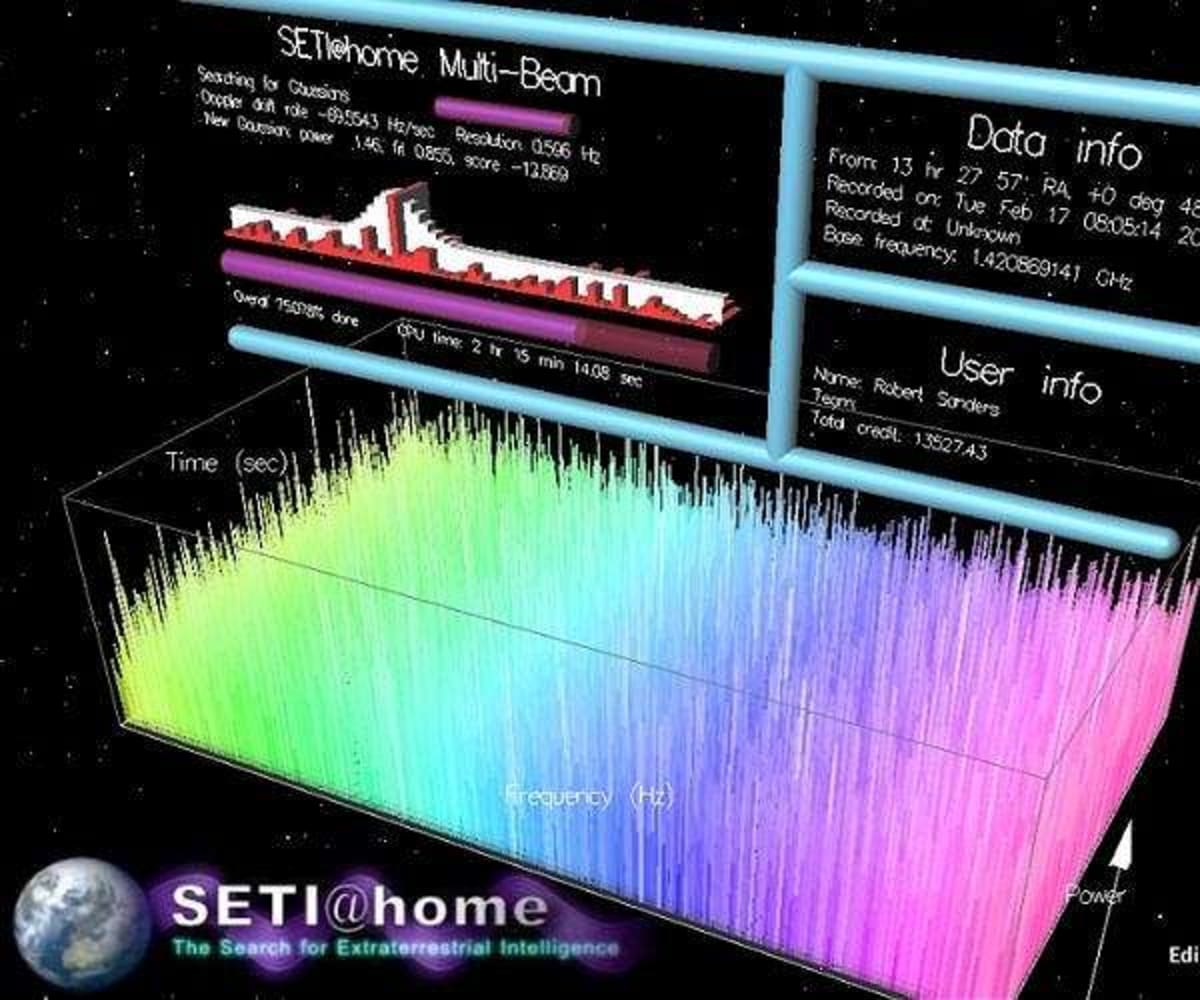
The SETI@home project started when UC Berkeley scientists wondered if 50,000 volunteers might help analyze radio telescope data. Within a year, two million people had signed up. At its peak, 235,000 computers worked together, processing signals from the massive Arecibo radio telescope in Puerto Rico.
The concept was beautifully simple. When your computer sat idle, it downloaded a small chunk of telescope recordings, searched for unusual patterns, and sent the results back to Berkeley. No special equipment needed, just a willingness to share unused processing power.
Over 14 years, the project scanned nearly the entire visible sky from Arecibo. Some areas got observed a dozen times, others hundreds or thousands. The volunteer network generated computing power that would have cost millions to build and maintain.
The computers flagged about 12 billion detections, each one a momentary spike of energy at a particular frequency from a specific sky location. Most were background noise, random fluctuations, or interference from human technology. That's exactly what scientists expected.
The real work came next. After SETI@home stopped sending new data in 2020, researchers spent another decade filtering those billions of detections. A computing cluster in Germany helped remove interference and group similar signals together.
Why This Inspires
This project proved that massive scientific challenges don't always need massive budgets. Two million volunteers, most connecting through slow dial-up modems in the early days, created one of the most powerful computing networks on Earth.
The software infrastructure outlived the original search. David Anderson built BOINC, the platform that powered SETI@home, so volunteers could donate time to other research. It now supports studies on protein folding, gravitational waves, and particle physics.
The 100 remaining targets aren't suspected alien transmitters. They're simply unusual enough to deserve another look with different telescopes and methods. That's how science works: patient, careful, honest about uncertainty.
Arecibo collapsed in 2020, the same year the project entered hibernation. But the data remains scientifically alive, and the model of millions of people contributing to something bigger than themselves continues inspiring new projects.
A global community turned curiosity about our cosmic neighbors into 21 years of real scientific work, one idle computer at a time.
More Images




Based on reporting by Google News - Science
This story was written by BrightWire based on verified news reports.
Spread the positivity!
Share this good news with someone who needs it