200-Year-Old Bamboo System Waters Meghalaya's Hill Farms
Farmers in India's Meghalaya state use a centuries-old bamboo pipe network to carry spring water downhill to crops, no electricity needed. The gravity-powered system waters plants drop by drop and proves ancient knowledge still solves modern farming challenges.
Deep in India's misty hills, farmers are keeping their crops healthy with a watering system their ancestors designed over 200 years ago. The secret ingredient is bamboo, and it works better than many modern irrigation methods.
The Khasi and Jaintia communities in Meghalaya state face a tricky problem. Their land is steep and hilly, so rainwater rushes downhill instead of soaking into the soil. Even though Meghalaya gets heavy monsoons, crops still need water during drier months.
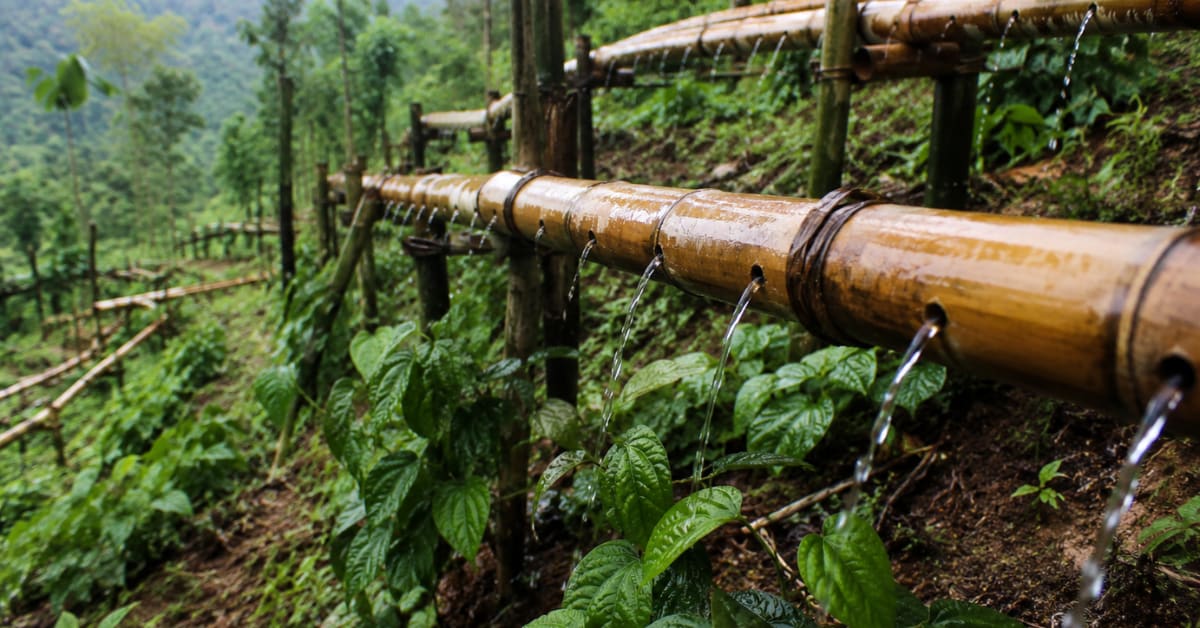
Their solution transforms local bamboo into an intricate network of natural pipes. Farmers cut bamboo stems, hollow them out by removing the inner partitions, and connect them to create channels that stretch hundreds of meters across the hillsides.
The system starts at a spring or stream higher up the mountain. Water flows into large bamboo pipes that act as main channels, then branches into smaller pipes that reach individual plants. By the time water arrives at each crop, it's slowed from 18 liters per minute to just 20 to 80 drops per minute.
This precise drip irrigation happens without pumps, electricity, or fuel. Gravity does all the work. Farmers raise the bamboo channels on forked wooden supports so they can work in fields below, and small holes control exactly how much water each plant receives.
The method works especially well for betel leaf and black pepper, which need steady moisture but hate waterlogged soil. Since water goes straight to the roots instead of flooding fields, almost nothing gets wasted.
When a bamboo section breaks or wears out, farmers simply replace it with fresh bamboo from nearby forests. The materials cost little, biodegrade naturally, and grow abundantly throughout the region.
The Ripple Effect
This bamboo system offers lessons far beyond Meghalaya's borders. As climate change makes water scarcer and farming more challenging worldwide, indigenous solutions like this show how working with nature beats fighting against it.
The system proves that innovation doesn't always mean high-tech equipment or expensive machinery. Sometimes the smartest solutions come from centuries of observation, experimentation, and respect for local ecosystems. Communities that lack modern resources often develop the most efficient methods.
Agricultural researchers now study these traditional techniques to understand how ancient knowledge can inform sustainable farming practices. The bamboo drip system uses no fossil fuels, requires no manufactured parts, and adapts easily to changing conditions.
For the farmers who maintain these networks, the system represents more than irrigation. It connects them to generations of knowledge passed down through families, and proves their ancestors were brilliant engineers who solved complex problems with simple, elegant designs.
Today, as the world searches for ways to farm sustainably on difficult terrain, Meghalaya's bamboo channels keep flowing, one steady drip at a time.
More Images
.png)
%2Fenglish-betterindia%2Fmedia%2Fmedia_files%2F2026%2F06%2F29%2Fbamboo-drip-irrigation-2026-06-29-15-21-45.png)

Based on reporting by The Better India
This story was written by BrightWire based on verified news reports.
Spread the positivity!
Share this good news with someone who needs it