Olive Ridley Turtles Navigate 20 Years to Their Birth Beach
After two decades in the ocean, Olive Ridley turtles return to the exact Indian beach where they hatched, guided by Earth's magnetic fields. Scientists are uncovering how these tiny hatchlings create a lifelong map in a single crawl to the sea.
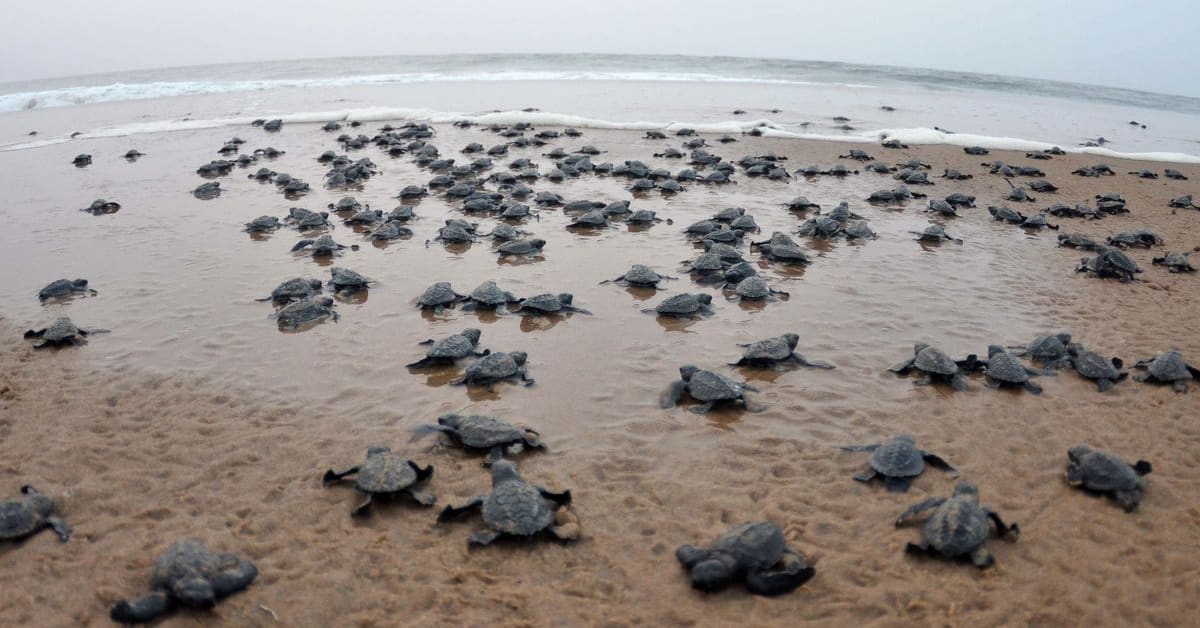
A baby turtle no bigger than your palm crawls across the sand for the first time. In those few frantic minutes reaching the ocean, it records something extraordinary: a magnetic address it will remember for 20 years.
Every year, thousands of Olive Ridley turtles emerge from the sea onto Odisha's coastline, covering beaches like Rushikulya and Gahirmatha in one of Earth's largest mass nesting events. These females have spent nearly two decades traveling thousands of kilometers through open ocean, yet they return to nest on the same stretch of coast where their lives began.
Scientists call this natal homing, and it's one of nature's most remarkable navigation systems. The strongest theory is magnetic imprinting: each point on Earth has its own magnetic fingerprint, and turtle hatchlings absorb this pattern during their first journey to the sea.
Buried 18 inches deep in sand, around 80 to 120 eggs wait 45 to 65 days before hatching. When the babies emerge and make that short but crucial crawl to the ocean, researchers believe they're recording multiple environmental markers: the Earth's magnetic field at that exact location, the chemical makeup of sand and seawater, beach slope, and nearby currents.
Then they vanish into the ocean for 15 to 20 years. The turtles grow, feed on jellyfish and crabs, and live almost entirely at sea until something pulls them back.
When it's time to nest, females detect those same magnetic cues they absorbed as hatchlings. They can sense magnetic intensity and inclination with enough accuracy to locate a specific coastline. Once closer to shore, other senses take over: each coastline carries its own chemical identity shaped by rivers, minerals, and algae, helping turtles narrow their search.
But why return at all? That beach has given life before. If the sand once protected her as an egg and gave her a safe path to the sea, it carries proof of survival. Sand temperature shapes how hatchlings develop, moisture keeps eggs from drying out, and beach slope affects how many babies reach the ocean.
Why This Inspires
India hosts the world's largest mass nesting grounds for Olive Ridleys, especially on Odisha's coast. During peak seasons, hundreds of thousands of females come ashore over just a few days in an event called arribada, Spanish for "arrival." They dig nests, lay eggs, cover them carefully, and return to sea before dawn.
Conservation efforts have grown stronger in recent years. Turtle Excluder Devices, modified fishing nets that allow turtles to escape while retaining fish, are increasingly used along India's coast. Local communities that once saw turtles as obstacles now participate in protecting nesting sites during critical seasons.
In that brief crawl from nest to ocean, a tiny turtle creates a map that lasts a lifetime, proving that even the smallest creatures carry extraordinary wisdom.
More Images
.png)
%2Fenglish-betterindia%2Fmedia%2Fmedia_files%2F2026%2F06%2F29%2Folive-ridley-2026-06-29-15-26-39.png)
%2Fenglish-betterindia%2Fmedia%2Fmedia_files%2F2025%2F11%2F20%2Fwild-at-heart-banner-image-microsite-banner-2025-11-20-16-17-04.jpg)

Based on reporting by The Better India
This story was written by BrightWire based on verified news reports.
Spread the positivity!
Share this good news with someone who needs it