2,000 Volunteers Restore 240-Million-Year-Old Giant Skeleton
Over 2,000 volunteers in Warsaw are helping scientists restore the world's largest Mastodonsaurus skeleton ever found, a 20-foot prehistoric predator from 240 million years ago. Visitors watch through glass walls as everyday people chip away at ancient rock to reveal bones no human has touched in millions of years.
Imagine being the first person in 240 million years to touch the bones of a massive prehistoric predator. That's exactly what's happening in Warsaw, where volunteers are helping scientists restore the largest ancient amphibian skeleton ever discovered.
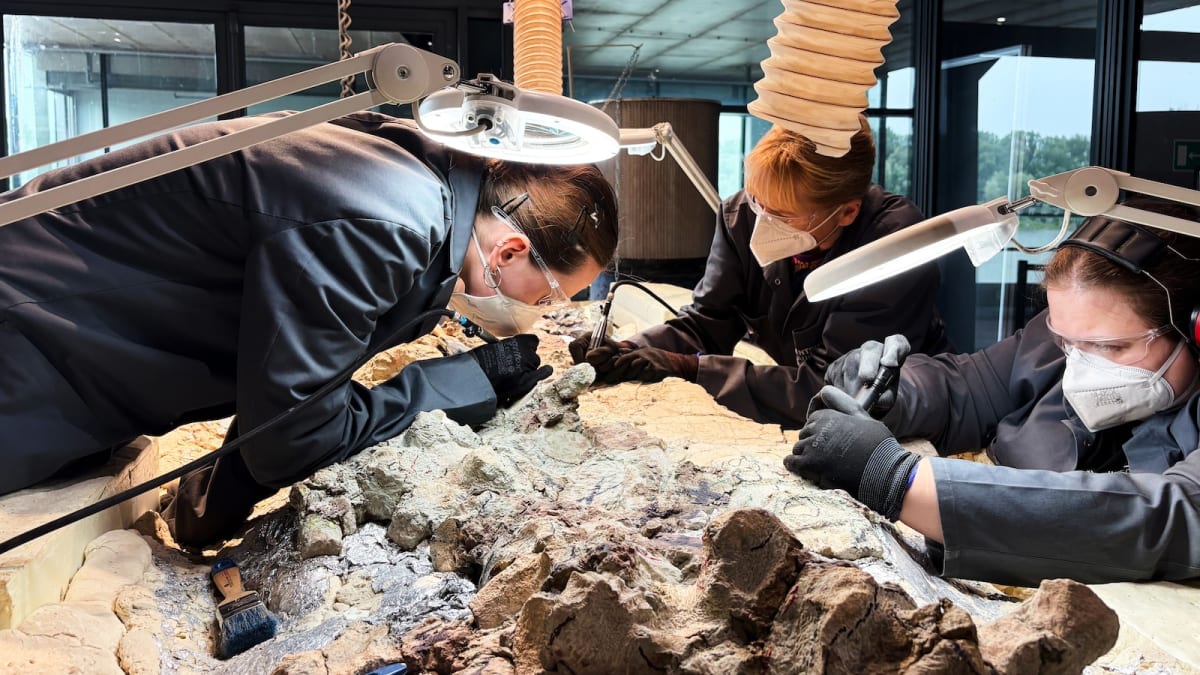
More than 2,000 everyday people have joined an extraordinary public science project at Warsaw's Copernicus Science Centre. Managers, cleaners, tattoo artists, and other non-scientists are carefully chiseling away rock to reveal the skeleton of a Mastodonsaurus, a fearsome 20-foot-long aquatic hunter that lived at the dawn of the dinosaur age.
The work happens in a glass-walled laboratory where museum visitors can watch the restoration unfold in real time. Children point excitedly while parents marvel at the creature taking shape before their eyes.
Each volunteer receives training and protective gear before beginning two-hour chiseling sessions under expert supervision. They use pneumatic chisels to break away rock millimeter by millimeter while ultraviolet light reveals where bone ends and rock begins.
"I imagine that those bones were lying underground for 240 million years and I am the first human on earth to touch them," said Tatyana Kozyk, coordinator of the volunteer teams. "I'm still trying to wrap my head around this experience."
The skeleton weighs nearly 2,865 pounds and will be the largest Mastodonsaurus ever exhibited in any museum worldwide. Polish scientists Tomasz Sulej and Wojciech Pawlak discovered it in southern Poland in 2023 and came up with the innovative idea to invite public participation in its restoration.
The Mastodonsaurus was an underwater ambush hunter that preyed on fish and smaller amphibians during the Middle Triassic period. With its broad flat head, long jaws, and sharp conical teeth, it resembled a crocodile but belonged to a different branch of the vertebrate family tree.
The Ripple Effect
This discovery is changing what scientists know about prehistoric life. "The structure of the body is different from what we knew so far," Sulej explained. Other Mastodonsaurus skeletons found in Germany and Russia measure only 6 to 10 feet long, making this Polish specimen truly extraordinary.
Dorota Serafin, a 51-year-old Warsaw manager who volunteers on the project, described the experience as "relaxing and philosophical, even mystical." She plans to return with her family when the restored skeleton goes on display this October or November.
The project offers an unexpected message of hope during uncertain times. The Mastodonsaurus thrived after Earth's largest known mass extinction, just before dinosaurs appeared. "Nature and life always find ways to survive," Sulej noted, reminding us that even after catastrophic change, life rebounds in remarkable ways.
Thousands of volunteers are proving that science belongs to everyone, one ancient bone at a time.
More Images


Based on reporting by Google: volunteers help
This story was written by BrightWire based on verified news reports.
Spread the positivity!
Share this good news with someone who needs it