Korean Team Unveils Ultrathin 2.7-Micron Battery
Imagine a microscopic battery that is safer, thinner than silk, and packs enough punch to power medical implants indefinitely. Researchers in South Korea have achieved just that by engineering an ultrathin solid-state battery using tin and carbon.
Imagine a world where life-saving medical devices inside the human body never need invasive surgery to replace a dying battery. That reassuring future moved a massive leap closer to reality thanks to an extraordinary engineering achievement in South Korea.
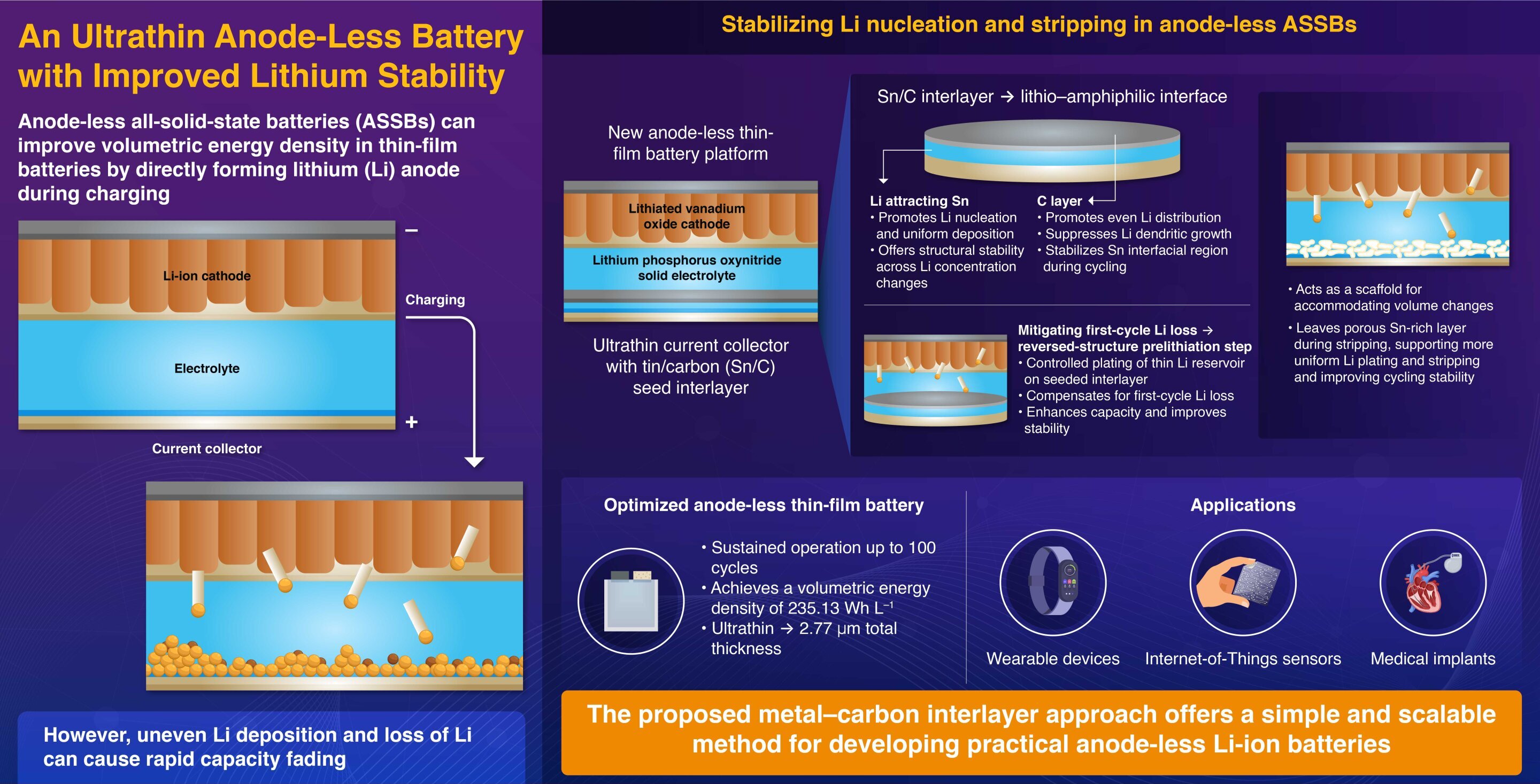
A pioneering team of materials scientists at Dongguk University has created an ultrathin, all-solid-state battery that measures an astonishing 2.77 micrometers thick. For comparison, a single strand of human hair is roughly thirty times thicker than this entire microscopic energy cell.
Led by Professor Hyun-Suk Kim, the researchers set out to solve one of the most frustrating puzzles in modern energy storage. They wanted to create a micro-battery that stores immense power in microscopic spaces without ever posing a fire hazard.
Most conventional batteries rely on volatile liquid electrolytes, which carry risks of leaks, fires, and rapid degradation over time. Solid-state batteries replace those liquids with robust solid materials, unlocking dramatic leaps in both everyday safety and raw storage potential.
However, shrinking solid-state technology down to the micro-scale has historically presented steep scientific obstacles. When engineers strip away bulky conventional anodes to save precious space, the battery must create its own working metal layer from scratch during its initial charge.
In the past, this delicate process frequently resulted in disastrous lithium loss. The energetic lithium atoms would deposit unevenly, form rogue microscopic spikes, and create disconnected pockets of dead metal that quickly drained battery capacity.
To overcome this persistent hurdle, Kim and his team spent months systematically screening combinations of metals and carbon coatings. Their exhaustive research revealed that a microscopic bilayer made from tin and carbon provided the perfect foundation for lithium to organize cleanly.
The tin layer acts as an inviting welcome mat, lowering the energy barrier so lithium atoms can nucleate smoothly and quickly. Directly above it, a protective carbon overlayer guides the incoming lithium, ensuring every atom settles into a uniform, orderly formation.
The team also introduced an ingenious prelithiation step into their manufacturing process. By depositing a slender initial reservoir of metallic lithium directly onto the collector, they effectively shielded the cell from early performance loss.
When tested in rigorous laboratory conditions, the resulting battery performed with stunning reliability. It produced a volumetric energy density of 235 watt-hours per liter at its one-hundredth cycle while maintaining smooth, stable energy delivery.
Underneath the surface, the tin and lithium naturally merged into a resilient, three-dimensional textured network. This flexible microscopic architecture accommodates swelling and shrinking during charge cycles, ensuring the components stay locked in tight contact over hundreds of hours.
The Ripple Effect
The practical impact of this microscopic breakthrough will soon touch countless corners of modern life. Because the device is virtually weightless, safe, and whisper-thin, it opens the door to an exciting new generation of micro-electronics.
Engineers can now envision painless biosensors applied directly to human skin, tracking essential health vitals without cumbersome power packs. Similarly, microscopic medical implants could monitor organs or deliver micro-doses of critical therapies indefinitely without needing dangerous battery replacement procedures.
Beyond healthcare, the design unlocks breathtaking possibilities for connected environmental sensors. Foresters and oceanographers could deploy thousands of invisible, self-contained monitors to track biodiversity, climate shifts, and wildfire risk in remote wilderness areas.
Even consumer devices stand to gain, as smart contact lenses and featherlight wearable tech become radically more practical. Furthermore, the innovative techniques developed by Kim's team demonstrate how interface engineering can make full-sized electric vehicle batteries safer and lighter too.
By guiding volatile lithium atoms with patience and precision, these researchers proved that monumental human progress often happens at the smallest conceivable scales.
With every microscopic barrier scientists dissolve, we move closer to a cleaner, safer, and endlessly powered world.
More Images
Based on reporting by Phys.org - Technology
Building Something New? Try the BrightWire Tech Stack Advisor
Compare modern frameworks, cloud hosting, and AI tools tailored to your project budget and scale.
Spread the positivity!
Share this good news with someone who needs it