2,300-Year-Old Boot Preserved Perfectly in Ice Reveals Ancient Art
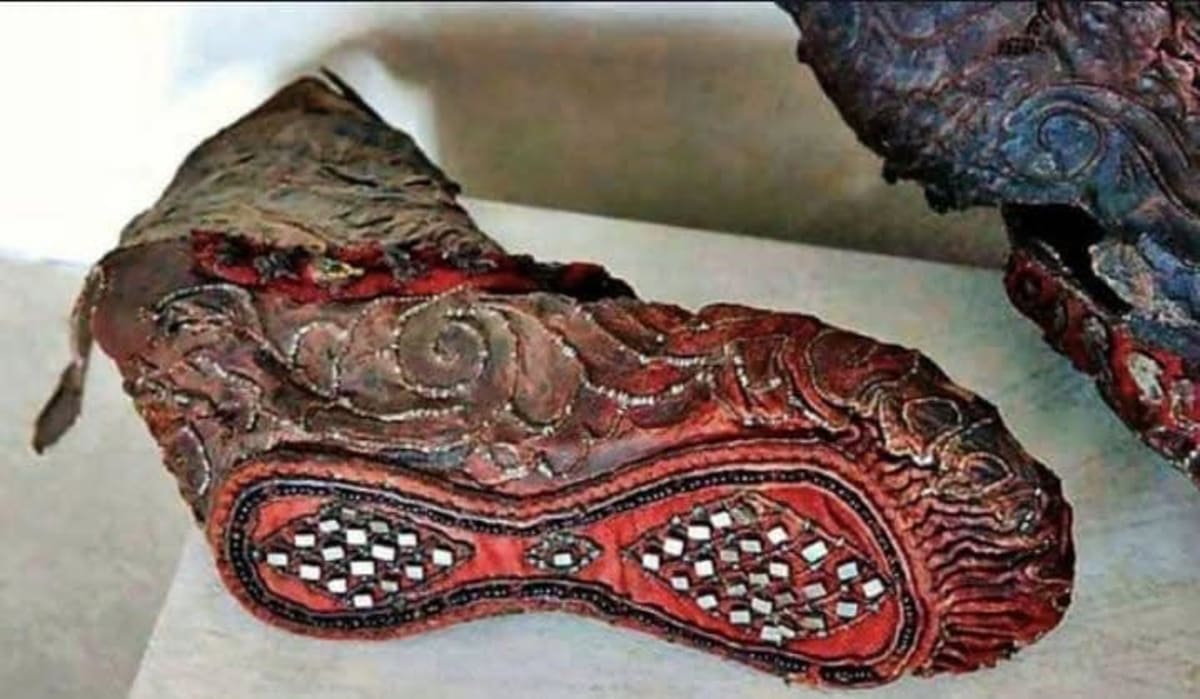
A woman's leather boot from 2,300 years ago, decorated with crystals and beads, survived frozen in Siberia's mountains. The stunning footwear reveals how skilled ancient craftspeople were and hints at how nomadic societies showed status.
A leather boot decorated with sparkling crystals and intricate beadwork sat frozen in the Altai Mountains for over two millennia, waiting to teach us something beautiful about the people who made it.
Archaeologists discovered the stunning red leather boot inside ancient burial mounds in Central Asia during the mid-20th century. It belonged to a woman from the Saka culture, nomadic peoples who roamed the Eurasian steppes around 300 BCE.
The boot shouldn't have survived at all. Leather typically decomposes within decades, but this one looks like it could have been made yesterday.
Nature provided the perfect storage system. After the woman was buried with her belongings in a wooden chamber, water seeped into the mound and froze solid in the harsh mountain climate. The permafrost acted as a natural freezer for 2,300 years, preserving the boot's shape, color, and every tiny decorative detail.
What makes this footwear extraordinary isn't just its age. The craftsmanship reveals sophisticated artistry that challenges what many assume about ancient nomadic peoples. Artisans decorated the soft red leather with black beads, gleaming pyrite crystals, metallic foil, and glass beads arranged in elaborate geometric patterns.
Here's the most fascinating part: even the sole is decorated. Intricate designs made from pyrite and dark beads cover the bottom of the boot, which historians find extremely rare in ancient footwear.
Why This Inspires
This detail opens a window into how these communities lived and interacted. Nomadic peoples often sat on the ground or knelt around campfires, meaning the soles of their boots would be visible to others nearby.
Researchers believe the decorated sole served as a status symbol. The wearer likely belonged to the tribal elite, and her footwear announced her position every time she sat among her community. Fashion and social signaling aren't modern inventions; they're deeply human.
Scholars debate whether this was everyday footwear or made specifically for burial. The boot shows minimal wear, suggesting it may have been created for the afterlife. Either way, someone cared enough to make something beautiful.
The boot now rests in Russia's State Hermitage Museum, one of the world's most famous collections. It stands as one of the most iconic artifacts from the Pazyryk culture, connecting us across millennia to people who valued beauty, skill, and community just as we do.
A frozen boot from ancient nomads reminds us that human creativity and the desire to express ourselves beautifully have always been part of who we are.
More Images



Based on reporting by Google: archaeological discovery
This story was written by BrightWire based on verified news reports.
Spread the positivity!
Share this good news with someone who needs it
%2Fhttps%3A%2F%2Ftf-cmsv2-smithsonianmag-media.s3.amazonaws.com%2Ffiler_public%2F81%2Fdd%2F81ddd40e-6ceb-4c0a-8b50-8faad9e7912c%2F3fgt4pc.jpg)

%2Fhttps%3A%2F%2Ftf-cmsv2-smithsonianmag-media.s3.amazonaws.com%2Ffiler_public%2Fcb%2Ff0%2Fcbf09863-7b51-4a6e-9146-18afe0ba8b81%2Ftomb2.png)