33-Year-Old Physicist Tackles Problems Einstein Never Solved
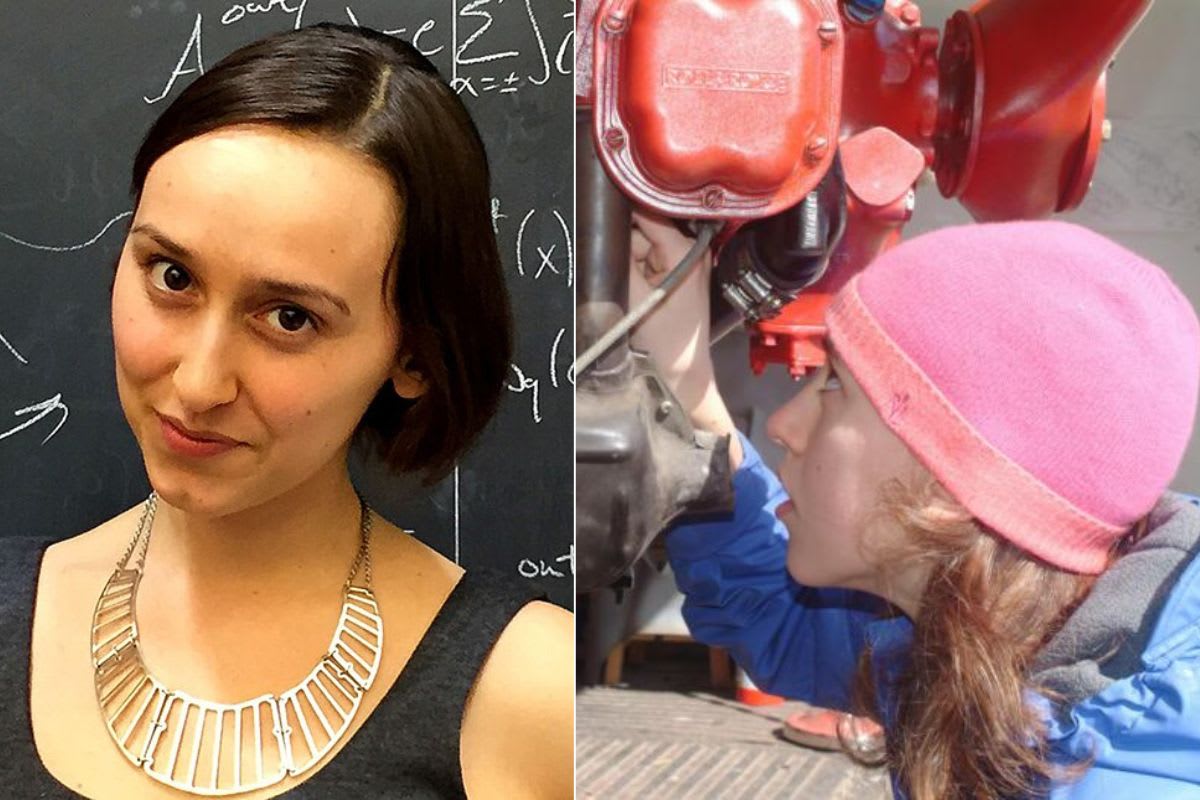
Former child prodigy Sabrina Gonzalez Pasterski is working to unite the two biggest theories in physics that have stumped scientists for decades. Her groundbreaking work on celestial holography could finally bridge quantum mechanics and general relativity.
When Sabrina Gonzalez Pasterski was 12, she didn't just dream about flying. She started building her own airplane from scratch.
By 16, the Chicago-born physicist became the youngest person ever to fly a plane she'd built herself. Jeff Bezos noticed and offered her a job at Blue Origin when she was still a teenager.
But Pasterski had bigger plans than just reaching the sky. She wanted to understand the universe itself.
She blazed through MIT in three years with a perfect 5.0 GPA, then headed to Harvard for her doctorate. While there, she made a discovery so profound that Stephen Hawking cited her work multiple times before she even graduated.
Pasterski and her colleagues discovered something called the "spin memory effect," which explains what happens when gravitational waves from colliding black holes ripple through space. When these waves pass through a region, they leave a permanent mark on the fabric of space-time itself.
Think of it like a stone dropped in a pond, except the ripples never fully disappear. They twist and warp the very structure of reality.
Now 33, Pasterski is taking on an even bigger challenge. She's working to solve a problem that stumped both Einstein and Hawking: how to unite quantum mechanics (the physics of tiny particles) with general relativity (the physics of massive things like black holes and galaxies).
For decades, these two fundamental theories haven't played well together. Pasterski thinks the answer might lie in "celestial holography," the idea that all the information in our 3D universe could be encoded on a 2D surface, like a hologram.
If she's right, it would revolutionize our understanding of reality itself.
Why This Inspires
Pasterski could easily rest on her laurels and bask in being called the "Next Einstein." Instead, she's actively rejecting that label while tackling problems even Einstein couldn't crack.
She's also using her spotlight for good. "I'm treating the spotlight as a resource, not a trophy," she told Be Giant, explaining that she wants to bring more attention and funding to physics while showing young people, especially those who don't see themselves in science, that the door is open.
Her approach to fame reveals something beautiful: she knows she's brilliant, but she's more interested in using that brilliance to advance human knowledge than to collect accolades.
When asked about being the next Einstein, her response was humble and hopeful: "He was who he was. I'm not cool. Not yet."
More Images



Based on reporting by Upworthy
This story was written by BrightWire based on verified news reports.
Spread the positivity!
Share this good news with someone who needs it