4 Indian Schools Ditch Classrooms for Trees, Farms, Mountains
From a Sikkim school reachable only by a 100-step climb to a Manipur forest where kids learn math by measuring shadows, four unconventional Indian schools are proving education doesn't need walls to work. Students are thriving with 95% attendance, 90% board exam scores, and deep connections to their communities.
In a village in Manipur, children arrive an hour early to school just because they want to be there. In Sikkim, a teacher climbs 100 steps and crosses a river to reach 18 students in one of India's most remote classrooms. These aren't struggling schools. They're thriving ones.
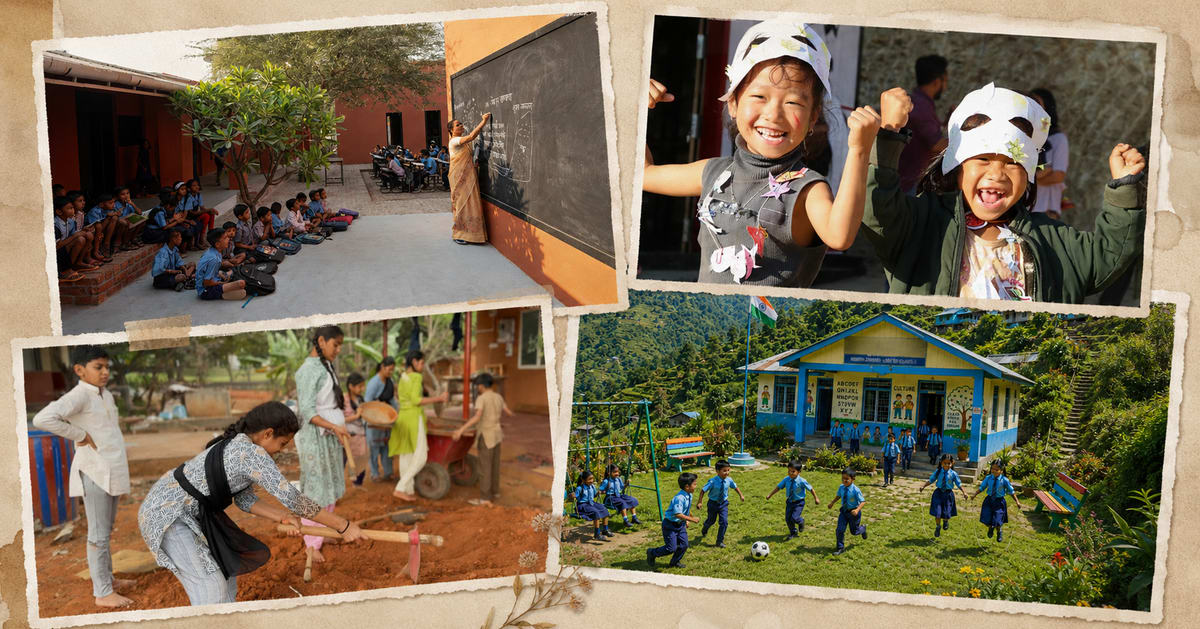
Four schools across India are rewriting what education can look like when you throw out the traditional playbook. No rows of desks. No rote memorization. Just mud, mountains, trees, and kids who actually love learning.
Kabithui Rongmei grew up in a Rongmei village where teachers rarely showed up and lessons were taught in a language kids didn't speak at home. He was sent away at six to study. Years later, he returned with educator Ananya Mukherjee to build Khaangchu, where the village itself becomes the classroom.
Children learn under trees, measure shadows to understand math, and study in their own Rongmei language. Village elders teach alongside trained educators. "When children cannot see their world in what they are learning, education slowly loses meaning for them," Kabithui says.
The results speak volumes. Attendance now sits above 95%. Children who once stayed silent now stand up and speak.
Meanwhile in Bengaluru, Muneet Dhiman was working in IT in Germany when he stopped to ask what he really wanted to do with his life. The answer was education. He and his wife returned to India, spent six years visiting 26 different types of schools, and in 2016 opened Vidyakshetra.
There are no fees, no internal exams, and no uniforms. The 157 students farm, weave on handlooms, perform Bharatanatyam, study Sanskrit, and run 300 science experiments a year. Board exam results sit between 90 and 96%. One recent graduate, Srinidhi, just got into product design at MIT Pune. "If I get some holidays in between, I will go back to school. That's how much I love the place!" she says.
Up in Sikkim's Dzongu region, Pentong village takes nearly three hours of off-road travel to reach, followed by a river crossing and those 100 steps on foot. There's no mobile network. Getting supplies in is a daily challenge.
Yet there's a proper school here with classrooms, a playground, and a government-funded hostel where 17 of the 18 students live during term time. They come from villages even more remote than Pentong. Teacher Clock Lepcha visits families door to door to make sure every child enrolls.
The Ripple Effect
These four schools aren't just teaching children differently. They're showing entire communities that education can honor local languages, traditional knowledge, and the natural world while still preparing kids for board exams and college.
At Belgaon Dhaga School in Maharashtra, architects designed the entire campus to feel like a traditional Indian village. Open courtyards replace hallways. Large windows bring in natural light and breezes. Trees are woven throughout. The walk from one room to another becomes part of the learning experience.
When schools look and feel like places children already belong, education stops being something kids endure and becomes something they choose.
More Images
%2Fenglish-betterindia%2Fmedia%2Fmedia_files%2F2026%2F07%2F04%2Ffour-indian-schools-2026-07-04-12-50-03.png)
%2Fenglish-betterindia%2Fmedia%2Fmedia_files%2F2026%2F07%2F03%2F12-2026-07-03-17-25-41.png)
%2Fenglish-betterindia%2Fmedia%2Fmedia_files%2F2026%2F07%2F03%2Fdr-cuterus-2026-07-03-18-34-18.jpg)
Based on reporting by The Better India
This story was written by BrightWire based on verified news reports.
Spread the positivity!
Share this good news with someone who needs it