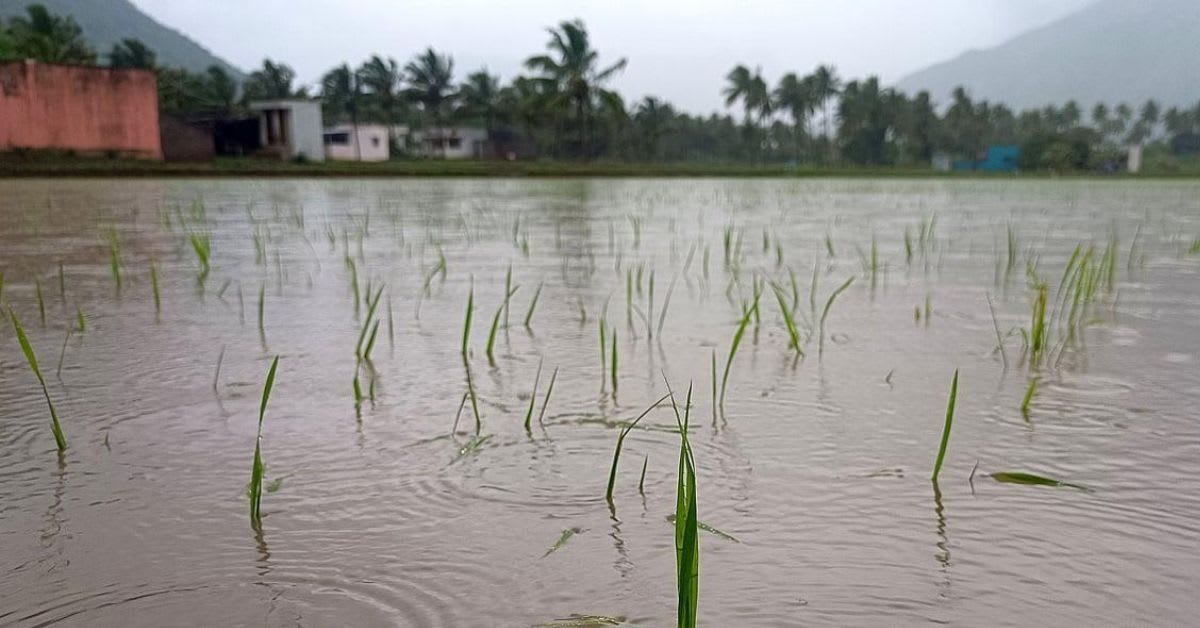
5 Indian Rice Varieties Built to Survive Extreme Floods
As climate change brings more intense rainfall, Indian farmers are turning to traditional rice varieties that can survive weeks underwater. These indigenous crops, conserved for generations, are proving that ancient agricultural wisdom might be the key to feeding communities through increasingly unpredictable monsoons.
When your farm sits below sea level or floods for weeks at a time, conventional crops simply won't cut it. But across India, farmers are rediscovering something remarkable: their ancestors already solved this problem.
Indigenous rice varieties that have been grown for generations in flood-prone regions are now drawing attention as extreme rainfall becomes more common. These aren't laboratory creations, they're crops that evolved alongside India's most challenging landscapes.
In coastal Karnataka, farmers grow Kajejaya, a red rice variety that can survive underwater for up to a week. While yields might drop during prolonged flooding, the crop survives conditions that would kill most modern varieties. For farmers facing unpredictable monsoons, that difference can mean the difference between some harvest and total loss.
Maharashtra's tribal farmer Rahibai Soma Popere has spent decades doing something that might save her community. She's conserved 48 indigenous varieties across 17 crops, including Rajbhog rice, which thrives in high rainfall. Her seed bank isn't just preserving history, it's preserving options.
Some traditional rice varieties take an even more creative approach. Deepwater rice grown in eastern India can elongate its stem as water levels rise, keeping its leaves above the surface. The plant literally grows with the flood.
In Odisha, researchers combined this wisdom with modern farming systems. They introduced flood-tolerant varieties like Hangseswari and Saraswati alongside fish farming and post-flood vegetables. Around 150 farmers in Puri district adopted the system, earning between Rs 80,000 and Rs 90,000 per hectare on land previously considered unproductive.
Then there's Kuttanad in Kerala, where farmers have been growing rice below sea level for generations. The region's specialized practices have earned recognition as a Globally Important Agricultural Heritage System. Instead of fighting the water, they learned to farm with it.
The Ripple Effect
This isn't just about saving crops. When farmers have varieties adapted to their specific conditions, entire communities become more food secure. The knowledge Rahibai Popere is preserving could help farmers across Maharashtra adapt as rainfall patterns shift. The integrated farming system in Odisha is turning previously unproductive land into thriving ecosystems that support both crops and aquaculture.
These traditional varieties carry traits scientists are now studying closely: submergence tolerance, rapid stem elongation, stronger plant architecture, and generations of adaptation to specific landscapes. Each variety represents centuries of natural selection and careful seed saving by farmers who understood their land.
As climate patterns become less predictable, crop diversity isn't just nice to have, it's essential insurance. When one variety struggles, another might thrive.
India's agricultural heritage is proving that sometimes the most innovative solution is remembering what already works.
More Images
%2Fenglish-betterindia%2Fmedia%2Fmedia_files%2F2026%2F09%2F04%2Fpaddy-in-rain-2026-09-04-18-31-14.jpg)
%2Ffilters%3Aformat(webp)%2Fenglish-betterindia%2Fmedia%2Fmedia_files%2F2026%2F09%2F04%2Fpaddy-in-rain-2026-09-04-18-32-48.jpg)
%2Fenglish-betterindia%2Fmedia%2Fmedia_files%2F2026%2F09%2F04%2Fkarnataka-wild-mango-conservation-2026-09-04-18-05-45.jpg)
Based on reporting by The Better India
This story was written by BrightWire based on verified news reports.
Spread the positivity!
Share this good news with someone who needs it