5 Women Built Businesses That Now Employ Thousands
From paper art to traditional embroidery, five women in India transformed inherited skills into thriving enterprises that now provide livelihoods for thousands of others. Their journeys show how one person's determination can create waves of economic independence across entire communities. #
When Gunavathy Chandrasekaran survived polio at age two and married at 16, few would have predicted she'd one day train over 2,000 artisans in the delicate art of paper quilling. But that's exactly what happened when this woman from Sivakasi, Tamil Nadu, taught herself to turn paper scraps into intricate art.
Through Guna's Quilling, she now sells wall art, cards, figurines and jewelry. Her trainees include women, homemakers, students and children in orphanages, many of whom she helps market their own creations. In 2015, she addressed a British Council gathering and received awards from both the Lions Club and Tamil Nadu government.
Godavari Satpute's story began with urgency. When her husband lost his job in 2009, she spotted a paper lamp at a local market and decided to make her own from home.
Banks refused her loan requests, but relatives provided small interest-free loans to get started. An organization called BYST later offered financial aid and guidance, helping her grow Godavari Akashkandil into a business that now generates over Rs 30 lakh annually and employs other women seeking financial independence.
In Telana, Assam, Sobita Tamuli had a different vision. Married as a teenager, she launched Seuji in 2002 to bring village women together making organic manure and traditional Assamese japis (hats). The organic manure uses cow dung, banana plant remains, earthworms and fallen leaves, selling for Rs 50 per 5-kg packet.
Her strategy focuses on eliminating middlemen entirely. The women handle everything from ideation and manufacturing to selling, giving them full control over their work and income.
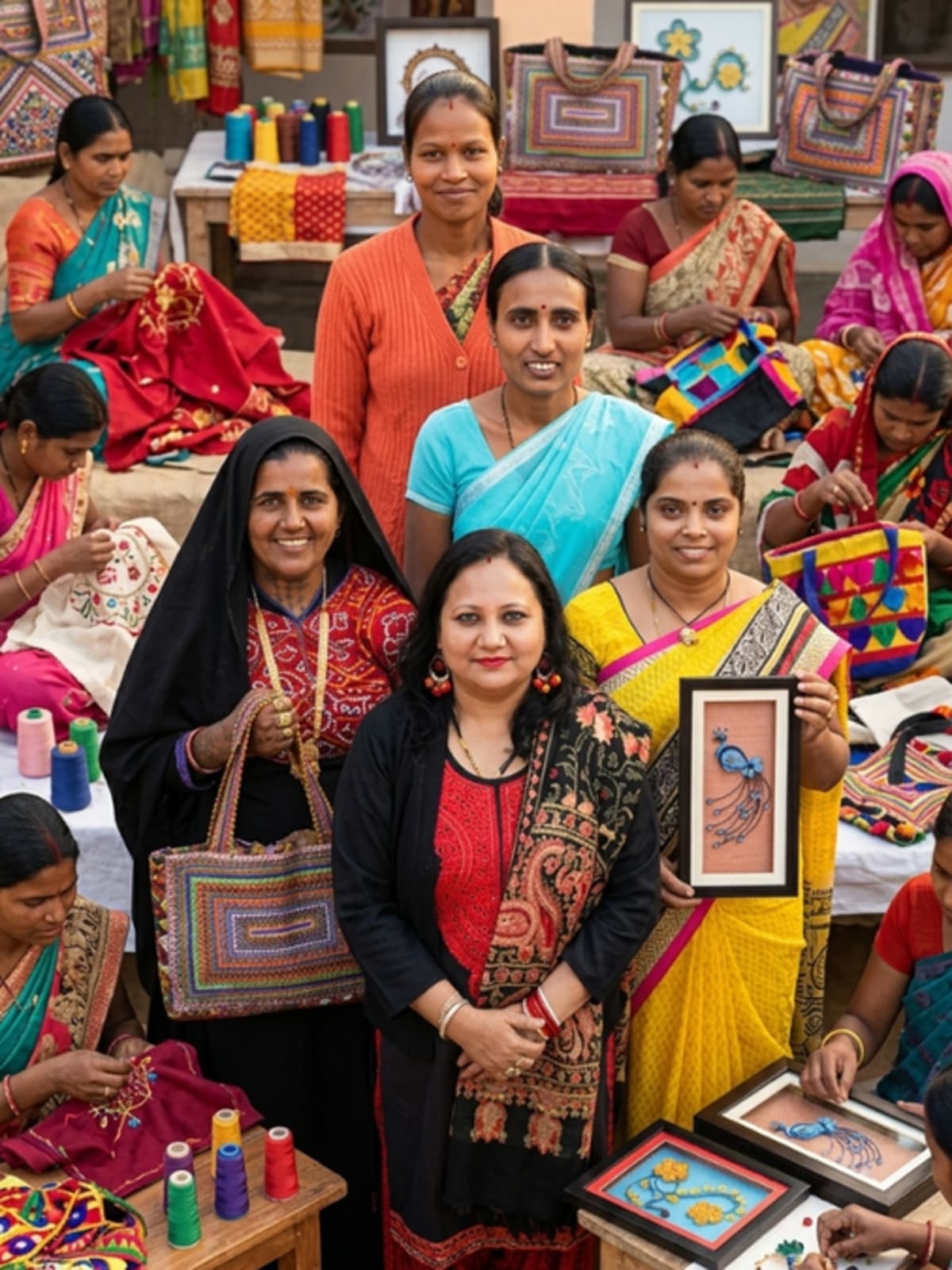
Pabiben Rabari couldn't finish school due to financial constraints, but she learned traditional embroidery from her mother. After joining a Rabari women's group in 1998, she developed Hari Jari, a craft technique using machine-applied ready-made elements to create vibrant products including the Pabi Bag, quilts and cushion covers.
Her enterprise now employs over 60 women in her Bhadroi village. In 2016, she received the Jankidevi Bajaj Puraskar for her contributions.
Anita Gupta took the widest approach. In 1993, she founded Bhojpur Mahila Kala Kendra to empower women through education and employment training across Bihar. The organization has since trained over 25,000 women in nearly 400 different skills.
The Ripple Effect
These five enterprises have created something more valuable than products. They've built ecosystems where knowledge flows freely, where one woman's success creates pathways for others, and where traditional skills become modern livelihoods.
Anita initially faced resistance from men who refused to let her meet women in their communities. She persisted, and her work has helped thousands gain skills, independence and hope.
The women's self-help groups formed through Bhojpur Mahila Kala Kendra now manufacture and sell jewelry at government fairs and supply stores across Delhi, Pune and Mumbai. Each sale represents not just a transaction, but proof that determination and community can transform entire regions.
From paper scraps to embroidered bags, these women saw potential where others saw limitations and built futures where others saw only tradition.
#
Based on reporting by The Better India
This story was written by BrightWire based on verified news reports.
Spread the positivity!
Share this good news with someone who needs it